Scientific American: How a python can devour a whole deer
Burmese pythons can swallow prey much bigger than their heads, UC study finds

Scientific American highlighted research by the University of Cincinnati that examined how Burmese pythons swallow prey far bigger than their heads.
UC College of Arts and Sciences professor Bruce Jayne examined the gape of Burmese pythons, which have invaded parts of Florida where they have found a smorgasbord of prey choices.

UC biologist Bruce Jayne demonstrates the enormous gape of a euthanized Burmese python captured in the Everglades. Photo/Bruce Jayne
Jayne and his co-authors found that it’s not just the size of the snake's head and body that puts almost everything on a python’s menu. They evolved super-stretchy skin between their lower jaws that allows them to consume prey up to six times larger than similarly sized snakes.
The study, funded in part by a grant from the National Science Foundation, was published in the journal Integrative Organismal Biology.
One common misunderstanding is that snakes dislocate their jaws to swallow prey, Jayne said.
But unlike our jaws, those of pythons and other snakes are comprised of two bones separated by stretchy skin.
“The stretchy skin between left and right lower jaws is radically different in pythons. Just over 40 percent of their total gape area on average is from stretchy skin,” Jayne said. “Even after you correct for their large heads, their gape is enormous.”
Read the Scientific American story.
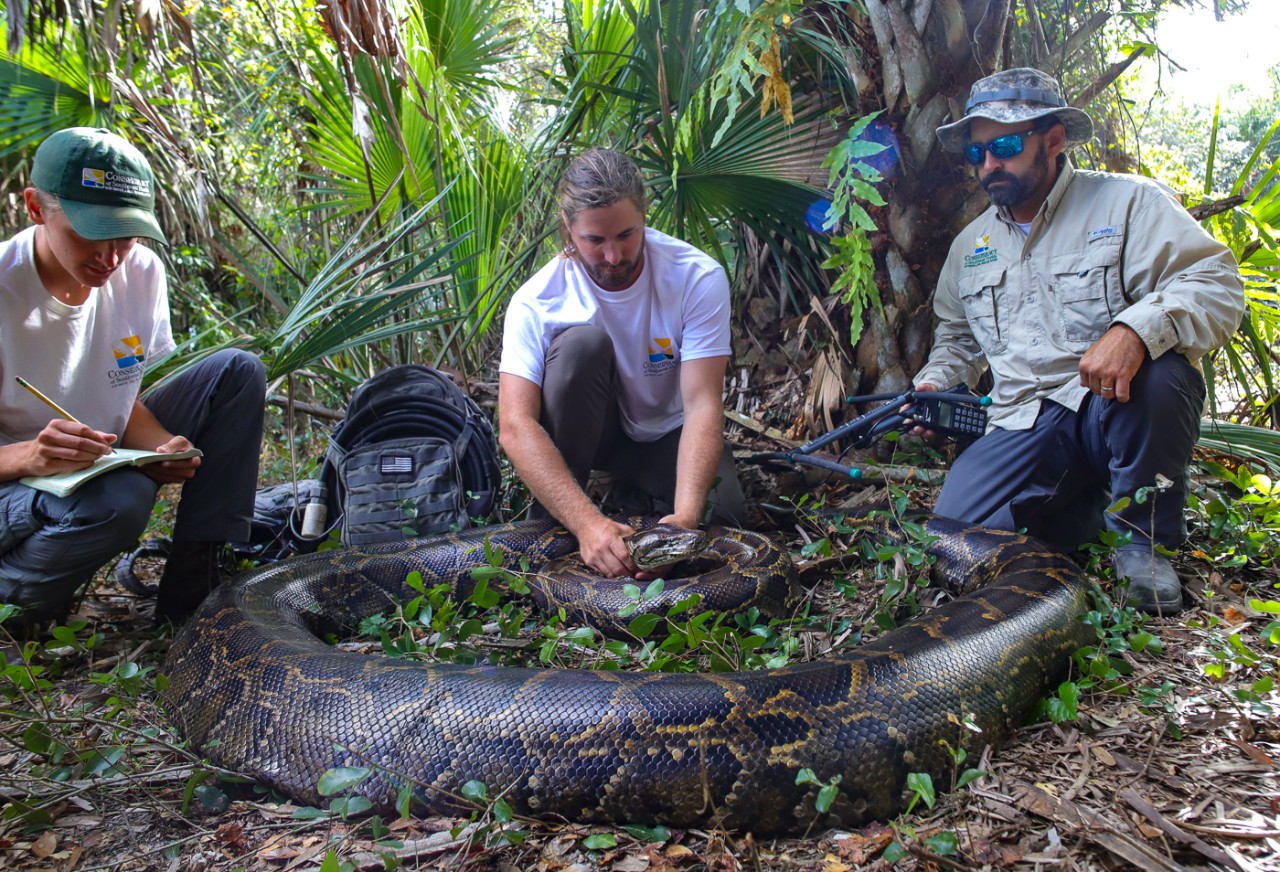
Featured image at top: Ian Bartoszek, right, science project manager for the Conservancy of Southwest Florida, captures a 215-pound Burmese python in Everglades National Park. Photo/ Conservancy of Southwest Florida
UC Biology in the News

UC professor Bruce Jayne works in his biology lab. Photo/Joseph Fuqua II/UC
- India Narrative: Scientists discover how pythons swallow huge prey like alligators
- Earth.com: How can pythons eat prey as big as a deer?
Related Stories
How phone scammers use your own voice against you
September 18, 2026

The Wall Street Journal recently did a deep dive on how artificial intelligence is making scamming people over the phone much easier, citing research by Kimberly Hyun, assistant professor of marketing at UC’s Lindner College of Business.
Gas prices spike... Again
September 18, 2026

UC economist Gary Painter goes through the tactics companies use to keep their consumer bases amid rising oil costs.
University of Cincinnati and Hamilton County work to lower overdose deaths
September 17, 2026

University of Cincinnati researchers and Hamilton County officials are using overdose data to identify Cincinnati hot spots and place free NaloxBoxes and fentanyl test strip dispensers where they are needed most to help prevent opioid overdose deaths.