Forbes: Parents of color more hesitant to choose medication to treat child's anxiety disorder

Forbes recently highlighted University of Cincinnati research examining factors behind the decision to begin or decline medication treatment for childhood anxiety disorders after cognitive behavioral therapy (CBT) did not lead to improvement.
Led by Jeffrey Mills, PhD, and Jeffrey Strawn, MD, the analysis of data of nearly 500 children and adolescents found only about 10% of patients that didn't get fully better with CBT elected to begin taking medication, even though medication and CBT are both proven evidence-based treatments.
Patients from racial and ethnic minorities were three times less likely to begin medication treatment compared to white patients, and younger patients were also significantly less likely to begin medication.
“We were able to leverage more recently developed statistical methods to better model the relationship between medication uptake and patient characteristics,” said Mills, PhD, professor of economics in UC’s Carl H. Lindner College of Business. “This allowed us to identify which of these potential predictors were important in driving a patient’s decision of whether or not to begin medication treatment.”
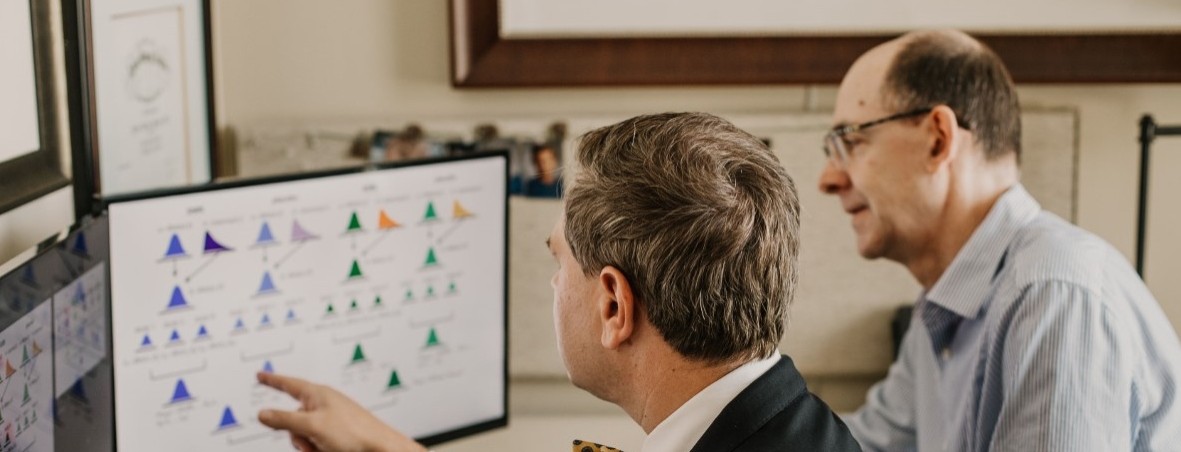
Featured photo at top of Strawn, left, and Mills, right reviewing data. Photo/University of Cincinnati.
Related Stories
Get to know CCM’s newest faculty and staff members
September 2, 2026
UC’s College-Conservatory of Music will welcome a variety of new faculty and staff members to its roster of distinguished performing and media arts experts, researchers and educators this fall.
Cancer Center plays key role in lab research, clinical trials for new pancreatic cancer drug
September 1, 2026

WLWT and WCPO highlighted the contributions of University of Cincinnati Cancer Center researchers that helped lead to the recent FDA approval of daraxonrasib, a new treatment for pancreatic cancer.
An expert pieced together this Roman document like a puzzle
September 1, 2026

National media highlighted a new project by UC Classics Assistant Professor Matthijs Wibier to piece together and translate an ancient Roman text from fragments buried in the desert for more than 1,600 years.