UC study: dietary education leads to healthier lives
Research establishes collaborative model between academic researchers and retail industry

Initial data from a first-of-its-kind University of Cincinnati clinical research study aimed at increasing diet quality and decreasing cardiovascular risk shows positive results.
The study, called Supermarket and Web-Based Intervention Targeting Nutrition (SuperWIN), was a randomized, controlled trial that promotes a heart-healthy diet through nutrition counseling provided by a supermarket-based, registered dietitian within one of each participant’s home grocery stores.
The trial is the result of a partnership between the university, UC Health, Cincinnati Children’s Hospital Medical Center and Kroger Health, the health care division of the Kroger Co.
The research was published in the journal Nature Medicine.
“The additional health benefits demonstrated by dietitian consultations in the SuperWIN study continue to reiterate the importance of access to nutrition consultations by licensed dietitians,” said Sarah Couch, PhD, in the Department of Rehabilitation, Exercise and Nutrition Sciences at the UC College of Allied Health Sciences and co-primary investigator of SuperWIN.

Dylan Steen, MD, Division of Cardiovascular Health and Disease at the UC College of Medicine/Photo/Andrew Higley/UC Marketing + Brand
The study results show that:
In-store, individualized educational tours conducted by a supermarket-based dietitian improve dietary quality in a continuous manner.
Education and training on online shopping, home delivery and nutrition applications further improves dietary quality.
Clinical trials can be executed with superb quality, even in community-based populations, using thoughtful designs and the retail store’s physical and technological infrastructure.
“The retail industry, including supermarkets and grocery stores, have long had enormous potential to expand the reach of traditional health care systems into communities, offering access, convenience and a customer-centric approach,” said Dylan Steen, MD, director of Clinical Trials and Population Health Research in the Division of Cardiovascular Health and Disease at the UC College of Medicine and a UC Health cardiologist.
“For problems like the massive, unaddressed issues of poor dietary quality and increasing obesity, this industry may also serve as the ideal environment to deliver dietary education interventions,” Steen adds. “SuperWIN is the first clinical trial to be successfully executed in a gold-standard fashion, under a partnership between a diverse academic group of investigators and a large supermarket chain.”
The SuperWIN study is the result of a partnership, years in the making, to study novel interventions to improve food purchase and dietary intake quality.
Results of the study showed improved adherence to the Dietary Approaches to Stop Hypertension, or DASH, diet. The study participants included 247 UC Health primary care patients with at least one of three cardiovascular risk factors —obesity, hypertension and/or high cholesterol. All study visits were conducted within Kroger supermarkets.
Participants first completed a medical nutrition therapy visit with a Kroger Health dietitian. Patients eligible to participate in the study were then randomized into one of three study groups.
The results of the study showed, on average, participants in the group who engaged with a Kroger Health dietitian for an on-site individualized education and shopping practice session had a greater increase in their adherence to a DASH diet than the control group.
The retail industry, including supermarkets and grocery stores, have long had enormous potential to expand the reach of traditional health care systems into communities, offering access, convenience and a customer-centric approach
Dylan Steen, MD
Cincinnati Children’s oversaw the data management, statistical analysis and interpretation of study results and supported design of the overall study, interactive web-based reports for participants to review purchases and food intake and modeling.
Cincinnati Children’s Schubert Research Clinic conducted dietary intake interviews with participants prior to the study and again after three and six months. Data collected from those interviews were used to estimate participants’ usual food and nutrition intake and, ultimately, determine whether or how these measures changed by the end of the study.
“SuperWIN’s findings highlight the positive impact retail dietitians can have on people trying to make healthful choices, and the unique role of the grocery store in simplifying those choices to impact health," said Taylor Newman, PhD, director of nutrition at Kroger Health. “The collaboration between the University of Cincinnati and Kroger Health is laying the groundwork to change the way people approach grocery shopping with a focus on health.”
The SuperWIN clinical trial examined the independent effect of adding online shopping, home grocery delivery and nutrition applications on top of on-site, individualized, purchasing data-guided education and shopping practice. Those with training by the Kroger Health dietitians on these tools increased their DASH diet adherence even further.
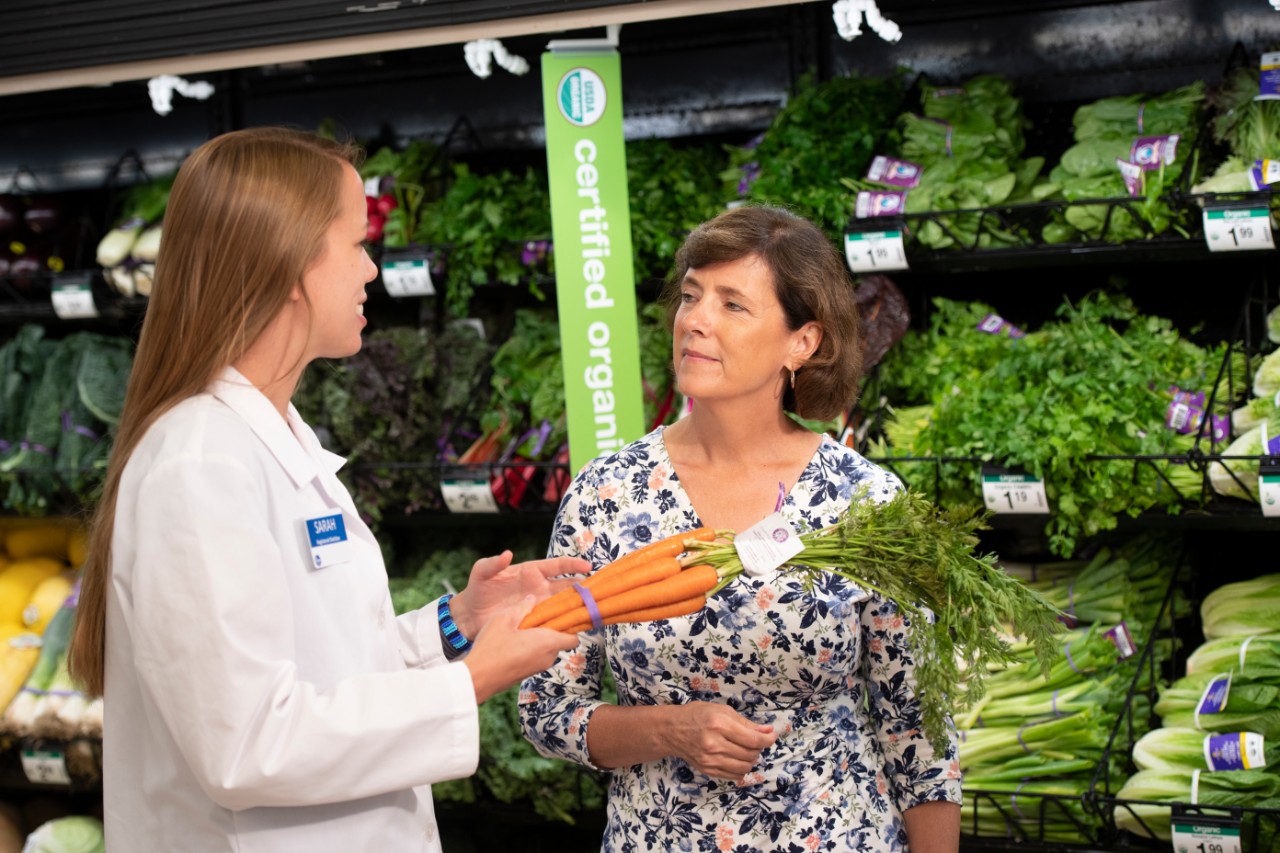
Lead photo of Sarah Limbert, left, Kroger dietitian and UC graduate and Sarah Couch, PhD. Photo/provided
Next Lives Here
The University of Cincinnati is classified as a Research 1 institution by the Carnegie Commission and is ranked in the National Science Foundation's Top-35 public research universities. UC's graduate students and faculty investigate problems and innovate solutions with real-world impact. Next Lives Here.
Related Stories
UC hematology researcher to study bone complications in sickle cell disease
September 25, 2026
University of Cincinnati hematology researcher Jahnavi Gollamudi, MD, has received new grant funding to study how inflammation predicts bone complications in people with sickle cell disease, offering new hope for treatment.
Engineering professor optimizes emergency room operations
September 24, 2026
Tommaso Giovannelli, assistant professor of industrial and systems engineering at the University of Cincinnati, is committed to improving emergency room operations. An expert in mathematical optimization, he is spearheading several projects surrounding efficiency in the healthcare system.
More young adults are having strokes than three decades ago
September 23, 2026
A University of Cincinnati-led study published in the journal Neurology found that strokes among adults ages 20 to 54 nearly doubled over almost three decades, even as short-term survival after stroke improved.