
UC students propose education reform solutions to state legislators
Students in CI 3010 participated in the Education Reform Symposium

Throughout her courses, Professor Sarah Stitzlein has been exposing her students to the real-life aspects of the educational world. The reality of education, as she’s found, is heavily dependent on the influence of local government—a concept she’s focused on in one of her courses.

Professor Sarah Stitzlein hosting the Education Reform Symposium Dec. 7.
Stitzlein, an Education professor at the University of Cincinnati (UC), teaches the course CI 3010, also known as Save our Schools: Education Controversy and Reform. The course, offered by the University Honors Program, covers subjects like the public education system, education reform methods and common issues that impact students.
A key component of CI 3010 is connecting its students with impactful members of the education world. Throughout the semester, various groups and individuals visited the students, like Teach for America and Cincinnati Federation of Teachers—along with local teachers and superintendents.
The first step of change
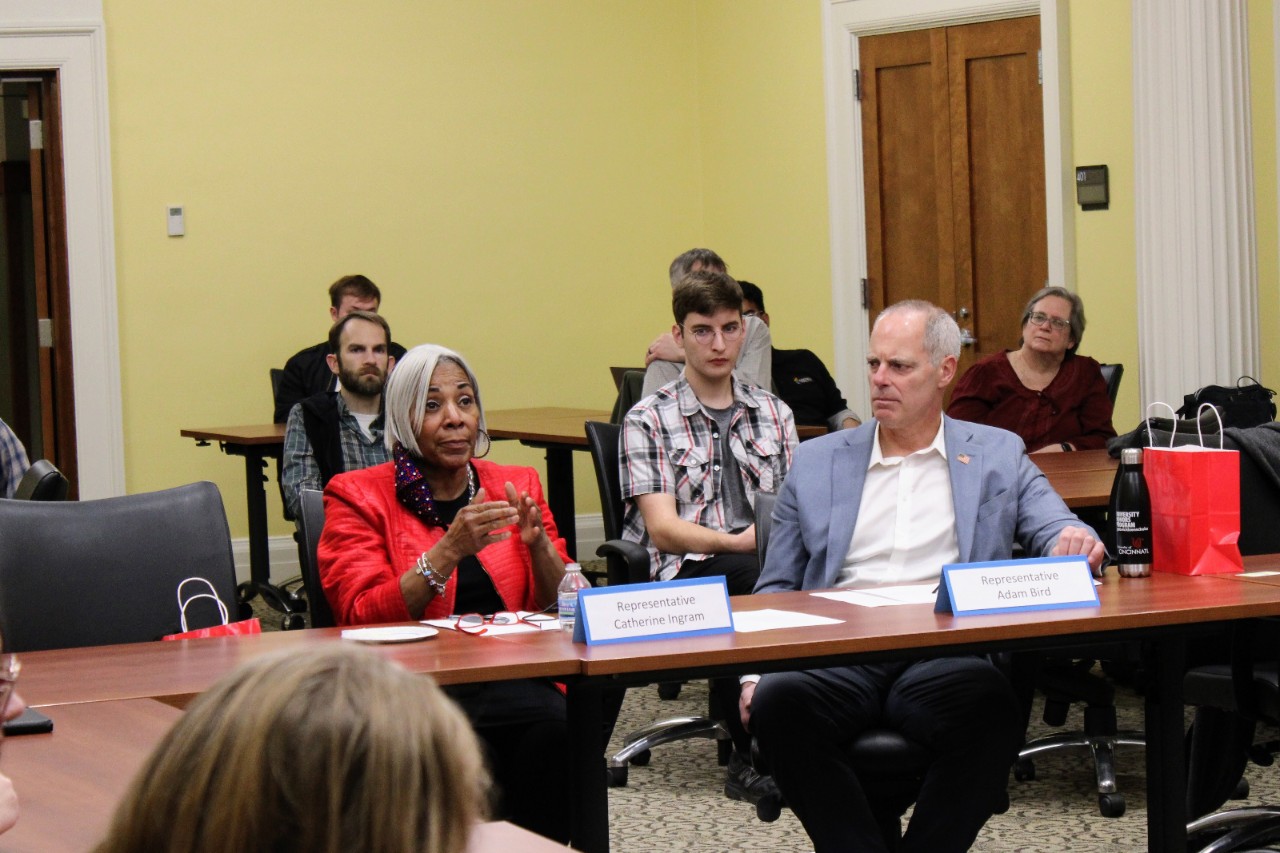
Ohio State Senator Catherine Ingram asks questions during a Q&A session with the participating students.
At the end of the fall 2022 semester, students in CI 3010 were given the chance to present their opinions on controversial education bills in front of Ohio state representatives Catherine Ingram and Adam Bird. This interaction was part of the Education Reform Symposium on December 7, which gave students the chance to present their semester projects—a proposal for change in specific education policies.
During the symposium, the students had the opportunity to share their opinions on a number of government bills related to education. The bills, which were being considered by state legislators, dealt with issues such as sex education, divisive concept bans and school funding.
After each presentation, the student groups answered questions from state representatives Ingram and Bird—diving further into the logistics of each group’s proposal.
It’s not enough to just advocate for change or to push back against particular policies. One has to put forward a feasible alternative and be prepared to engage in conversation that questions and challenges that proposed alternative."
Sarah Stitzlein
Prepared for the future

Participants in the Education Reform Symposium pose for a group photo Dec. 7.
Creating these presentations is part of a semester-long process for the students, according to Stitzlein. From the beginning of the school year, students in CI 3010 slowly build their expertise in the reality of the education world—starting with lessons about recent education controversies and ending the semester by putting forth their own opinions. This process is facilitated by a few educational methods-- all of which provide their own type of perspective on the realities of education.
“[My students] learn how to critique educational reform initiatives by analyzing recent films that give conflicting accounts of what should be done to improve schools,” Stitzlein said. “Then, they learn how to put forward their own [opinions] using persuasive language and evidence to support their claims, which includes writing letters to school boards and other elected officials.”
Save our Schools: Education Controversy and Reform is offered by the University Honors Program and housed within the College of Education, Criminal Justice, and Human Services (CECH). To learn more about CECH’s School of Education, click here.
Featured image at top: Students presenting their reform proposal regarding divisive concept bans in public schools. All photos taken by Luke Bisesi.
Next Lives Here
The University of Cincinnati is leading public urban universities into a new era of innovation and impact. Our faculty, staff and students are saving lives, changing outcomes and bending the future in our city's direction. Next Lives Here.
Related Stories
Simple ways to find a deeper sense of happiness and well being
October 8, 2026

UC assistant professor Suzie White, featured in an AARP story on practical ways to live a happier, healthier life, shared research-backed strategies for increasing well-being through gratitude and service to others. White teaches Happiness in Action, a course that helps students apply the science of happiness in everyday life.
New vending machine helps people with addiction
October 8, 2026

The University of Cincinnati's Daniel Arendt was featured in a Spectrum News report on a new harm reduction vending machine installed at the IPM Food Pantry in partnership with the Hamilton County Mental Health and Recovery Services Board.
UC study correlates increased physical activity with slower Parkinson’s progression
October 7, 2026
Higher levels of physical activity were associated with slower declines in thinking and memory as well as slower worsening of movement symptoms for people with Parkinson’s disease, according to a new study led by University of Cincinnati researchers published Oct. 7, 2026, in Neurology.