
Making pancreatic cancer treatments more effective
NCI to fund research on targeted treatments, processes that drive drug resistance

Pancreatic cancer diagnoses are increasing more rapidly than any other cancer type while remaining one of the most deadly cancers.
The American Cancer Society estimates approximately 64,000 Americans will be diagnosed with pancreatic cancer this year, and approximately 50,500 people in the U.S. will die of pancreatic cancer in 2023. While currently the third-leading cause of cancer death in the United States, pancreatic cancer is expected to become the second-leading cause of cancer death by 2030, highlighting the need for new and innovative treatments.
More than 90% of pancreatic cancers are driven by mutations in a certain gene called KRAS. The National Cancer Institute (NCI) has announced an intent to fund research from the University of Cincinnati’s Andrew Waters, PhD, to better understand how to overcome treatment resistance and develop better treatments for KRAS-mutated pancreatic cancer.
KRAS basics
In healthy human cells, the KRAS gene acts as a “light switch” telling cells when to divide.
“In the on position, cells divide. In the off position, cells stop dividing. It is tightly controlled, regulated, and balanced,” said Waters, University of Cincinnati Cancer Center researcher and assistant professor in the UC College of Medicine’s Department of Surgery, Division of Surgical Oncology and Department of Cancer Biology. “When you have a mutation in KRAS, the light switch can’t be turned off, and cells divide uncontrollably. If left unchecked, this can lead to pancreatic cancer.”
The KRAS gene mutations were discovered more than 40 years ago, but it was considered not able to be treated by drugs, or “undruggable,” for decades. Drawn to difficult problems, Waters said the challenge of KRAS appealed to him as an area where he could make a difference.
“Initially when I heard almost all pancreatic cancers had a mutation in the KRAS gene, and it was undruggable, this seemed like somewhere I could potentially contribute,” he said. “As I learned more and more about KRAS, it became a passion of mine, and now I am hooked.”
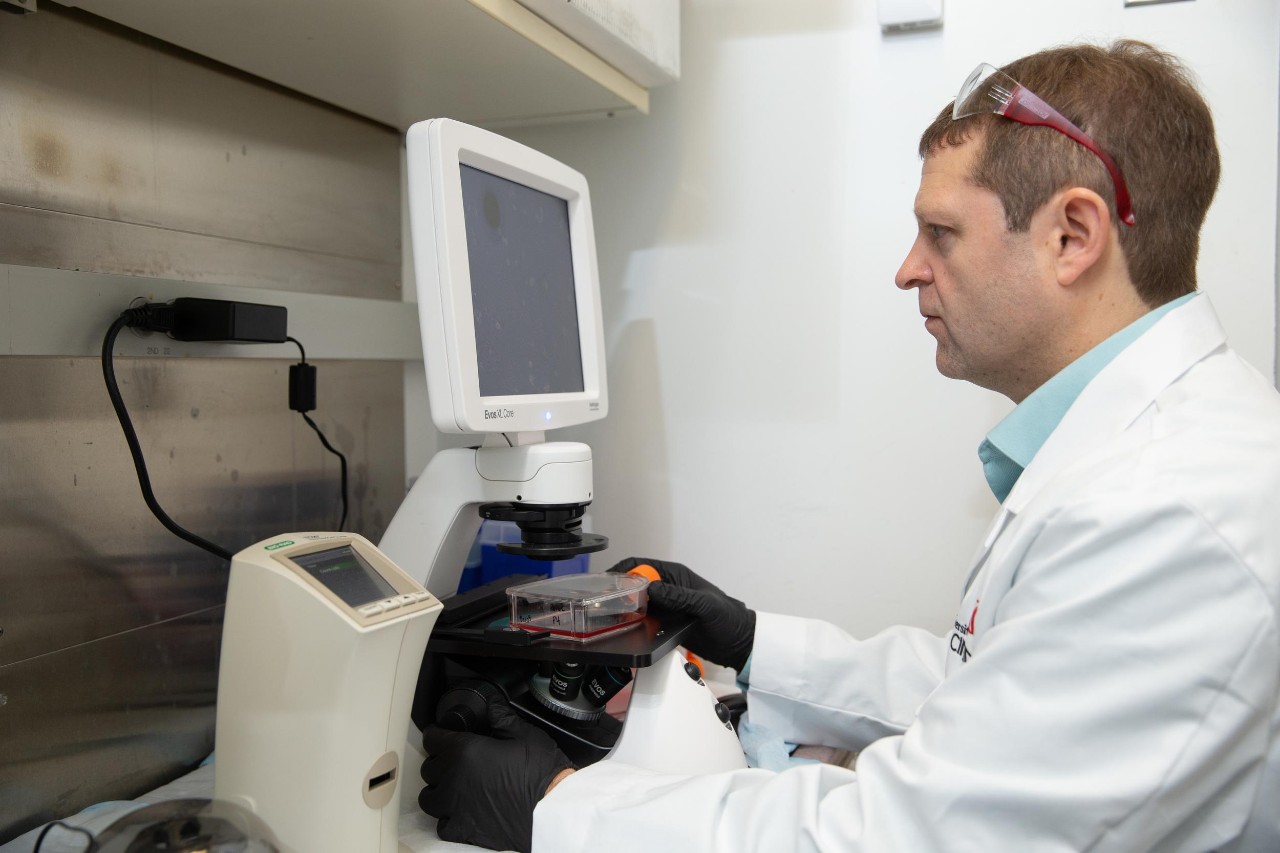
Andrew Waters uses a microscope to analyze cell samples in his laboratory. Photo/Andrew Higley/UC Marketing + Brand.
The Food and Drug Administration recently approved the first two drugs that target one particular KRAS mutation, but the drugs have a limited use in pancreatic cancer. While the KRAS mutation that the drugs target is common in lung cancers, it is rare in pancreatic cancers.
“About 98% to 99% of KRAS-mutant pancreatic cancer patients have other KRAS mutations and will not benefit from this class of drugs,” said Waters. “We need KRAS drugs that target the KRAS mutations that occur in pancreatic cancer.”
The recently approved KRAS drugs are also limited because like with all targeted therapies, the cancer cells eventually develop resistance to the targeted treatment, Waters said.
“Because we know relapse will occur, we need to identify the resistance mechanisms in pancreatic cancer that drive the relapse in order to develop KRAS inhibitor combination approaches,” he said.
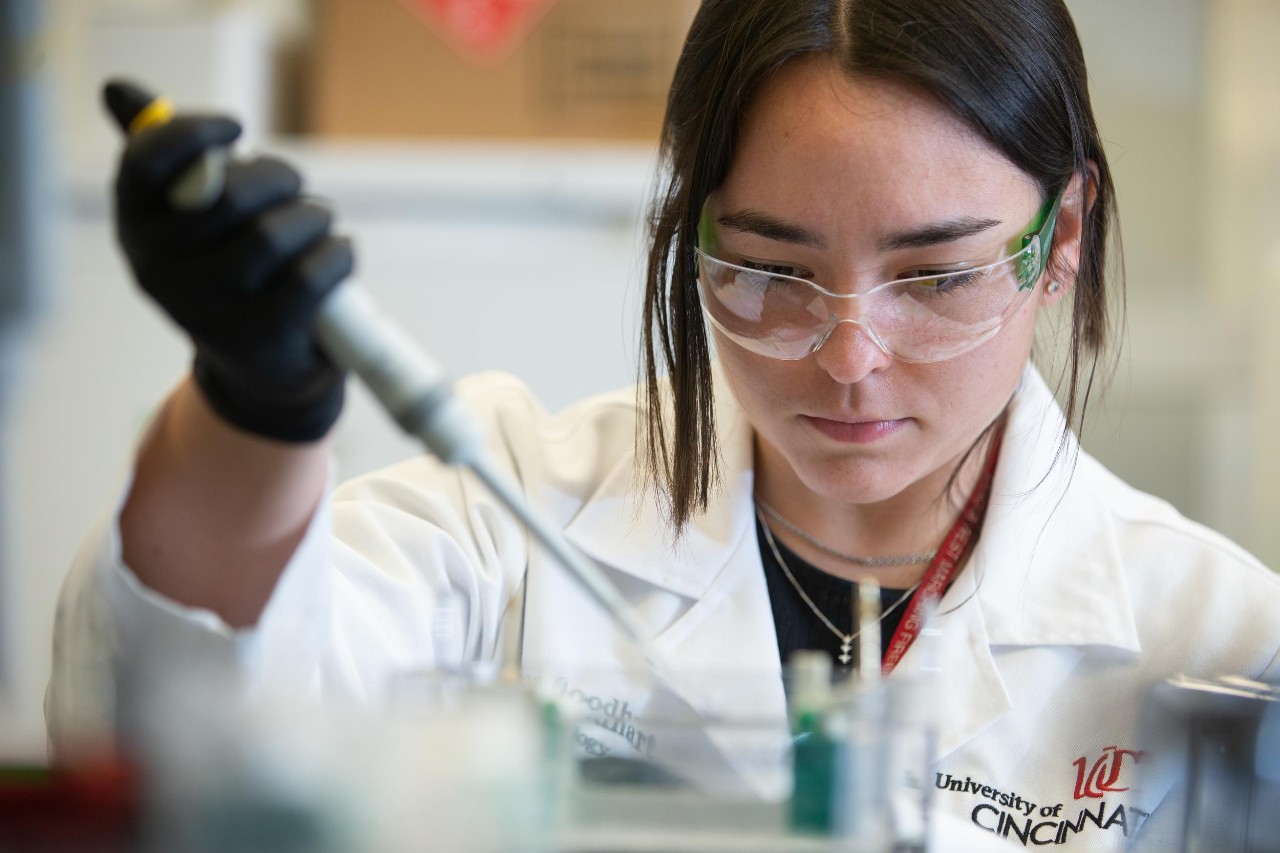
Grace Goodhart, research associate, pipettes samples in Waters' lab. Photo/Andrew Higley/UC Marketing + Brand.
Grant-funded research
The NCI intends to fund Waters’ lab through an approximately $587,000, three-year career development grant. With the funds, Waters will test clinically relevant drugs that target two particular KRAS mutations more commonly found in pancreatic cancer. The drugs being tested are novel, unpublished formulations that will be studied both through cell lines and animal models.
Waters will also study the specific mechanisms within KRAS-mutated pancreatic cancer cells that lead to resistance to targeted treatments. Some of these processes may be similar to resistance processes found in KRAS-mutated lung cancer cells, but Waters said there is growing evidence that each mutation is different.
“Until somewhat recently, almost everyone thought all KRAS mutations are equal,” he said. “I hypothesize different mutations will have some distinct resistance mechanisms. In the era of personalized medicine, this is extremely important, because understanding these mutation-specific resistance mechanisms can potentially guide treatment options in a personalized way.”
With more knowledge on what drugs effectively treat KRAS-mutated pancreatic cancer and what causes drug resistance, the goal is to increase the efficacy and longevity of KRAS-targeted treatments for pancreatic cancer patients.
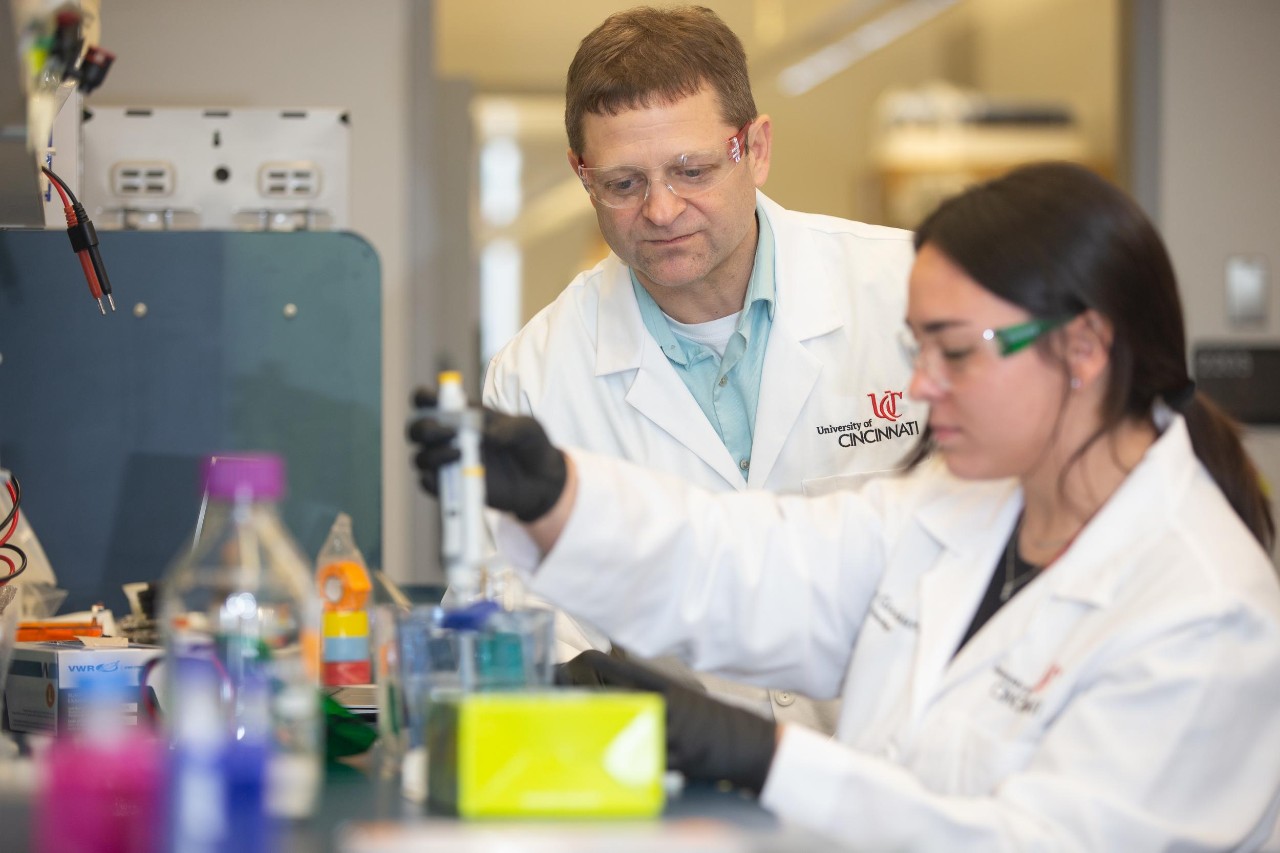
Andrew Waters and Grace Goodhart collaborate in the lab. Photo/Andrew Higley/UC Marketing + Brand.
Personal motivation
As his work continues, Waters said he continues to be motivated by pancreatic cancer patients, volunteer work with organizations like the Pancreatic Cancer Action Network and the personal effect cancer has had on his life.
“I have lost many family members and close friends to cancer, and some of those people that I lost have been my biggest supporters,” he said.
Waters said his path to joining UC’s faculty has been unconventional, including work at biotech companies and conducting his doctoral research at the Frederick National Laboratory for Cancer Research.
“National laboratories are funded by the federal government so there isn’t a big push to apply for grants and secure additional external funding,” he said. “To receive the best possible score on my first independent grant application from the NCI, arguably the most competitive division of the National Institutes of Health, feels very validating.”
Read about additional pancreatic cancer research at UC led by Krushna Patra.
Featured photo at top: Researchers Krushna Patra, Andrew Waters and Patrick Krause review data. Photo/Andrew Higley/UC Marketing + Brand.
Next Lives Here
The University of Cincinnati is classified as a Research 1 institution by the Carnegie Commission and is ranked in the National Science Foundation's Top-35 public research universities. UC's medical, graduate and undergraduate students and faculty investigate problems and innovate solutions with real-world impact. Next Lives Here.
Related Stories
UC Speech & Hearing Clinic serves patients while acting as training site
September 30, 2026

The University of Cincinnati's Speech & Hearing Clinic provides graduate students in audiology and speech-language pathology with hands-on experience while delivering care to patients across the region. Located on the university's medical campus, the clinic serves patients of all ages and was recently featured on Spectrum News 1 Ohio.
UC economist warns of higher heating costs this winter
September 30, 2026

David Brasington explains why home heating will cost so much this winter and how to save money.
Now strollers are getting an electric upgrade
September 30, 2026

Following the trend of e-bikes and e-scooters, several baby gear brands have announced strollers with battery-boosted assist and other autonomous features. But are these pricey new strollers (most cost more than $2,000) just a flashy status symbol, or can they deliver real benefits? A University of Cincinnati disability expert recently offered her perspective to Forbes.