
Spectrum News: Medical students find out their futures on Match Day

The University of Cincinnati College of Medicine recently hosted its annual Match Day event, where fourth-year medical students learn where they will spend the next three-to-seven years of their life training as residents.
In the United States, future physicians must complete residency to be licensed to practice medicine. As with last year’s event, some of the 168 fourth-year students opened their envelopes en masse at 12:15 p.m. to learn their match results. The rest anxiously waited until their names are randomly called before running onto the Kresge Auditorium stage and tearing into their envelope while everyone watches from the auditorium and on a livestream.
Spectrum News highlighted students Halimat Olaniyan and Rachel Holloway before and after they learned of their matches.
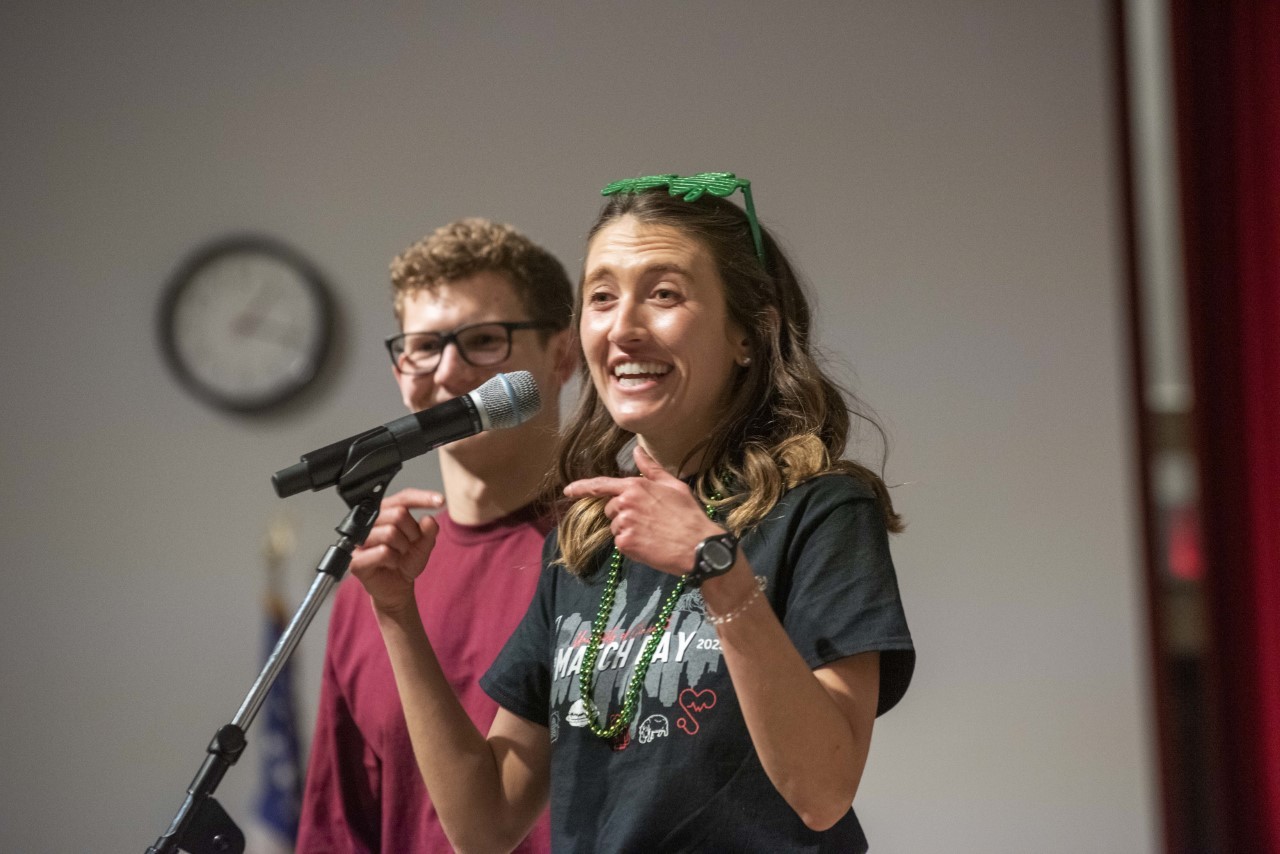
Rachel Holloway announces her match on the Kresge Auditorium Stage. Photo/Joe Fuqua.
“Oh man, today is the most exciting day of all of med school,” Olaniyan told Spectrum News. “You’ve worked so hard to get to this moment. For me, it’s a bigger deal than graduation.”
Olaniyan matched to Indiana University to specialize in pathology. Holloway matched to stay in Cincinnati with a residency at Cincinnati Children's.
“I’ve dreamed of this day for a while now and it’s just surreal that it’s here and that I’ve matched with such a great program,” Holloway said. “I’m so excited to be here.”
Watch the Spectrum News story.
Read more about Match Day 2023.
Featured photo at top of Halimat Olaniyan holding her Match Day poster. Photo/Joe Fuqua.
Related Stories
When grief doesn't end: Nursing PhD students bring a classroom theory to Ohio families
October 29, 2026
Most of us think of grief as something with an ending. A loss happens, it hurts, and over time the hurt fades. For many parents of children with developmental disabilities, it doesn't work that way. The sadness can quiet down for months or years and then come back. It might return on the first day of kindergarten, at a cousin's wedding, at a high school graduation, or on the day a young adult ages out of school services. Nurses and researchers have a name for this: chronic sorrow. Last October, two University of Cincinnati College of Nursing PhD students helped bring that name to a room of families, people with disabilities and the professionals who support them.
UC engineers drones that know if they're damaged
October 29, 2026

UC engineering students are developing drones that can work in warehouses using a digital twin and others that can warn of damaged propellers or motors before a flight.
UC student's NFL internship leads to $20,000 gift to reduce loan burden
October 29, 2026
University of Cincinnati athletic training graduate student Savannah Posey interned with the Buffalo Bills during training camp and received a surprise $20,000 gift toward her student loans from safety C.J. Gardner-Johnson through his Ceedy Cares Foundation.