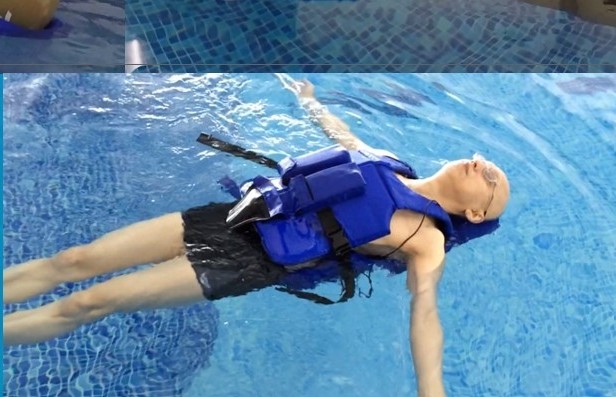
UC faculty member pioneers new polyethylene wetsuit
Enhancing hydrotherapy rehabilitation for patients and therapists

Hydrotherapy, also known as aquatic therapy, is a type of healing therapy that employs the power of water to help patients recover from injuries, reduce pain and enhance overall physical function.
Inspired by a family member who uses a wheelchair, Kristina Shin, an assistant professor in the College of Design, Architecture, Art and Planning (DAAP), embarked on a quest to design a more user-friendly wetsuit for aquatic therapy. Shin then took her idea to the Venture Lab, where she participated in an eight-week pre-accelerator program to examine its market potential.
The challenge
Doing physical therapy in water reduces the impact on the joints and muscles, making it a highly effective form of therapy for individuals grappling with limited mobility caused by issues such as:
- Paralysis or impaired leg muscle control
- Orthopedic surgery
- Arthritis
Despite the advantages of hydrotherapy, the process of getting in and out of the water — and getting in and out of the required wetsuit — is cumbersome. Typically made from Styrofoam, the wetsuits are bulky and require two physical therapists to assist each patient, along with special machines to fasten and remove the device from the patient. The suits also tend to ride up over the wearer’s shoulder, impairing movement.
The UC Venture Lab was amazing, helping me figure out how to approach and market the potential of my product.
Kristina Shin Assistant professor in the College of Design, Architecture, Art and Planning
The design
In her quest for a better wetsuit, Shin immersed herself in research, consulting with physiotherapists and patients, reviewing 53 flotation patents and testing buoyant materials. Armed with feedback and market insights, she created a prototype with polyethylene.
Unlike its neoprene counterparts, which can become heavy and restrictive when drenched in water, polyethylene foam is more buoyant and flexible, easing movement.
The user-centric wetsuit also allows the patient to operate the movable foam panels on the back by pulling the two handles on the front. Whereas two operators are needed for a traditional hydrotherapy wetsuit, Shin’s model reduces the number of therapists down to one.
Other features include:
- Polyethylene is more resistant to bacteria and mold than neoprene, making it easier to clean and maintain
- The material is more pliable than neoprene, making the suit easier to put on and take off than traditional designs
- Material is lighter and less cumbersome than neoprene, reducing strain on the staff's muscles
- Movable foam panel helps patients change their posture from upright (deeper water) to supine to upright (shallow water)
- Smooth design surface reduces friction, making it easier for staff to assist patients in and out of the water

Infographic of Adaptive Hydrotherapy wetsuit design.
The UC Venture Lab
Through a DAAP colleague, Shin heard about the UC Venture Lab. Housed within the 1819 Innovation Hub — the nerve center of the Cincinnati Innovation District — the Venture Lab offers a pre-accelerator program to help innovators examine the commercial potential of their ideas.
“The UC Venture Lab was amazing, helping me figure out how to approach and market the potential of my product. Each week we were paired up with a new entrepreneur-in-residence mentor. Their insights ranged from refining the concept to presentation creation,” Shin said.
As Shin sets her sights on commercialization, she's on the lookout for a business partner or investor who can help take her venture to the next level.
While she waits for the perfect partner to come along, Shin has been paying it forward, bringing her insights back to DAAP.
“There are many students who want to start their own brand after graduation. I am grateful to utilize my Venture Lab experience in any way to help guide them to realize their dreams,” Shin said.
Featured image at top: A patient demonstrates an adaptive hydrotherapy wetsuit.
Learn more
Learn more about UC 1819 Innovation Hub and the UC Venture Lab.
Contact Kristina Shin.
Related Stories
President Pinto’s 2nd glow party brings first-year Bearcats together
September 20, 2026
UC President Neville Pinto and team hosted the second annual Bright Beginnings glow party for first-year students
UC emergency medicine physicians safely eliminate thousands of unnecessary CT scans
September 18, 2026
A University of Cincinnati emergency medicine quality improvement campaign avoids 3,500-plus head and cervical spine CT scans, saving $6.2 million in patient charges, more than 14,000 hours of waiting time and significant radiation exposure with no patient harm.