UC students develop esports cheating detection software
Invention could be a game-changing tool for tournament organizers

Combining their love of gaming with expertise in cybersecurity and information technology, a group of University of Cincinnati students developed an innovative software solution to video game cheating.
The idea for the capstone project originated when the students learned about a cheating incident involving a remote gamer, Mekarazium. During an annual charity fundraiser, Summer Games Done Quick (SGDQ), for Doctors Without Borders, Mekarazium recorded a fake speedrun for an unfair advantage over participating gamers.
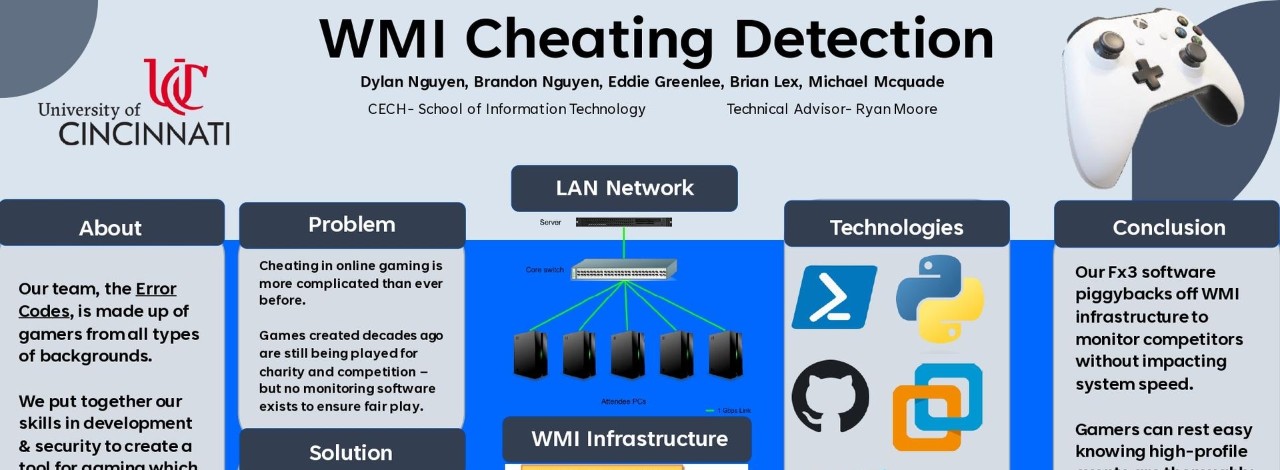
UC student Brian Lex was part of a team of students in the School of Information Technology (SoIT). Brandon Nguyen, Dylan Nguyen, Eddie Greenlee and Michael McQuade call themselves Error Codes and used their capstone project to develop a software called Fx3 to tackle this kind of problem.
“The group members all shared the common knowledge provided by the core of BS in information technology and BS cyber degrees," Ryan Moore, assistant professor educator, SoIT, said. "With their unique technical specializations, including networking, system administration, cybersecurity and software development, they created a solution that integrated elements from each.”

How it works
The development process examined the cheater’s method of playing video on a remote stream or a submitted recording to the leaderboards.
“When Fx3 connects to a participant’s machine for monitoring, it can run agentless on the participant’s side, collecting the data that Windows Management Instrumentation (WMI) naturally processes on every Windows PC during the monitoring period. Taking data from Task Manager, it passes that through to the event organizer’s machine to compare against ‘good’ (required) and ‘bad’ (banned) processes,” Lex said.
Examples of cheating Error Codes encountered:
- Third-party cheating software, such as Aimbot
- Splicing videos for speedrun submissions
- Altering cycle speed for emulated games, such as those run on DOSBOX or console emulators
- Lag switching for multiplayer games
This type of project allows students to develop their problem-solving skills leading to unique and out-of-the-box solutions. In the case of Fx3, the group identified a niche problem in a well-known space (competitive video game cheating).
Ryan Moore Assistant professor educator
Testing the process
Error Codes connected all team members' devices to a single system for monitoring, taking turns trying to open banned processes. Every process flagged as banned sent alerts to the monitor within three seconds of opening. Anything other than the expected speed was flagged as cheating for the monitor, ensuring that Fx3 was not impacting the gamer's side.
Fx3 differentiator
Most anti-cheat software is built into the games that use them, such as Easy Anti-Cheat.
“Fx3 serves as an auditing tool for games from any era, including games released before anti-cheat methods were developed. Ideally, Fx3 can be seen as a way to verify good behavior as much as it could be used to find bad actors,” Lex said.
Error Codes acknowledged their professors, including Moore, as instrumental in developing and preparing to enter Fx3 into the annual IT Expo hosted by UC School of Information Technology.
“This type of project allows students to develop their problem-solving skills leading to unique and out-of-the-box solutions. In the case of Fx3, the group identified a niche problem in a well-known space (competitive video game cheating). Their project may have an impact by shedding light on a problem that may have been overlooked, and they provided a potential solution,” Moore said.
Featured image at top: Error Codes poster for Fx3 software. Photo provided
Learn more
Learn more about the UC School of Information Technology, the 1819 Innovation Hub and the UC eSports Innovation Lab.
Related Stories
Cancer Center plays key role in lab research, clinical trials for new pancreatic cancer drug
September 1, 2026

WLWT and WCPO highlighted the contributions of University of Cincinnati Cancer Center researchers that helped lead to the recent FDA approval of daraxonrasib, a new treatment for pancreatic cancer.
Major grant expands apprenticeship opportunities at UC
August 31, 2026
UC will expand registered apprenticeship opportunities in AI, semiconductor, and nuclear-energy infrastructure through a major U.S. Department of Labor grant partnership led by JFF.
Campus buzz returns as UC students experience their first week
August 27, 2026
Near-perfect weather, record first-year enrollment, Thrifty Move-In and a packed Involvement Fair mark the University of Cincinnati’s first week back as thousands of Bearcats move into campus housing.