
Scientific American: Parrots are taking over the world
UC researcher explains why parrots are so adaptable

Scientific American turned to a University of Cincinnati researcher to explain what makes parrots so adaptable, particularly in cities they share with people.
According to the magazine, at least 60 of the world's 380 parrot species have breeding populations outside their historic geographic range. These transplants are thriving in new places where they have learned to adapt.
“They're animals that are really social. They live in cognitively complex social environments,” Grace Smith-Vidaurre, a postdoctoral fellow at the University of Cincinnati, told Scientific American. “They're like humans in a lot of ways.”
Smith-Vidaurre studies birds in UC Assistant Professor Elizabeth Hobson's lab.
Monk parakeets, in particular, have adapted to city life in places like Chicago, New Jersey, and Brooklyn, New York. They were introduced to the United States from South America through the pet trade.
So far, concerns that monk parakeets would become an agricultural pest in the United States have not come true. Instead, they seem to enjoy city life.
Now Smith-Vidaurre is comparing the vocalizations of the U.S. birds to those found in their native South America. She found that the calls made by birds living in this noisy city soundscape are less complex than those found in South America.
“Something about their environment might be constraining their ability to produce or perceive these vocal signatures,” she says.
Read the Scientific American story.
Featured image at top: Monk parakeets perch in a tree in Cape Coral, Florida. These nonnative, invasive species are thriving in many cities across the United States. Photo/Michael Miller
More UC biology in the news
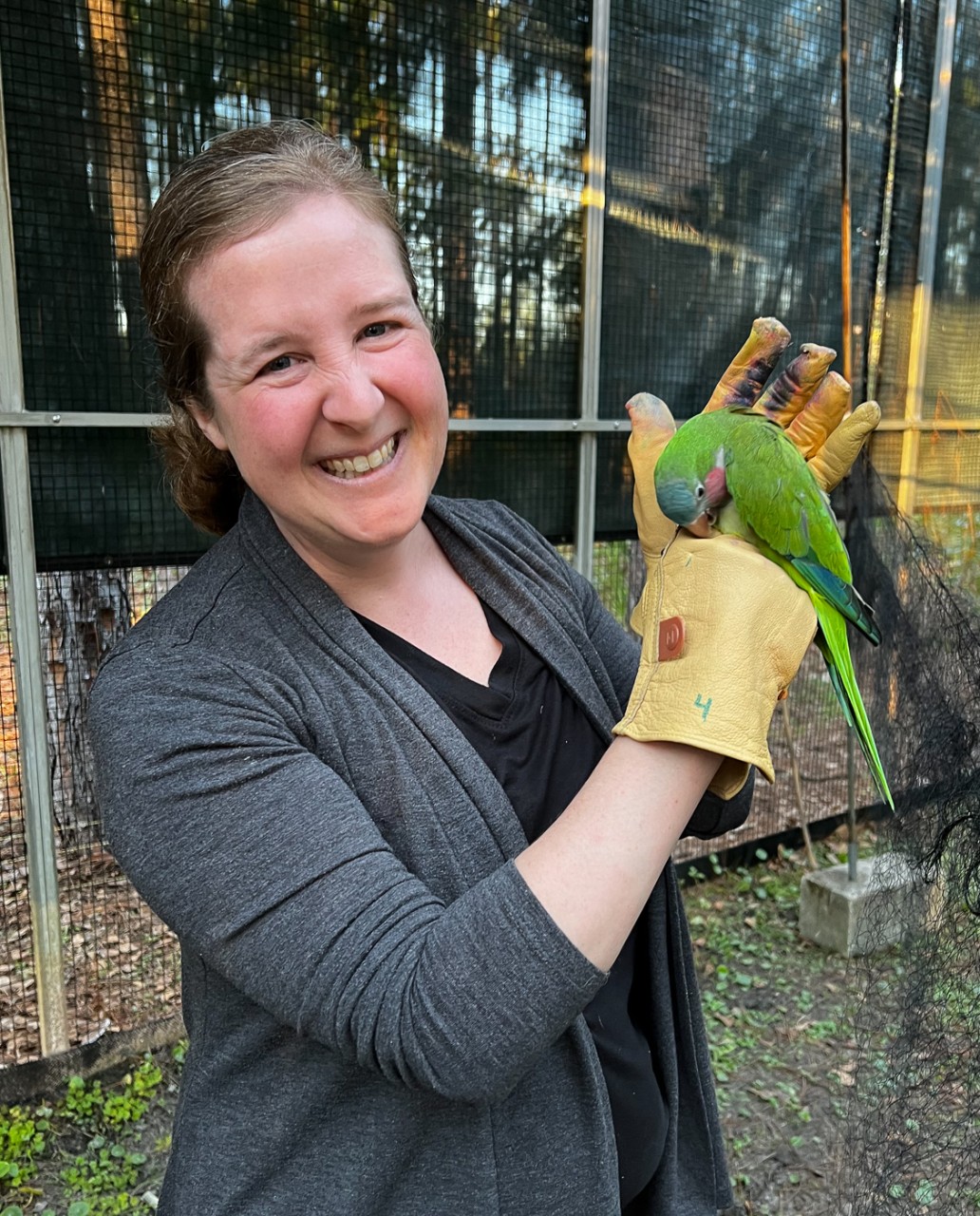
UC Assistant Professor Elizabeth Hobson works with a parakeet in a flight cage in Florida. Photo/Provided
Related Stories
'There's a strong community here:' UC transfer student finds place in College of Arts and Sciences
October 23, 2026
This week marks National Transfer Students Week, and the College of Arts and Sciences celebrated those students Thursday. Olivia White, assistant director of recruitment, said around 13-15% of students at UC are transfer students, and with that comes its own set of challenges.
UC expert explains potential impact of Pennsylvania’s new vape product law
October 22, 2026

UC professor Ashley Merianos speaks to the Pittsburgh Post-Gazette about Pennsylvania’s new vape law, youth vaping prevention, enforcement challenges and possible unintended consequences.
Still the top ‘cat
October 20, 2026

The University of Cincinnati Bearcat mascot was voted Cincinnati’s favorite mascot in a Cincinnati Enquirer reader poll, earning 45.1% of the vote and topping other local favorites.