
Criminal justice researcher says bail reform needs to go further
Half of arrests lead to dismissals, not convictions, but defendants still wait behind bars

If you are innocent until proven guilty, why would you have to pay money to get out of jail before the case goes to trial?
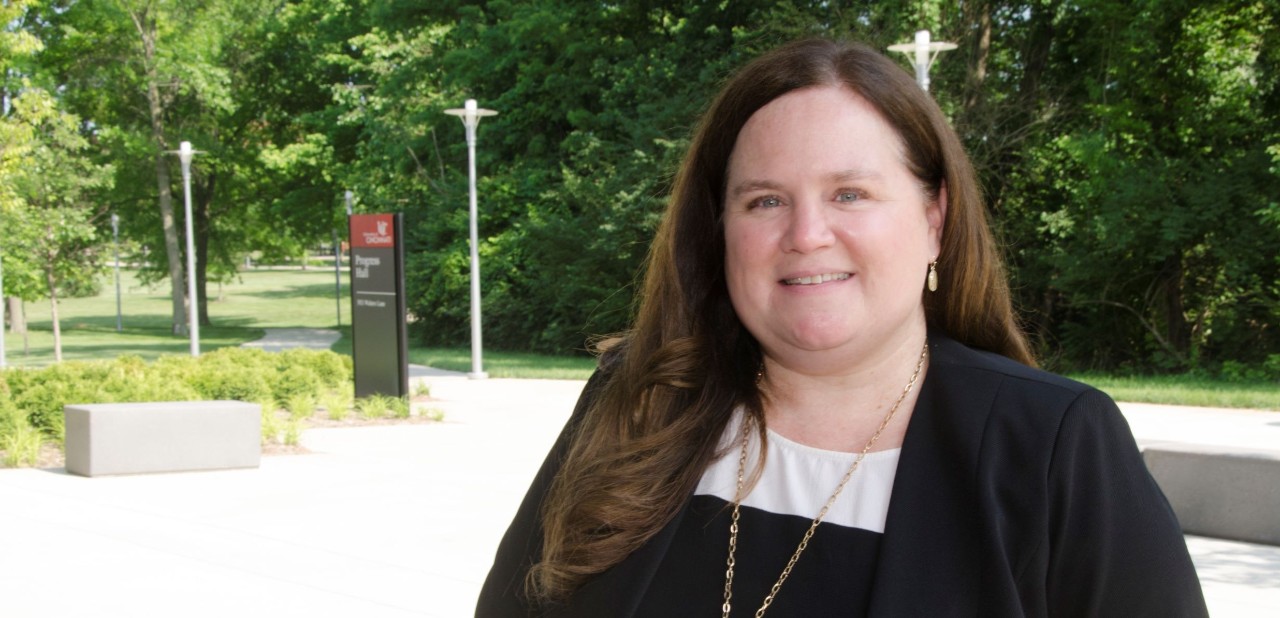
Criminal justice researcher Wendy Calaway. Photo/UC Blue Ash/Pete Gemmer
That’s just one of the questions posed by University of Cincinnati researchers who study the U.S. criminal justice system, specifically the pretrial phase.
“While the bail reform movement has had many notable successes, there are still places where the issue continues to be debated or where reforms have yet to take hold,” says Wendy Calaway, a practicing attorney and assistant professor of criminal justice at UC Blue Ash College.
Calaway's research
In a paper published in the Saint Louis University Law Journal, Calaway lays out arguments for continued bail reform, citing her new research which shows that criminal case arrests end in dismissal over 50% of the time.
In a case study of bail hearings, her research found that after an arrest and bail decision, criminal cases are more likely to be dismissed either by the grand jury or for want of prosecution than to be resolved in the adjudicative process on the merits.
“The high rate at which criminal cases are dismissed and the large number of people who are detained until dismissal underscores the need for reforms to pretrial detention practices,” says Calaway who has years of experience defending clients who are often held behind bars while awaiting trial because they could not post bail.
System favors the wealthy
Studies also reveal that the majority of those whose cases are dismissed were unable to post bail and are detained until the time of the case dismissal, which Calaway says favors the wealthy.
“The practice of connecting pretrial release from incarceration on the ability to pay money not only unfairly affects the poor, but also has a disparate impact on racial minorities,” she says, adding, “Researchers have noted that pretrial detention is inconsistent with due process because it constitutes punishment before conviction.”
The paper states that defendants who cannot afford bail are more likely to be convicted and sentenced more severely than those released.
Who benefits
With crime and incarceration at the forefront of ongoing political campaigns, the paper also notes that between 2009 and 2017, the commercial bail industry made $1.7 million in political contributions to state campaigns with almost $1.4 million going directly to candidates for governor, legislative office, district attorney and attorney general.
“The commercial bail industry’s profit model is premised on the existence of cash bail and the higher cash bail is set by the court, the more money the commercial bondsman makes.”
The bail industry opposition to reform, she says, has been a factor contributing to the political opposition to bail reform efforts. This opposition serves only to perpetuate the financial interests of the for-profit commercial bail industry and exacerbates the harm of wealth-based pretrial detention for our communities, she says.
Featured image at top of Calaway provided by Pete Gemmer/UC Blue Ash College
Impact Lives Here
The University of Cincinnati is leading public urban universities into a new era of innovation and impact. Our faculty, staff and students are saving lives, changing outcomes and bending the future in our city's direction. Next Lives Here.
Related Stories
AI breast cancer survival model from Cancer Center could improve accuracy and personalize care
October 23, 2026
UC Cancer Center researchers, including lead author Wedad Alatebi, developed a deep learning survival model for breast cancer that combines detailed clinical and genetic information, potentially offering physicians a more accurate tool to guide treatment decisions.
UC aerospace engineer leads global computational fluid dynamics taskforce
October 21, 2026
The American Institute of Aeronautics and Astronautics' CFD 2030 Integration Committee has announced the formation of the Computational Fluid Dynamics (CFD) Vision 2045 Team, a multi-institution working group tasked with defining where the field of computational fluid dynamics should be by 2045 to align with the changing and evolving needs of the aerospace industry. The University of Cincinnati's Prashant Khare, Bradley Jones professor and head of the Department of Aerospace Engineering, is leading this specialized group.
UC Blue Ash Career Champions make career development part of the everyday experience
October 21, 2026
The University of Cincinnati Blue Ash College is bringing career development into students' everyday experiences through its Career Champions program.