UC cancer researcher pioneers method of detecting early-stage cancers
New assay is cheaper, faster, less invasive and more accurate than current methods

No one wants to hear a diagnosis of cancer, but if anything is worse, it would be a diagnosis that comes too late.
Jiajie Diao, associate professor in the University of Cincinnati College of Medicine, has invented a method for detecting early-stage cancers that could help his colleagues at UC and worldwide save many lives.
The route to this breakthrough runs through a coffee shop. It began, of course, with Diao’s natural curiosity and interest in science, his degree work at the University of Illinois and a postdoc at Stanford University. But Diao remembers taking a coffee break during the postdoc and “chatting with the person next to me, and it turns out he was doing biomarker labeling. I was working on imaging, and I thought, ‘Let’s do something together.’”
The science that grew from that collaboration led first to an early pancreatic cancer detection procedure that received Food and Drug Administration breakthrough designation, then continued to grow at UC’s Vontz Center for Molecular Studies, where Diao has perfected a new assay for diagnosing cancer and cancer progression that is cheaper than current procedures, faster, less invasive and, most importantly, more accurate.
“Ultra-sensitive detection methods are required for diagnosing early-stage cancers,” Diao said.
He describes his method, called single molecule epigenetic localization, as “a little like fishing.” It uses a long strand of DNA to gather cell-free DNAs that are released by cancer cells and float free in a sample of blood (or urine, for kidney and bladder cancer), looking for DNA epigenetic modifications.
“These play important functions in a broad range of physiological and pathological processes,” Diao explained. Their dysregulation can lead to a variety of human diseases.
Researchers then take a look at the epigenetic modifications of this dysregulated DNA — one type, called 5-hmC, has been recently linked to several types of cancer — by placing it on a microscope slide, then fluorescing and imaging it to learn not just how many cell-free DNA modifications exist, but where.
This is a dramatic advance, Diao said. “Current methods of epigenetic imaging are still blind to the specific genomic location of these modifications.”
His invention, which he has successfully tested, “will provide additional insight to the diagnosing practitioner about where dysregulation exists, if cancer is the cause and whether that cancer has progressed.” The new method offers remarkably high accuracy even in the earliest stages of cancer, Stages 1 and 2.
“That information is critical for early treatment,” Diao said, “especially in the case of lung, pancreatic and other aggressive cancers.”
Diao and his co-inventor, Chun-Xiao Song, associate professor at the University of Oxford, are collaborating with UC’s Technology Transfer team. The duo have started the patent process and are now seeking partners to commercialize their technology. Those interested in further developing or licensing their assay should contact the tech transfer team.
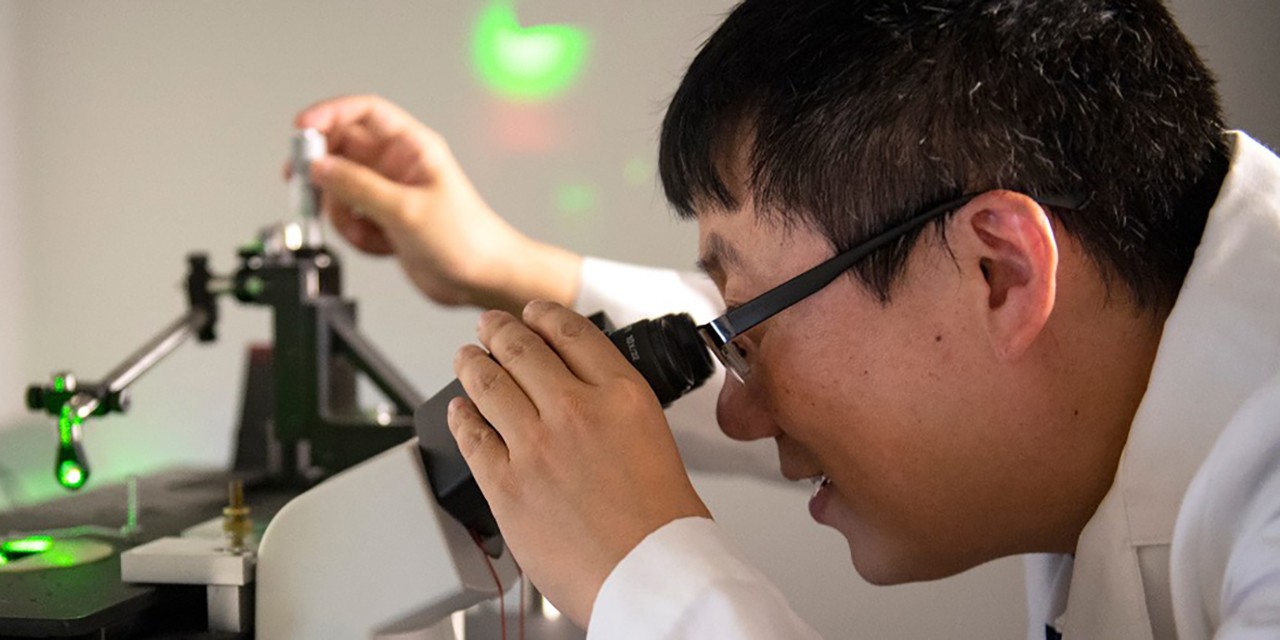
Featured image at top: Jiajie Diao and his collaborator are working with UC’s Technology Transfer team to commercialize their new method for early cancer diagnosis. Photo/Colleen Kelley/UC Marketing + Brand
Innovation Lives Here
The University of Cincinnati is leading public urban universities into a new era of innovation and impact. Our faculty, staff and students are saving lives, changing outcomes and bending the future in our city's direction. Next Lives Here.
Related Stories
University of Cincinnati and Hamilton County work to lower overdose deaths
September 17, 2026

University of Cincinnati researchers and Hamilton County officials are using overdose data to identify Cincinnati hot spots and place free NaloxBoxes and fentanyl test strip dispensers where they are needed most to help prevent opioid overdose deaths.
UC Blue Ash continues enrollment growth
September 14, 2026
The University of Cincinnati Blue Ash College is welcoming its largest incoming class as it continues a growth trend that spans the past four years.
Playbill ranks CCM in Top 10 most represented colleges on Broadway
September 14, 2026

The University of Cincinnati College-Conservatory of Music has once again been named as one of Playbill’s Top 10 most represented schools on Broadway.