Supporting the next generation of researchers
American Cancer Society awards pilot funding for early-stage investigators
The American Cancer Society has awarded the University of Cincinnati Cancer Center an Institutional Research Grant.
Cancer Center member David Plas, PhD, is primary investigator for the grant, with members Maria Czyzyk-Krzeska, MD, PhD, and Kathryn Wikenheiser-Brokamp, MD, PhD, serving as co-principal investigators.
The American Cancer Society awards Institutional Research Grants to academic and nonprofit organizations that have a track record of outstanding cancer research and a pool of experienced researchers who can mentor junior faculty. The purpose is to support early-stage faculty investigators in initiating cancer research projects so they can obtain preliminary results that will enable them to compete successfully for national research grants.
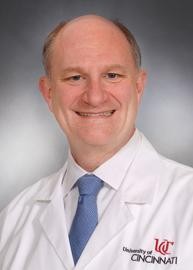
David Plas, PhD. Photo/University of Cincinnati.
The grant will provide a total of $360,000 in pilot funding over three years.
“I am excited for the benefits that this grant will bring to our early-stage investigators, the added recognition it will bring to the Cancer Center and for the opportunity to further partner with the ACS," said Plas, professor and Anna and Harold W. Huffman endowed chair in glioblastoma experimental therapeutics in the Department of Cancer Biology in UC’s College of Medicine.
"The American Cancer Society is committed to investing in the careers of the best and the brightest early-stage investigators who can bring innovative ideas to the forefront,” said Natasha Coleman, American Cancer Society vice president of community impact. “We are confident that this institutional research grant to the University of Cincinnati Cancer Center, with leadership and expertise from co-investigators Dr. David Plas, Dr. Maria Czyzyk-Krzeska and Dr. Kathryn Wikenheiser-Brokamp, will provide essential mentoring to launch new researchers who are able to further our understanding of cancer and its treatment.”
"Receiving this award from the American Cancer Society is a validation of the cancer research happening across campus and our commitment to developing junior faculty. This award puts us in good company with peer institutions, including Case Comprehensive Cancer Center at Case Western Reserve University and Markey Cancer Center at the University of Kentucky. We are incredibly proud of the work the grant co-PIs put into receiving this award, and we are excited for the impact this will have on our early-stage investigators," said Syed Ahmad, MD, and William Barrett, MD, co-directors at the University of Cincinnati Cancer Center.
Over the next three years, up to nine early-stage Cancer Center investigators will benefit from this new pilot program. With matching funds provided by the Cancer Center, each funded investigator can receive up to $80,000 in support. Information on eligibility and how to apply will be available later this year.

Brad McElhaney
Director of Membership Communications & Marketing, University of Cincinnati Cancer Center
Impact Lives Here
The University of Cincinnati is classified as a Research 1 institution by the Carnegie Commission and is ranked in the National Science Foundation's Top-35 public research universities. UC's medical, graduate and undergraduate students and faculty investigate problems and innovate solutions with real-world impact. Next Lives Here.
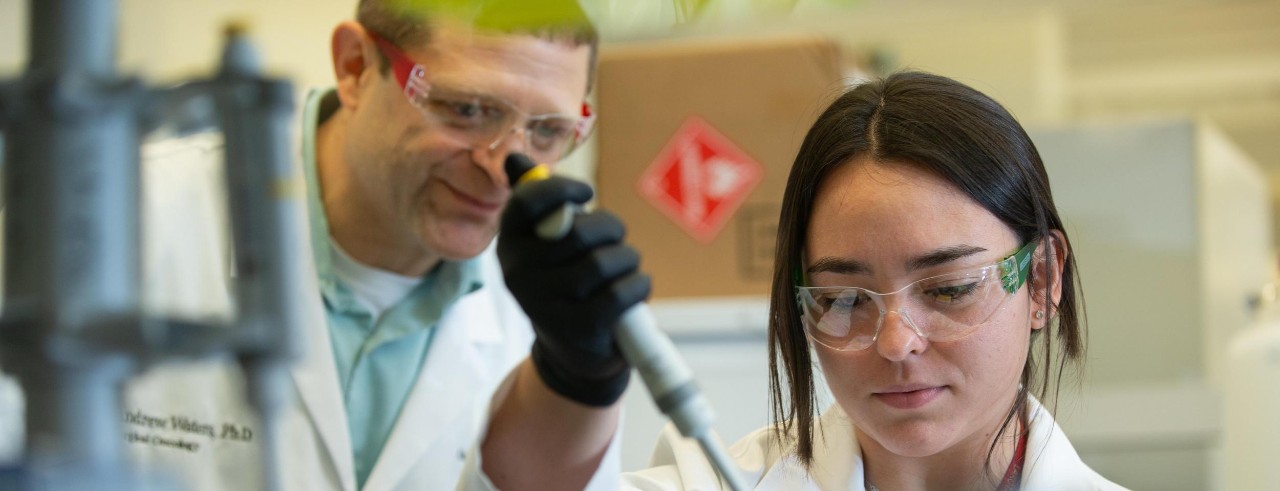
Featured photo at top: Research assistant Grace Goodhart, right, works in the laboratory as Andrew Waters, PhD, left, looks on. Photo/Andrew Higley/UC Marketing + Brand.
Related Stories
More young adults are having strokes than three decades ago
September 23, 2026
A University of Cincinnati-led study published in the journal Neurology found that strokes among adults ages 20 to 54 nearly doubled over almost three decades, even as short-term survival after stroke improved.
UC part of $18 million initiative to expand behavioral health workforce in Ohio
September 23, 2026

The University of Cincinnati is participating in a new $18 million statewide scholarship program, as Cleveland.com recently reported, to address critical shortages of mental health and substance use treatment providers across Ohio.
Unlike many parents, children are fearless around AI
September 23, 2026
Researchers at the University of Cincinnati found that children ages 5-10 are enthusiastic about playing with new AI toys but also tend to believe what the AI tells them. Their embrace of AI contrasts with concerns expressed by some of their parents.