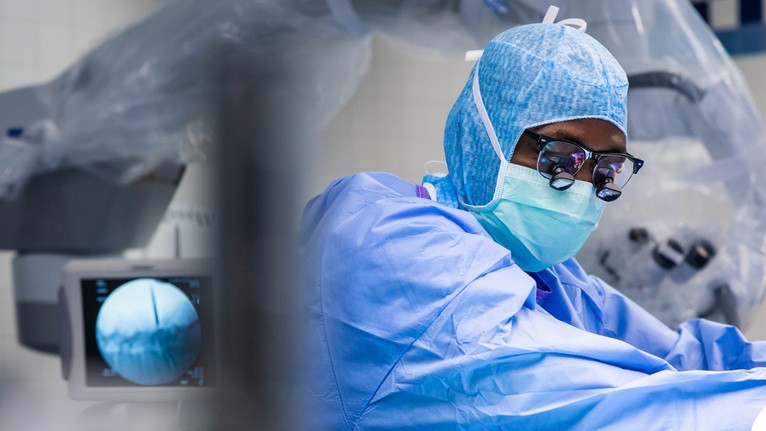
Precision Medicine Online: UC launches clinical trial for post-spinal surgery pain management

Precision Medicine Online highlighted a University of Cincinnati Gardner Neuroscience Institute clinical trial applying a personalized approach to pain management that doctors hope can improve post-surgical pain, reduce opioid dependence and reduce length of hospital stays.
More than half of patients who undergo spine surgery report poor pain control, and between 30 and 50 percent experience chronic pain for longer than 12 weeks (the time of routine tissue healing) following surgery.
Led by the University of Cincinnati's Owoicho Adogwa, MD, the trial takes patients' blood and saliva samples to see how their unique genes respond to different medications.
"Drug reactions vary significantly among individuals," Adogwa, assistant professor of neurosurgery in UC's College of Medicine, told Precision Medicine Online. "In spine surgery, traditional 'one size fits all' pain management is often inadequate due to genetic variations in drug metabolism."
Adogwa said early results of the trial have been encouraging, including shorter hospital stays for patients in the active arm of the trial.
Read the Precision Medicine Online story.
Featured photo at top of Dr. Adogwa in surgery. Photo/UC Health.
Related Stories
These teeny spiders are social media stars
August 28, 2026

The New York Times turned to a University of Cincinnati professor to explain the appeal of jumping spiders on social media.
An internal divide among unions on AI impacts the Wisconsin gubernatorial race
August 28, 2026

Anne Lofaso, a professor in the Donald P. Klekamp College of Law at UC, spoke with Wisconsin Public Radio, about the schism among unions over AI and whether it is a plus, a negative, or somewhere in between when looking at job creation.
On-site training in Speech & Hearing Clinic sets UC’s programs apart
August 27, 2026
At the University of Cincinnati’s Speech & Hearing Clinic, Doctor of Audiology and Speech-Language Pathology graduate students gain real-world experience while providing free speech and hearing services to the community.