
University of Cincinnati Cancer Center first in Midwest to open pancreatic cancer vaccine trial
Vaccine opens new frontier for cancer treatment

The University of Cincinnati Cancer Center is the first site in the Midwest enrolling patients in a new Phase 2 clinical trial testing a vaccine to treat pancreatic cancer.
According to the National Cancer Institute, more than 66,000 Americans will be diagnosed with pancreatic cancer in 2024. It ranks as the third leading cause of cancer death in women and fourth leading cause of cancer death in men.
Davendra Sohal, MD, site principal investigator, said this trial builds on the same mRNA technology that was used to develop vaccines for COVID-19.
“They took the COVID virus and sequenced it and then made a vaccine against its RNA sequence, and here they do the same thing,” said Sohal, associate director for clinical research at the Cancer Center and professor of internal medicine in UC’s College of Medicine. “After surgery to remove the tumor, a piece of it is taken and sent to the lab. They sequence the tumor, make a highly personalized vaccine to target each person’s cancer specifically, and send it back to us.”
The vaccine is developed in about four to six weeks while patients are recovering from surgery, and patients are then given six weekly injections of the vaccine. Following six months of standard chemotherapy, patients then receive six more vaccine injections as boosters.
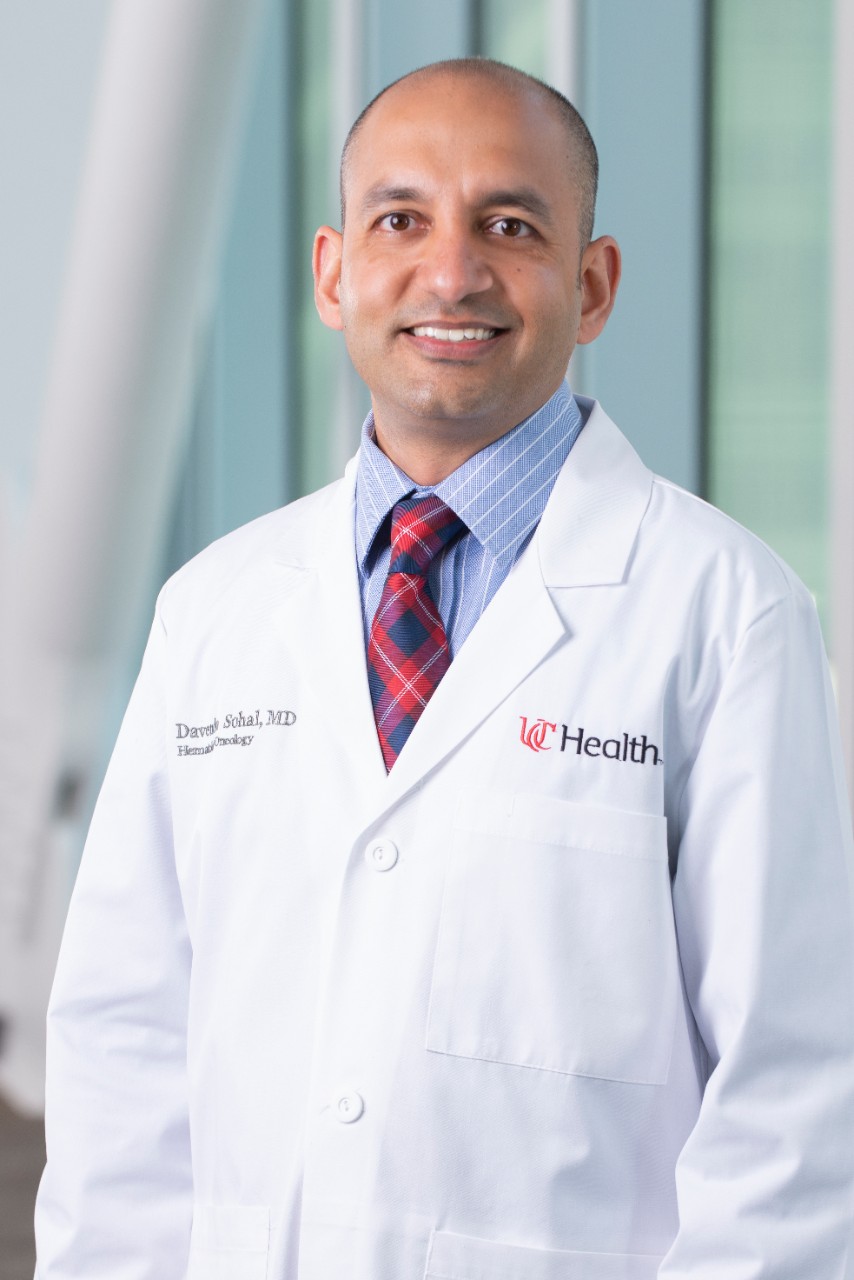
Davendra Sohal, MD. Photo/UC Health
“There’s hardly any downside. These patients all get surgery and all get chemotherapy anyway,” Sohal said. “There’s no placebo (everyone knows what they are getting), and there’s no shortchanging them on standard treatment.”
Sohal said any patient diagnosed with pancreatic cancer that can be treated with surgery and has not started any other treatments, including radiation or chemotherapy, is eligible to enroll. The trial is aiming to enroll 260 patients across its sites globally, and Sohal said he hopes to enroll as many patients as possible in Cincinnati.
Side effects of the vaccine reported in the Phase 1 trial were minimal and similar to those for COVID-19 vaccinations, including mild aches, chills and a mild fever. In the Phase 1 trial, Sohal said eight out of 32 patients were completely cured of their cancer.
“That looks like a small number, but a 25% cure in pancreas cancer is much better than the current barely 5% cure,” he said. “So this can be game changing”
Sohal said mRNA vaccines are opening an exciting new frontier for cancer treatment, as researchers are testing this method in a variety of cancers in addition to pancreatic cancer.
“There are many opportunities, and this could certainly be the future of treating cancer,” he said.
For more information on the trial, please call 513-584-7698 or email cancer@uchealth.com.
Researchers: Learn more at Cancer Center GI cancer symposium
Vinod P. Balachandran, MD, a surgical oncologist at Memorial Sloan Kettering Cancer Center and principal investigator of the original pancreatic cancer vaccine trial, is the keynote speaker for the University of Cincinnati Cancer Center’s Multidisciplinary Management of Gastrointestinal Cancers Symposium Feb. 23. This symposium is for researchers, physicians/clinicians, nurses, residents, fellows and students.
Featured photo at top of a vaccine being administered. Photo/National Cancer Institute/Unsplash.
Related Stories
UC's Anita Afzali, MD, receives American College of Gastroenterology International Leadership Award
October 27, 2026
The University of Cincinnati's Anita Afzali, MD, receives the American College of Gastroenterology's 2026 International Leadership Award for advancing global digestive health education, research and partnerships.
UC Foundation celebrates 2026 philanthropy winners
October 23, 2026
The University of Cincinnati Foundation recognized its Outstanding Philanthropic Volunteer Award honorees at the George Rieveschl Recognition Dinner on October 22, 2026.
AI breast cancer survival model from Cancer Center could improve accuracy and personalize care
October 23, 2026
UC Cancer Center researchers, including lead author Wedad Alatebi, developed a deep learning survival model for breast cancer that combines detailed clinical and genetic information, potentially offering physicians a more accurate tool to guide treatment decisions.