
Slate: Are the sandworms of 'Dune' really worms?
UC snake expert sheds light on the locomotion of Frank Herbert's creepy desert monsters

Are the sandworms depicted in the science fiction blockbusters “Dune” and “Dune: Part II” really worms?
Slate spoke to a University of Cincinnati biologist to see if there are real biological analogies to the wormlike leviathans depicted in the Frank Herbert books and movies.
UC College of Arts and Sciences Professor Bruce Jayne is an expert on snakes and the fascinating ways they move, swim and climb without benefit of limbs.

UC Professor Bruce Jayne says the sandworms of Dune are most like legless lizards that burrow in sand dunes. Photo/mlharing/Unsplash
Jayne said Dune's sandworms don't move like earthworms, which propel themselves forward using fluid-filled sacs that expand and contract in synchrony.
Instead, the sandworms move in a straight line like an enormous python in an undulating, rippling movement called rectilinear locomotion.
“The skeleton is basically sliding inside of the skin,” Jayne told Slate.
But this locomotion isn't known for speed.
Jayne said the sandworms of Dune are fast-moving burrowers in the sand, which is more like the movement found in a family of legless lizards. Like the fictional sandworms, some species of legless lizards burrow in sand dunes.
And like sandworms, the legless lizard can detect the vibrations of prey in the sand while hunting.
Jayne has studied snakes around the world. In 2021, he and his research colleagues discovered a form of snake movement new to science they called lasso locomotion.
Featured image at top: Sandworms rise from the desert to attack Harkonnen soldiers in the Warner Bros. movie Dune: Part II. Photo/Warner Bros.
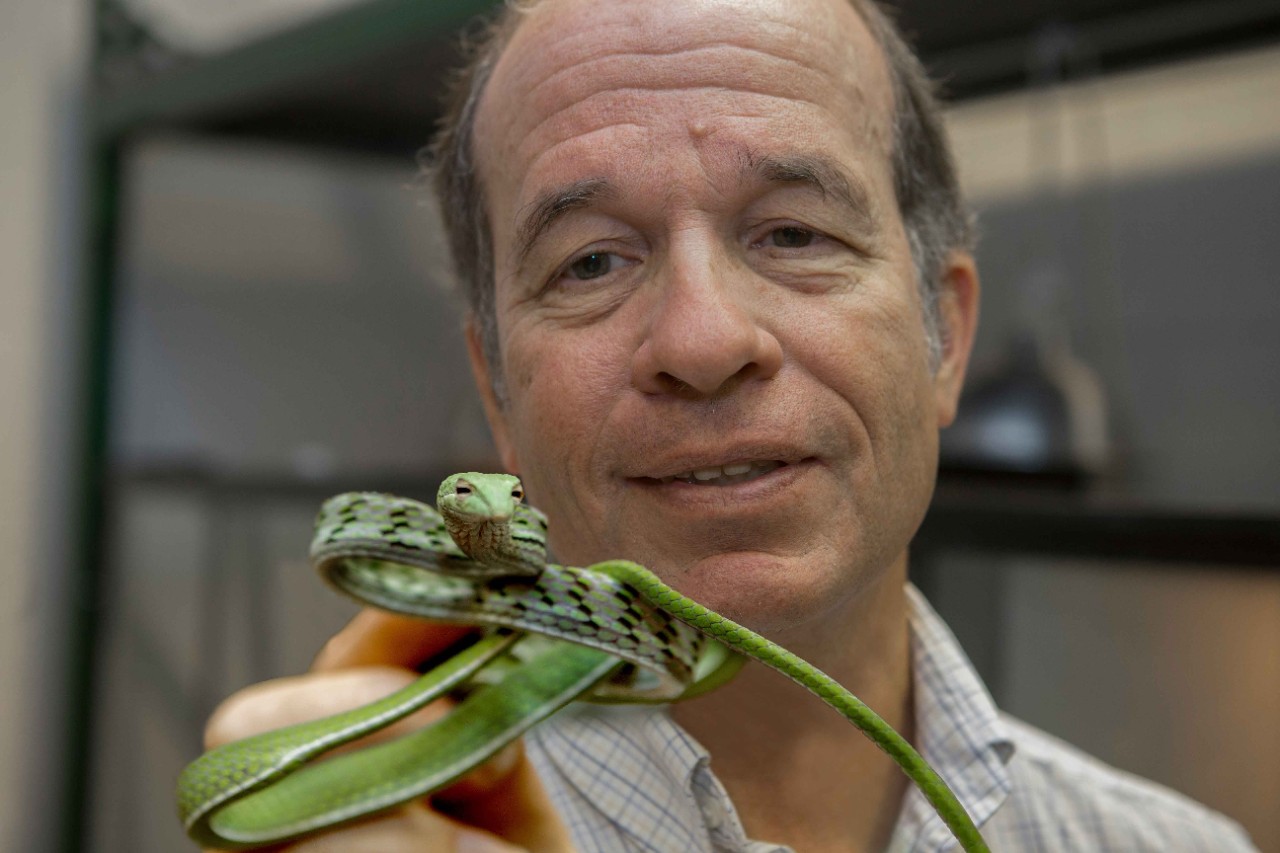
UC Professor Bruce Jayne holds a vine snake in his biology lab. Photo/Joseph Fuqua II/UC
Related Stories
UC part of $18 million initiative to expand behavioral health workforce in Ohio
September 23, 2026

The University of Cincinnati is participating in a new $18 million statewide scholarship program, as Cleveland.com recently reported, to address critical shortages of mental health and substance use treatment providers across Ohio.
Unlike many parents, children are fearless around AI
September 23, 2026
Researchers at the University of Cincinnati found that children ages 5-10 are enthusiastic about playing with new AI toys but also tend to believe what the AI tells them. Their embrace of AI contrasts with concerns expressed by some of their parents.
Is Cincinnati building new homes fast enough?
September 22, 2026

Gary Painter, professor and academic director of the Real Estate Center at UC's Lindner College of Business, offers comments on affordability issues in Cincinnati.