
UC educator granted innovation fellowship with Stanford University
NEXT Innovation Scholars director 1 of 16 chosen globally

Aaron Bradley, the University of Cincinnati NEXT Innovation Scholars director and associate professor, has been recognized by Stanford University's Hasso Plattner Institute of Design (d.school) as a Faculty Innovation Fellow.
The prestigious two-year program is an extension of University Innovation Fellows (UIF), a global program spearheaded by the Stanford University d.school that aims to cultivate innovative projects that enrich the academic landscape within the fellows' respective institutions.
Bradley first entered the fellowship training process in 2021 with a cohort of 16 candidates representing 11 global higher education institutions. Candidates were selected as faculty poised to drive transformative initiatives that empower students and peers by fostering a culture of innovation, entrepreneurship, creativity and design thinking at their respective institutions and beyond.
“Being selected for this program is an honor, and sometimes surreal to step back and reflect on the doors it’s opened for my growth as an educator and leader, as well as the students I get to interact with and support,” Bradley said.
Peers from universities worldwide are looking to us for inspiration, thanks to signature initiatives like the 1819 Innovation Hub, the NEXT Innovation Scholars program and our leadership in the field of experiential learning.
Aaron Bradley Director, UC Next Innovation Scholars Program
Fellows like Bradley serve as mentors, known as Faculty Champions, to students participating in innovation programs on their campuses, such as the NEXT Innovation Scholars program Bradley leads, located inside the 1819 Innovation Hub. Fellows also collaborate with faculty peers at other universities, working to advance innovation initiatives at their institutions.
Humera Fasihuddin, co-director of the University Innovation Fellows program, shared insights into the program's genesis, stating, "We designed this program in response to the expressed needs of faculty and staff within our community. These academic leaders sought resources and a community of practice akin to what our student Fellows enjoy."
She further expressed enthusiasm for the collaborative efforts of the newly appointed Faculty Innovation Fellows and their potential impact on student engagement.
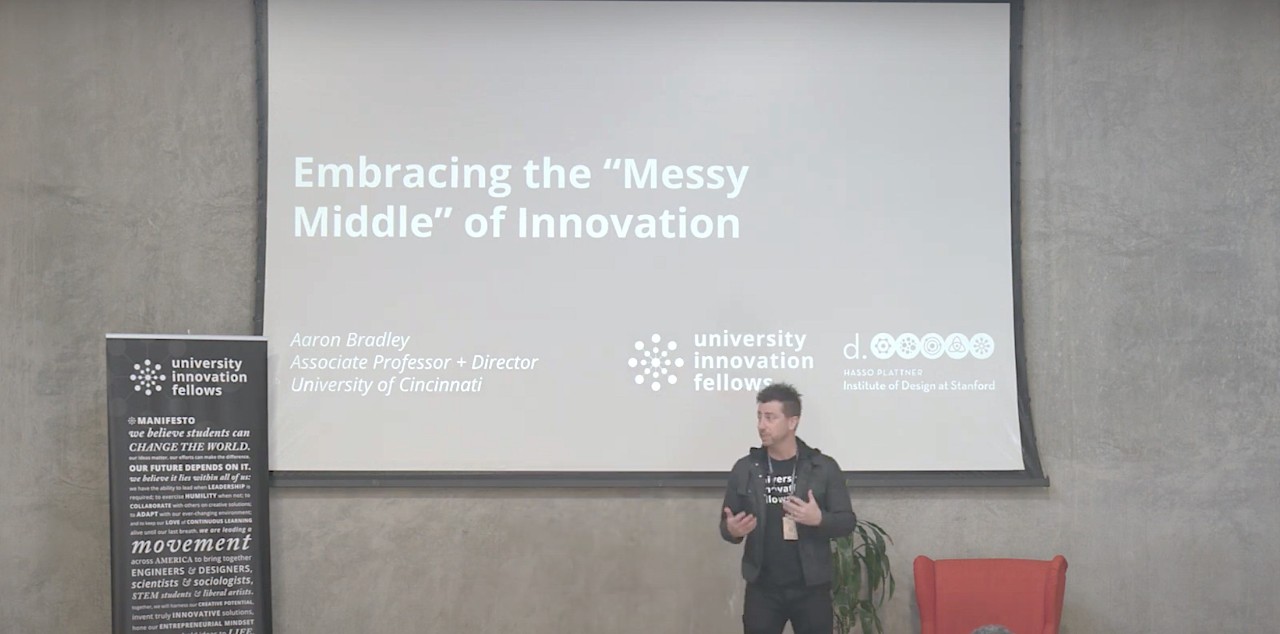
Aaron Bradley delivers a TED-style talk to University Innovation Fellows at Standford University d.school. Photo/NIS
Throughout the program, fellows exchange strategies for driving change, refine project concepts, solicit feedback and share resources.
“Progressing through the milestones of this program and building a global network of peers working in the university innovation space has given me a chance to look past the day-to-day aspects of running an innovation program and focus more on developing scalable strategies that can drive impactful change and innovation across systems,” Bradley said. “It’s also grown my appreciation for the innovation ecosystem we already have and continue to build here at UC. Peers from universities worldwide are looking to us for inspiration, thanks to signature initiatives like the 1819 Innovation Hub, the NEXT Innovation Scholars program and our leadership in the field of experiential learning.”
Since its launch, the program has facilitated collaboration among participants, enabling the identification of opportunities for meaningful change and the development of impactful projects benefiting students across various academic institutions.
Faculty fellows pursue a diverse set of projects, including developing new curricula and academic programs, securing funding for innovation initiatives, introducing new and novel courses and advancing initiatives aimed at fostering more robust connections between campuses and their surrounding communities.
The valuable resources provided by the Faculty Innovation Fellows program are designed to equip fellows with newfound knowledge, enhanced skills and an extensive network of peers across the nation and beyond.
Bradley’s training culminated at Stanford University with a TED-style presentation to a global audience of faculty and university leaders sharing insights from his journey through the program and inspirational recommendations for creating the future of higher education. Having completed his fellowship training and project, Bradley is now positioned as a coach to new candidate fellows, working to grow their capacity for teaching design thinking and innovation. He’s also poised to create new opportunities for current and future Bearcats to engage in the UC innovation ecosystem and beyond.
Featured image at top: Aaron Bradley sits third in from right, sits with University Innovation Fellows. Photo/NIS
Impact Lives Here
The University of Cincinnati is leading public urban universities into a new era of innovation and impact. Our faculty, staff and students are saving lives, changing outcomes and bending the future in our city's direction. Next Lives Here.
Related Stories
UC Blue Ash Career Champions make career development part of the everyday experience
October 21, 2026
The University of Cincinnati Blue Ash College is bringing career development into students' everyday experiences through its Career Champions program.
Researchers test gene therapy as less invasive treatment for hydrocephalus
October 20, 2026

Researchers at the University of Cincinnati College of Medicine say an experimental gene therapy could eventually lead to a less invasive treatment for hydrocephalus, a condition in which excess fluid accumulates in the brain. The early-stage study, led by Agnes (Yu) Luo, PhD, professor and vice chair for research, was published in the journal Fluids and Barriers of the CNS. Yahoo! News recently featured it.
Got three minutes? Present your research for a chance to win $1,500
October 19, 2026
The University of Cincinnati’s Three Minute Thesis (3MT) Competition challenges graduate students to explain their research or scholarship to people outside their field in just three minutes using a single slide. Applications for the 2027 competition open Sunday, Nov. 1, 2026, giving graduate students a chance to sharpen a skill that can make a difference far beyond graduate school.