Local 12: UC investigates potential PFAS contamination in groundwater
UC launches a new water quality investigation along Great Miami River

Local 12 highlighted a new University of Cincinnati project to study water quality in southwest Ohio.
At the Theis-Nash Environmental Monitoring and Modeling Site along the Great Miami River, UC has studied the flow of water from the surface into the aquifer, a source of drinking water for much of southwest Ohio. These monitoring wells initially provided researchers with real-time data about the hydrodynamics of surface river water as it moved through the aquifer, particularly during periodic floods.

Assistant Professor Annette Rowe is studying the microbiology of groundwater along the Great Miami River. Photo/Andrew Higley/UC Marketing + Brand
Now the monitoring site named for UC Professor Emeritus David Nash and the late hydrogeologist C.V. Theis will turn its focus to excess nutrients like nitrogen and phosphorous and contaminants such as PFAS.
Groundwater is a source of drinking water for more than 2 million people in Ohio. Scientists are trying to understand what happens to chemicals such as PFAS, known as a forever chemicals, that leaches into the groundwater.
PFAS has been found in water along the entirety of the Ohio River.
UC microbiologist Annette Rowe, an assistant professor of biology, said many chemicals we release into the environment end up in our drinking water.
"The more we produce, the more we put into those ecosystems, the more they accumulate and have the potential to have detrimental impacts on every trophic level," she told Local 12.
We're just trying to understand what's going on and how big a problem it is. And every researcher's hope is that then will lead us to how do we fix these problems?" Rowe said.
UC is looking at ways microbes interact with the chemicals, which could make them less harmful to human health, Rowe said.
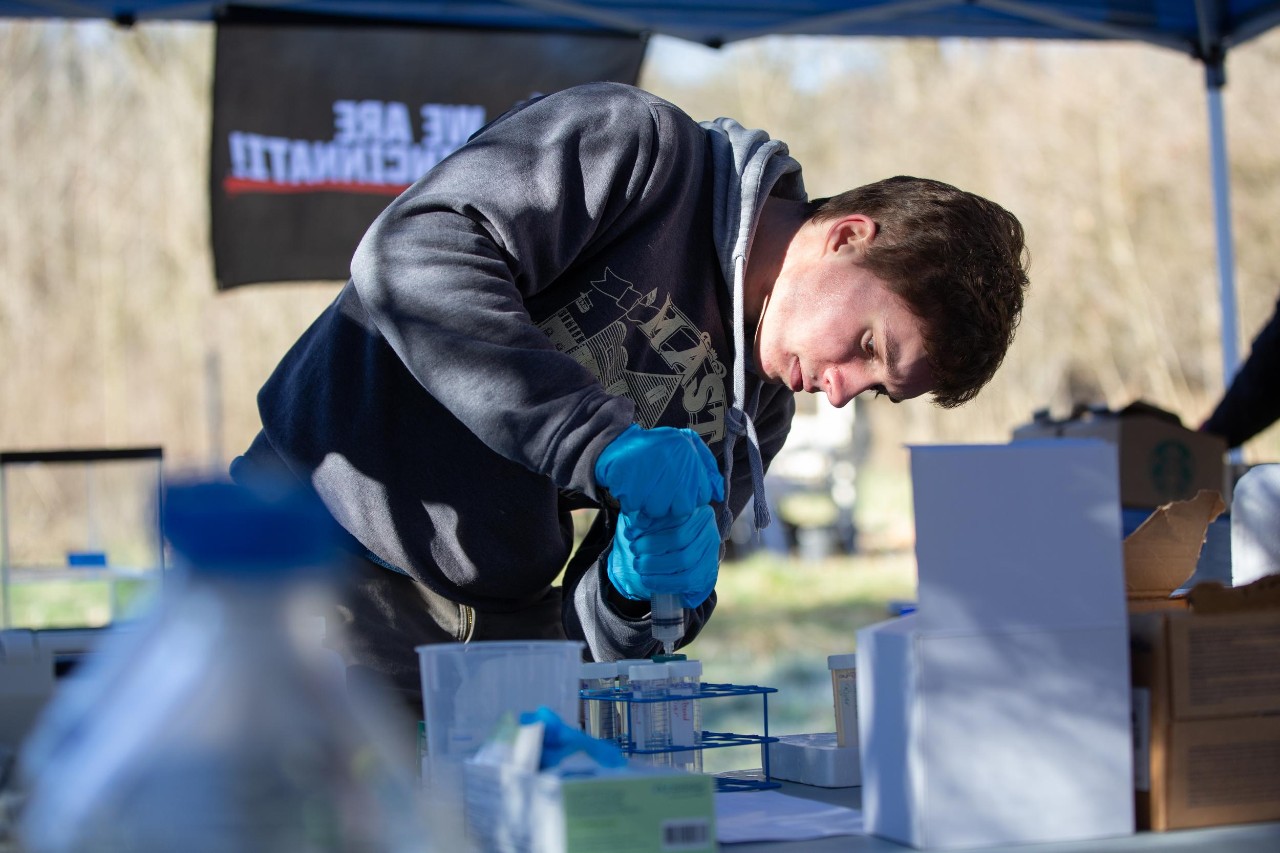
Featured image at top: UC students work with water samples at the groundwater observatory, which includes a network of monitoring wells. Photo/Andrew Higley/UC Marketing + Brand

Work crews dig a new monitoring well along the Great Miami River. Photo/Andrew Higley/UC Marketing + Brand
Related Stories
These teeny spiders are social media stars
August 28, 2026

The New York Times turned to a University of Cincinnati professor to explain the appeal of jumping spiders on social media.
An internal divide among unions on AI impacts the Wisconsin gubernatorial race
August 28, 2026

Anne Lofaso, a professor in the Donald P. Klekamp College of Law at UC, spoke with Wisconsin Public Radio, about the schism among unions over AI and whether it is a plus, a negative, or somewhere in between when looking at job creation.
UC, NKU renew longstanding partnership supporting Army ROTC cadets
August 26, 2026
The University of Cincinnati Army ROTC and Northern Kentucky University (NKU) have renewed a longstanding partnership that supports students preparing to become Army officers and leaders in their communities. The universities formalized the renewed agreement during a signing event Aug. 11 at NKU.