UC hosts ‘Day of Light’ at museum
Chemists will introduce children to all the ways scientists use light in STEM outreach program

Chemists at the University of Cincinnati will encourage children and their families to celebrate light and its study called photonics at the Cincinnati Museum Center.
UC faculty will lead children of all ages through interactive activities and demonstrations of scientific tools and processes that use light.
“We want to show kids all the cool things we can do with light and explain how light works,” UC Assistant Professor Pietro Strobbia said.
The second-annual International Day of Light from 10 a.m. to 3 p.m. May 25 is sponsored by the Cincinnati chapter of the Society of Applied Spectroscopy.

UC graduate student Manisha Sheokand uses equipment that emits red laser light in a chemistry lab. Photo/Andrew Higley/UC Marketing + Brand
Scientists from UC will be joined by colleagues from Miami University, Northern Kentucky University and Procter & Gamble Co along with representatives from the U.S. Food and Drug Administration.
The STEM outreach program for children is inspired by the International Day of Light created by UNESCO or the United Nations Educational, Scientific, and Cultural Organization, the group known for its list of world heritage sites.
The International Day of Light was created by UNESCO to celebrate the anniversary of the creation of the first laser in 1960. But it is meant to celebrate the study of all things light that have helped in advances in medicine, energy, technology and the arts.
In his chemistry lab, Strobbia uses spectroscopy to identify traces of infections or harmful chemicals in samples of everything from blood to plant sap to wastewater. Using spectroscopy, scientists can split light apart into its constituent colors or wavelengths, allowing scientists to identify the chemicals present in the sample.
Light science, or photonics, is present in our everyday life.
Pietro Strobbia, UC College of Arts and Sciences
The tools have been useful in surprising applications.
Spectroscopy can be used to identify unlabeled pharmaceuticals, he said.
“You can tell if a tablet contains aspirin or fentanyl” he said.
Strobbia collaborated with geologists and art historians at UC to help area museums learn more about artworks in their collection. They analyzed some pieces whose provenance were murky to see if science could resolve the questions using spectroscopy to study the chemical composition of the paints.
Light is also fundamental to optics used in instruments such as microscopes, telescopes and cameras.
“Light science, or photonics, is present in our everyday life,” Strobbia said.

UC's Chemistry Department will host a STEM outreach program from 10 a.m. to 3 p.m. Saturday, May 25, at the Cincinnati Museum Center's STEM Lab. Photo/Andrew Higley/UC Marketing + Brand
Nanoparticles interacting with light are used as sensors for medical devices. It’s what creates the red lines that you see in home tests for COVID-19, he said. And sunscreens are designed to block ultraviolet light from reaching your skin.
Strobbia has been working with lasers, which have been called one of the most important scientific and technological inventions of the 20th century. A laser beam is a coherent and mono-directional beam of light of a single color. It’s created by electrical energy exciting photons that get bounced between mirrors and directed through a tiny portal to create a laser beam.
“Spectroscopy can even tell you what kinds of plastic bottles can be recycled,” he said.
The program is a good networking opportunity for local members of the Society for Applied Spectroscopy, he said. Some of his students will help run the outreach activities.
“There are a lot of career opportunities in chemistry in Cincinnati. So by reaching younger kids, we can introduce them to chemistry,” he said.
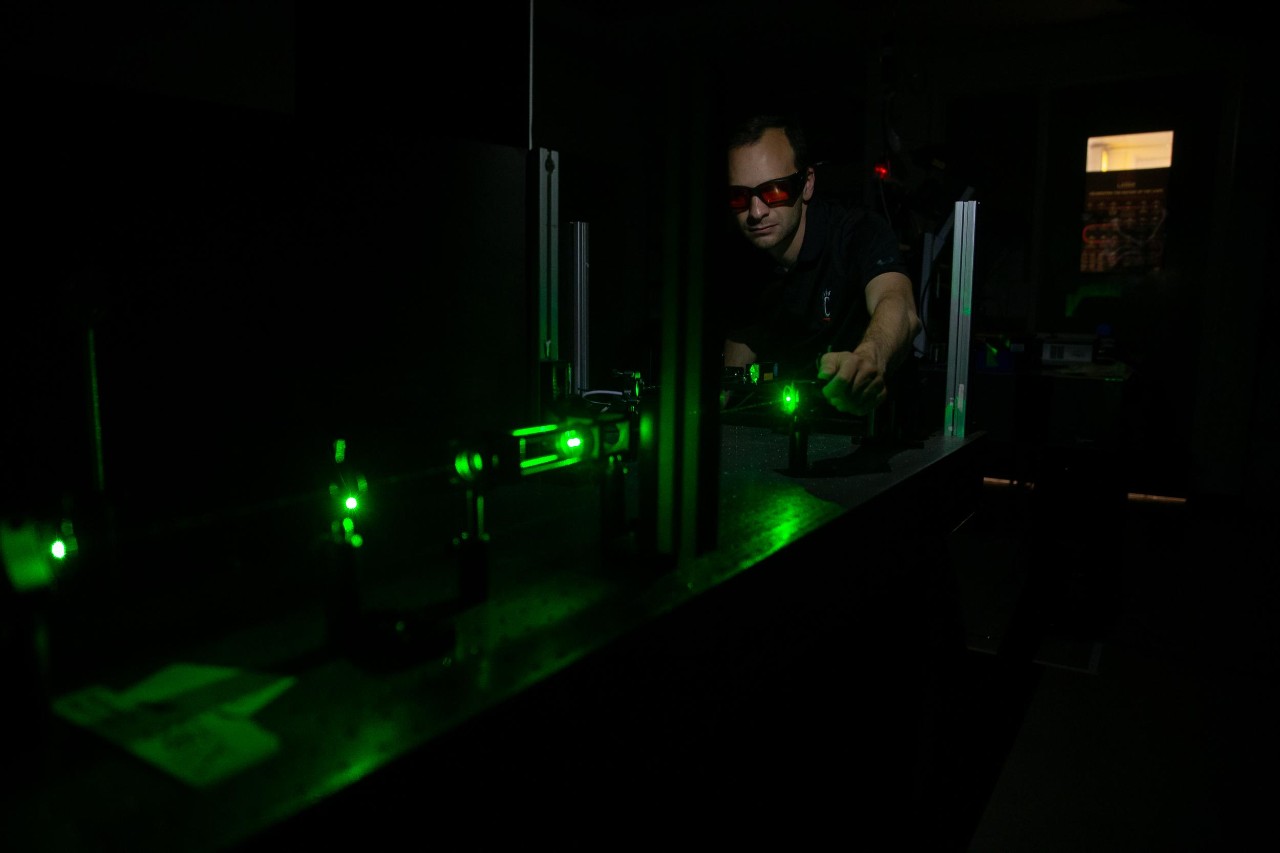
Featured image at top: UC Assistant Professor Pietro Strobbia uses a laser in his chemistry lab. Photo/Andrew Higley/UC Marketing + Brand

UC College of Arts and Sciences Assistant Professor Pietro Strobbia uses tools such as spectroscopy to conduct environmental analysis and clinical diagnostics in his chemistry lab. Photo/Andrew Higley/UC Marketing + Brand
Next Lives Here
The University of Cincinnati is leading public urban universities into a new era of innovation and impact. Our faculty, staff and students are saving lives, changing outcomes and bending the future in our city's direction. Next Lives Here.
Related Stories
These teeny spiders are social media stars
August 28, 2026

The New York Times turned to a University of Cincinnati professor to explain the appeal of jumping spiders on social media.
DAAP professor and artist turns grass clippings into biodegradable art
August 27, 2026
Through biodegradable bioplastic made from grass clippings, Supermrin shows how creativity can connect science, sustainability and everyday life.
Designing with cancer patients' needs in focus
August 27, 2026
Kristina Shin is designing garments that prioritize the comfort, function and confidence of breast cancer patients, addressing a need often overlooked by traditional fashion.