
History comes alive: UC Holocaust class experiments with VR technology
Students gain immersive experiences, transported into the scenes of Auschwitz-Birkenau
Students in a UC College of Arts and Sciences Judaic studies class took a first-hand look at the story of Holocaust survivor Fritzie Fritzshall and her experiences at Auschwitz-Birkenau, thanks to virtual reality (VR) technology.
The students were participating in a class titled Teaching and Remembering Trauma: Designing Holocaust and Genocide Education. UC is one of the first colleges granted exclusive access to the museum’s traveling set of VR headsets, provided by the Illinois Holocaust Museum and Education Center.
Alexis Morrisroe, adjunct instructor in the Judaic Studies program, secured access to the VR headsets through her prior role as a youth educator at the museum from June 2008 to April 2020. Seizing the opportunity, the department became one of the first schools participating in the soft launch.

UC adjunct instructor of Judaic Studies Alexis Morrisroe. Photo/Provided.
The Illinois Holocaust Museum and Education Center’s latest exhibit, titled “The Journey Back,” takes viewers into a 360-degree 15 minute long experience narrated by Holocaust survivor Fritzie Fritzshall.
The scenes are set in real locations, such as the concentration camp yards, the factories, the lavatories and the sleeping blocks.
Fritzshall would recount her memories and often stand in the middle of the rooms, as if she were speaking directly in front of the viewer.
The 13 students wore their own Oculus VR headsets. These headsets are wearable technology that resembles a pair of goggles.
They feature a high-resolution display that sits in front of the user's eyes as well as built-in speakers for audio. These stimuli, as well as sensors and motion tracking technology that allows it to detect the user's head movements in all directions, make up a highly immersive experience.
“Seeing it right in front of my face, it looks very realistic,” student Sarah Murphy said. “I really liked being able to turn around and look above me, like I could see the sky.”
The students felt the realism of the simulation added to their emotional reactions and their overall understanding of the information.
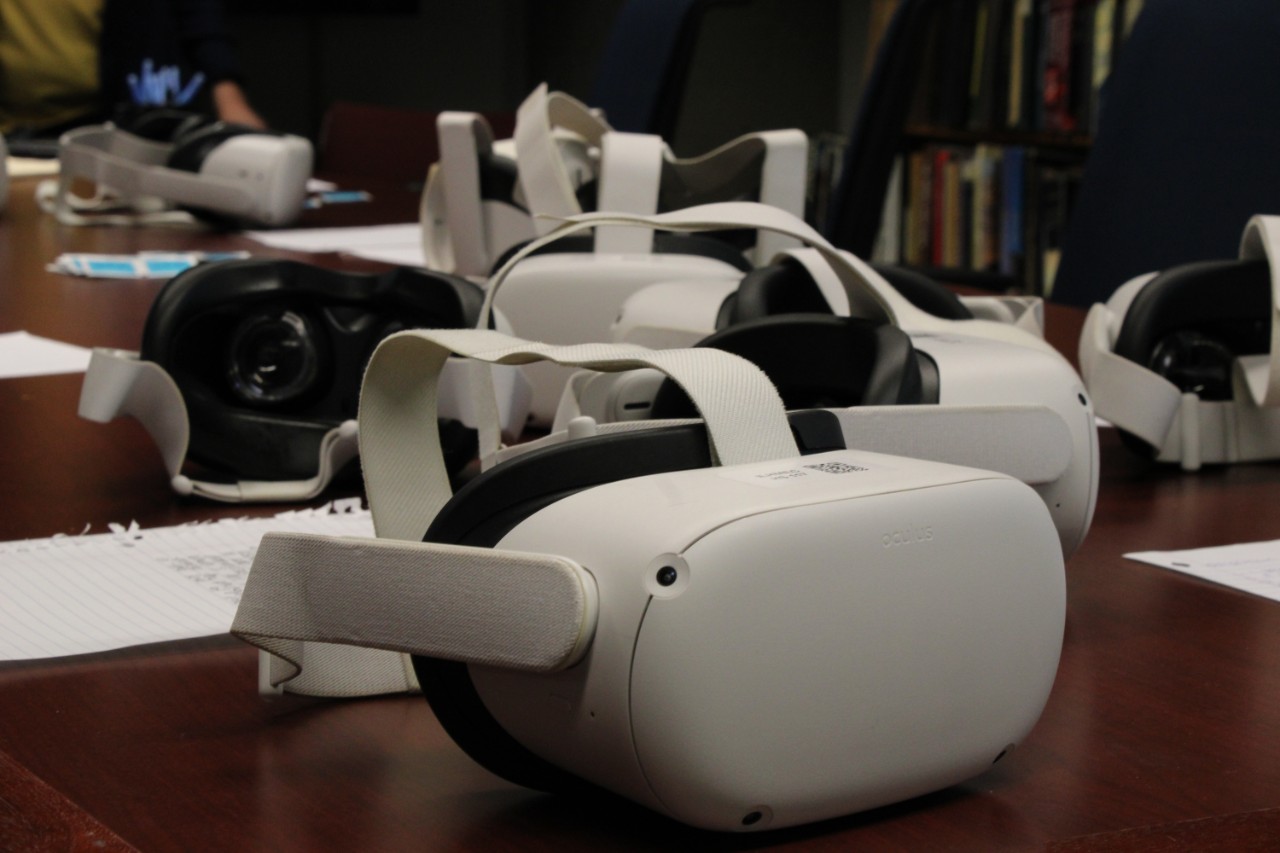
VR ocular headsets used by A&S students in pilot Holocaust studies. Photo/Rowan Hetzer
“It was really impactful to see the actual depth of certain areas, like the sleeping quarters and the train car, because even if it were to be mapped out on the floor, it wouldn’t have the same effect,” Murphy said.
“I think they did meet their goal of trying to make history and learning about history more empathetic, because I definitely felt more in tune and emotional learning the history rather than if I was just reading about it or watching a video," said student Jordan Schrand. "They wanted you to feel uncomfortable in these rooms."
Taking this learning experience to a higher level, leveraging the link between emotional engagement and information retention was one of the department’s objectives in implementing this technology in the classroom.
We are committed to innovative approaches to education.
Professor Matthew Kraus Head, UC Department of Judaic Studies
“The virtual reality definitely had an emotional impact on students. In a class like this, how to teach the Holocaust, the affective experience of the modality and the medium is significant… you want to stimulate discussion, and people had a lot to say about this,” department head Matthew Kraus said.
It’s not enough to rely on the interesting usage of technology alone; designing lesson plans and connecting the experience to learning objectives in class takes time, but ultimately brings the lesson to life.
“We could have easily been like ‘okay put on these headsets, watch this film, what do you think?’ How do you make it a learning experience?,” Morrisroe asked.
“We say we are committed to innovative approaches to education; there’s a lot of behind the scenes and preparation to make those things successful and not just be innovative for the sake of being innovative,” Kraus added. “That’s an important part of how you make these things actually work.”
Morrisroe said she would like to use VR technology again, especially given the prevalence of its usage in museums and education centers. As Holocaust survivors may not be around much longer to directly contribute to Holocaust education, VR could offer a beneficial alternative. It has the potential to permanently preserve the survivors' voices and experiences in an accessible and personable manner.
By integrating VR technology into the classroom, UC not only enhanced emotional engagement and understanding among its students, but also contributed to the preservation of survivors' stories and Holocaust history by taking the chance to participate in this experimental usage opportunity.
Featured image at top: Flag flies above the entrance to the Auschwitz-Birkenau museum center. Photo/whoismargot for Pixabay.

By Rowan Hetzer
Student Journalist, A&S Department of Marketing and Communication
artscinews@ucmail.uc.edu
Related Stories
UC researcher to launch national study with $2.5 million NIH grant
October 9, 2026

A University of Cincinnati researcher has received a $2.5 million National Institutes of Health grant to conduct research during the next five years. Natalie Kreitzer, MD, a University of Cincinnati College of Medicine physician-researcher, received an R01 independent research grant from the NIH's Eunice Kennedy Shriver National Institute of Child Health and Human Development. The funding will support a test program for caregivers of patients with traumatic brain injury, as reported by the Cincinnati Business Courier.
Lighting up the skyline for Blink
October 9, 2026
A team of University of Cincinnati College-Conservatory of Music students designed “Echoes of Light,” a music-and-light installation on Ohio’s largest mural for BLINK, Cincinnati’s massive public light and art festival.
They aimed a laser at a Bronze Age wall and found a fleet
October 8, 2026

MSN highlights the archaeological discovery by researchers at the University of Cincinnati of Bronze Age nautical etchings on a stone wall in Cyprus.