
UC steers innovation in carbon capture for coal-fired power plants
Engineers help reconcile coal and climate change

Local 12 highlighted the ways researchers at the University of Cincinnati are developing new technologies to address pollution and greenhouse gases from coal-fired power plants.
The Ohio Department of Development awarded more than $1.6 million in grants to researchers in UC’s College of Engineering and Applied Science to examine better ways to capture carbon dioxide and other pollutants from industrial emissions.
Coal lost some of its economic luster over the past five years as the price of natural gas became more competitive. But with rising gas prices, coal is becoming more attractive. China and India continue to build new plants.

Joo-Youp Lee. Photo/Provided
Professor Joo-Youp Lee, who teaches chemical engineering at UC, said coal produces far more carbon dioxide during combustion than natural gas.
“Because of the push to address climate change, more effective technology is critical,” Lee said.
His lab is getting $250,000 to assess a new absorption-based method for separating carbon dioxide in emissions. Lee is developing new solvents that minimize water and energy use to remove greenhouse gases.
His technology has been effective in controlled lab tests, he said. The next step is a pilot project.
“This system can save at least 40% of energy relative to what’s available out there now,” Lee said.
Lee has spent much of his career working on better pollution controls for coal-fired power plants for emission such as sulfur dioxide, nitrogen oxides, mercury and other heavy metals.
UC has a long history of working with the state’s coal industry.
“Ohio is a coal-producing state,” Lee said. “But our technologies can be applied readily to other industrial emissions like cement kilns, steel manufacturing, paper mills, refineries, chemical and petrochemical plants and natural gas production as well.”
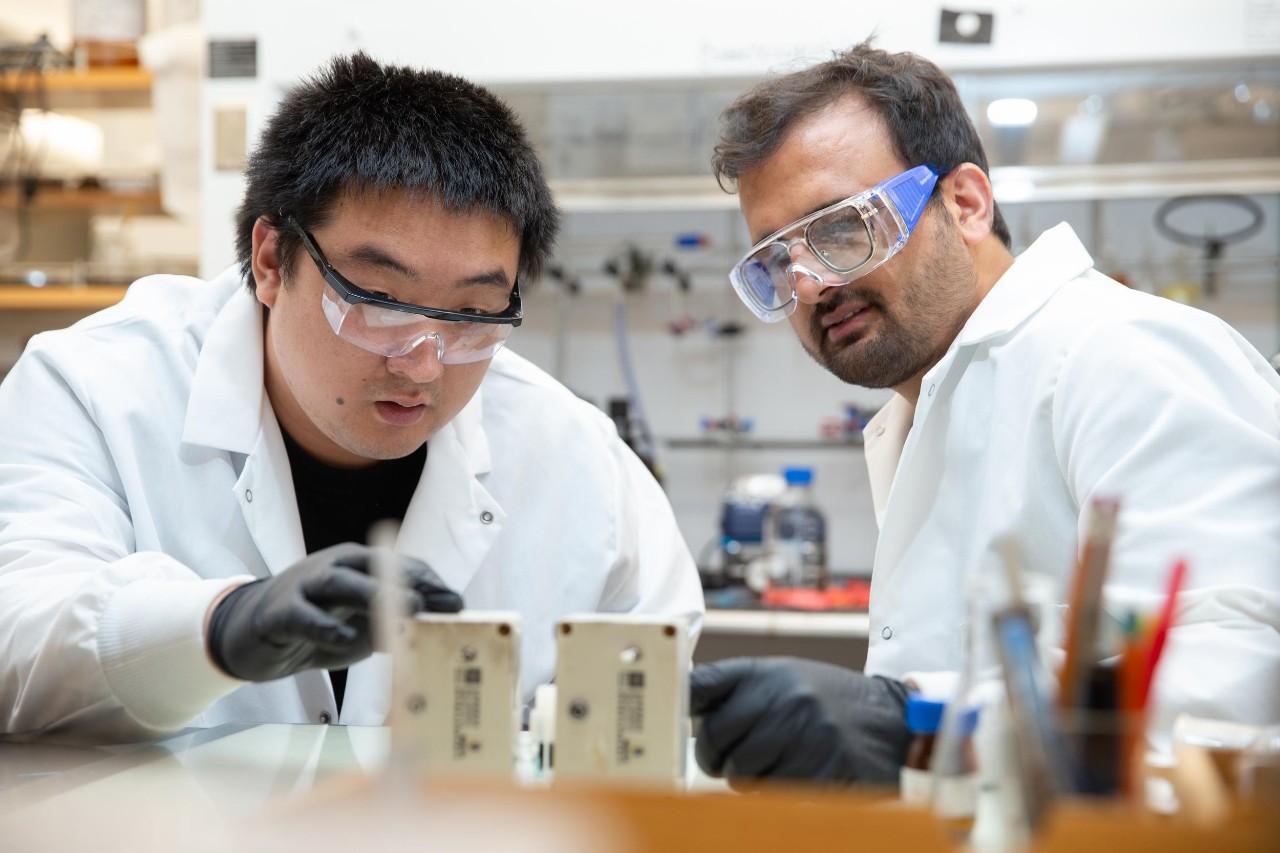
Doctoral students Xiao Wang, left, and Rabin Siwakoti work on a battery project together in a chemistry lab. Students and researchers across UC's colleges are working on innovations in energy generation, storage and efficiency. Photo/Andrew Higley/UC Marketing + Brand
Liability to asset
The Ohio Department of Development awarded UC Professor Vadim Guliants three grants totaling $750,000 to investigate:
- Converting emissions into products used in lithium-ion batteries and polymers.
- Using coal fly ash to degrade organic pollutants in wastewater through oxidation.
- Extracting lithium and rare earth elements from coal.
“While carbon dioxide is considered a waste in the context of its environmental impact, efforts are being made to turn it from a liability into a resource by developing technologies that can capture and utilize it,” Guliants said.
Demand is booming for rare earth elements and lithium used in many electronics. So developing efficient ways to harvest them from coal could create a new supply stream, he said.
“As demand for lithium and rare earths has risen significantly, there has been an increased focus in this country on securing a stable supply chain and exploring new extraction technologies for these elements including new resources,” Guliants said.
His lab also is investigating the feasibility of using coal fly ash, or the mineral residue that remains from burning coal, to degrade harmful organic pollutants found in coal washing wastewater. These pollutants can be resistant to biological treatments typically used to degrade them, he said.
Guliants and his students will examine coal fly ash, a by-product of coal combustion, as a potential catalyst to oxidize and degrade the pollutants. This has the potential of making fly ash a commodity that energy producers could sell rather than a liability that must be landfilled.
The grants will support research by both UC graduate students and undergraduate students as part of their senior design projects and will give them practical experience working with partners in industry, Guliants said.
Pursuing new technology
The agency awarded $750,000 to UC Professor Panagiotis Smirniotis for three projects to:
- Develop and test new materials for removing carbon dioxide from flue gas emissions of coal-fired boilers at a wide range of temperatures.
- Create novel and cost-effective ways to produce ethylene from coal.
- Use nano-catalysts to convert carbon dioxide from emissions into synthetic gas.
Smirniotis credited the Ohio Department of Development for supporting his research group with more than $2.3 million in grants since 1998 for a variety of projects related to the types of coal found in Ohio.
Lastly, the agency awarded $100,000 to UC Professor Junhang Dong to showcase his novel carbon capture system for batteries used in thermal and electric energy storage at coal-fired power plants.
Featured image at top: Chemical engineers in UC's College of Engineering and Applied Science received $1.8 million in stage grants to pursue innovations to address pollution and greenhouse gas emissions from coal-fired power plants. Photo/Acilo/iStockPhoto
Innovation Lives Here
The University of Cincinnati is leading public urban universities into a new era of innovation and impact. Our faculty, staff and students are saving lives, changing outcomes and bending the future in our city's direction. Next Lives Here.
Related Stories
AI breast cancer survival model from Cancer Center could improve accuracy and personalize care
October 23, 2026
UC Cancer Center researchers, including lead author Wedad Alatebi, developed a deep learning survival model for breast cancer that combines detailed clinical and genetic information, potentially offering physicians a more accurate tool to guide treatment decisions.
UC expert explains potential impact of Pennsylvania’s new vape product law
October 22, 2026

UC professor Ashley Merianos speaks to the Pittsburgh Post-Gazette about Pennsylvania’s new vape law, youth vaping prevention, enforcement challenges and possible unintended consequences.
UC Biomedical Engineering student launches mobile healthcare platform
October 22, 2026
As a fifth-year biomedical engineering student at the University of Cincinnati College of Engineering and Applied Science, Amelia Wares has been a trailblazer in nearly every area imaginable — and this is only the beginning of her journey.