Tastes so good: Learning to swallow after stroke
Yahoo News highlights UC trial

Yahoo News highlighted a trial at the University of Cincinnati testing an at-home tongue endurance exercise to improve patients’ swallowing function.
“Eating and drinking is something we all take for granted and do every single day,” said Brittany Krekeler, PhD, assistant professor and clinician-scientist at the UC College of Medicine’s Dysphagia Rehabilitation Laboratory. “A lot of patients that are recovering from stroke do have what we call oral phase impairments in swallowing and that their tongue is weak."
Patients enrolled in the trial led by Krekeler receive a device with a pressurized bulb that connects to their phone or tablet through Bluetooth to give them real-time feedback about how hard they are pressing the bulb with their tongue. Participants in the trial will press their tongue to the bulb, with the device recording the number of times they do so and if they meet their goal. They’ll complete the exercises three times a day for eight weeks, with their goal increasing as they build endurance.
After a stroke, patient Kevin Moss had to learn how to walk, talk and swallow again. Following surgery, he worked with Krekeler and did tongue exercises to strengthen his swallowing function.
“I eat anything and everything now,” he sais.
Read the Yahoo News story, originally published on YourErie.com.
Quincy, Illinois television station WGEM also highlighted the trial. Watch or read the WGEM article.
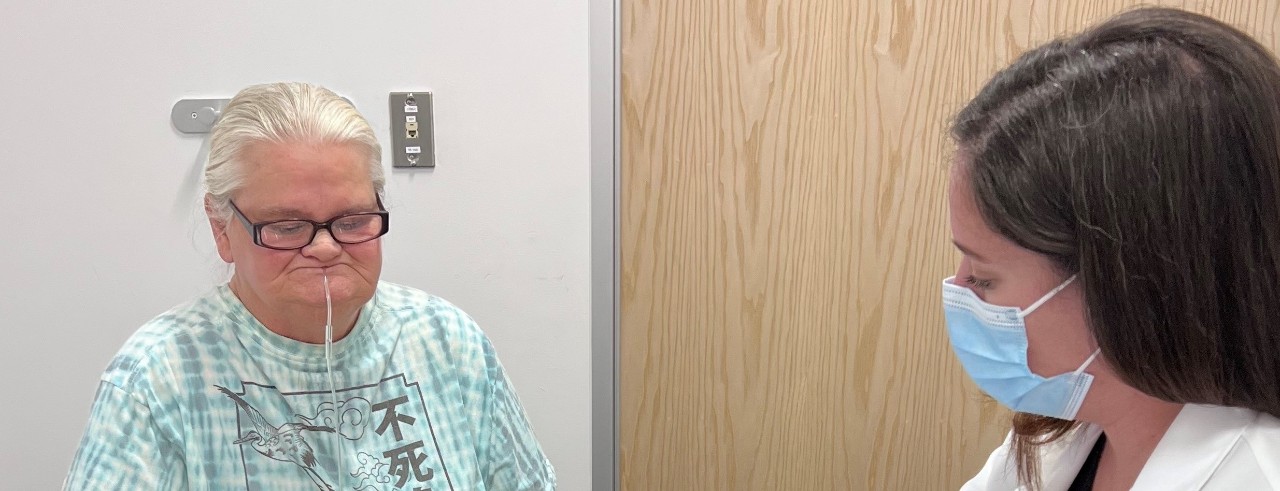
Featured photo at top of a patient working in the Dysphagia Rehabilitation Laboratory. Photo/Rachel Treinen Photography.
Related Stories
Why is there a statue of Stephen Foster in Cincinnati?
June 26, 2026

Even if you don't know American parlor composer Stephen Foster, you’ve probably heard his music. His mid-19th century folk songs, including “Camptown Races” and “Oh Susanna,” make appearances in pop culture to this day. There’s a statue of Foster overlooking the Ohio river in Alms Park that prompted WVXU's Bill Rinehart to feature him in his Cincinnati mysteries segment, OKI Wanna Know. WVXU turned to University of Cincinnati music history expert Kristy Swift for a peek into Foster’s life and impact in the region.
World Cup watch parties unite fans, communities
June 26, 2026

UC Assistant Professor Letisha Brown tells Spectrum News that watch parties for sporting events and entertainment are popular because people feed on others' excitement.
Drone-delivered groceries descending into Cincinnati
June 25, 2026

Walmart is bringing drone delivery to Cincinnati, as reported by 700WLW. Host Scott Sloan spoke with Michael Jones, associate professor of economics at the University of Cincinnati's Lindner College of Business, for a look at what it means for Cincinnati shoppers.