Maya power plants
UC archaeologist uses eDNA to unlock secrets of ancient Mayan civilizations

Archaeology magazine highlighted the work of an international research team led by the University of Cincinnati that used environmental DNA to unlock the secrets of ancient Mayan culture.
UC College of Arts and Sciences Professor David Lentz told the magazine that a DNA analysis of a stained section of ground at the base of a Maya ballcourt revealed the surprising discovery of possible ritual blessings at the important landmark in the city of Yaxnohcah.
Researchers said the ancient Maya likely made a ceremonial offering during the ballcourt’s construction.
Environmental DNA from the site came from, among other plants, a tree called jool, the bark of which is used in ceremonial wrappings, and xtabentun, a plant with hallucinogenic properties also used in rituals.
The research was carried out through Mexico's National Institute of Anthropology and History in collaboration with researchers from the University of Calgary, the Autonomous University of Campeche and the National Autonomous University of Mexico.
Lentz and his research partners have been studying ancient Mesoamerican cultures across Mexico and Central America. New tools that can identify environmental DNA are helping them unlock secrets about how the ancient Maya might have used these spaces.
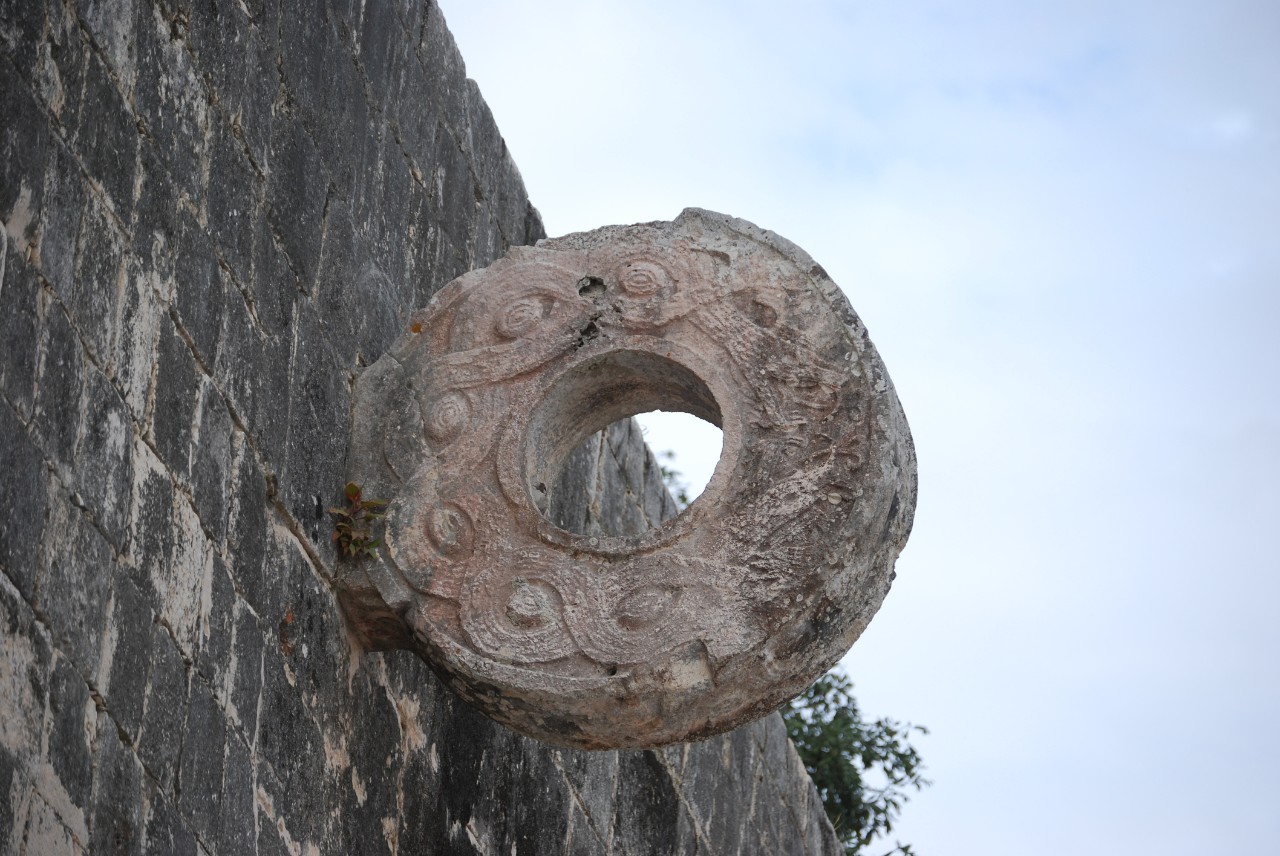
The ancient Maya played several ball games, including pok-a-tok, which was a mix of soccer and basketball. Players tried to get a ball through a ring or hoop on a wall.
“Ballcourts occupied prime real estate in the ceremonial center,” Lentz said. “They were a fundamental part of the city.”
Now UC researchers hope to apply similar environmental DNA techniques to excavations at the ancient Maya city of Calakmul, about 10 miles north of Yaxnohcah, where lidar surveys have identified previously unknown agricultural terraces.
“We’re about to get a completely new picture of how the Maya fed themselves,” he told the magazine.
Read the Archaeology magazine story.
Featured image at top: A decorative ring made from carved stone is embedded in the wall of a ballcourt in the ancient Maya city of Chichen Itza. Photo/LanaCanada

UC Professor David Lentz holds a sculpture that bears reproductions of ancient Maya glyphs. Photo/Andrew Higley/UC Marketing + Brand
Related Stories
Is Cincinnati building new homes fast enough?
September 22, 2026

Gary Painter, professor and academic director of the Real Estate Center at UC's Lindner College of Business, offers comments on affordability issues in Cincinnati.
UC climbs to No. 3 in the nation for co-ops and internships in 2027 U.S. News rankings
September 22, 2026
In U.S. News & World Report’s 2027 Best Colleges rankings, the University of Cincinnati rises to No. 3 in the nation for co-ops and internships — No. 1 among public institutions — and posts gains in undergraduate business, computer science and psychology.
Tina Cheng, MD, receives American Academy of Pediatrics’ highest honor
September 22, 2026
UC Pediatrics chair Tina Cheng, MD, has received the American Academy of Pediatrics' highest honor for her decades of advancing child health.