Dangers of forever chemicals
News report shows scientists are getting clearer picture of impact of PFAS

PFAS are known as forever chemicals. They are a large, complex group of synthetic chemicals that have been used in consumer products since the 1950s. Now scientists are getting a clearer picture of just how dangerous these chemicals are.
Per- and poly-fluoroalkyl substances, or PFAS, are used in the aerospace, automotive, construction and electronic industries. These chemicals keep food from sticking and clothes from burning, but scientists said they can also be life-threatening.
PFAS can leak into soil and water, and because they break down slowly, if at all, almost everyone is repeatedly exposed to them.
“They can be found in house dust,” explained Susan Pinney, PhD, professor of epidemiology in the Department of Environmental and Public Health Sciences at the University of Cincinnati College of Medicine. A report on her research recently aired on KPLC-TV in Lake Charles, La.
PFAS can cause increased cholesterol levels, lower immunity and some cancers. Now a new study out of UC shows that exposure to PFAS may impact young girls.
“We found that PFAS delayed the onset of puberty,” said Pinney.
85 percent of the young girls in the study had measurable levels of PFAS in their blood — impacting the same hormones that delay the onset of puberty, which could in turn make these girls more susceptible to breast cancer, infertility and endometriosis.
So, what can anyone do? Use a water filter that removes PFAS, and when possible, opt for products labeled as PFAS-free.
Pinney also suggests getting rid of any old Teflon cookware.
Click here to read the entire report from KPLC-TV.
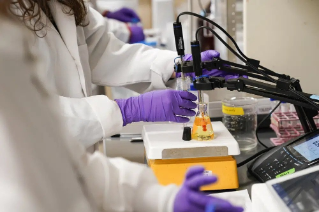
Featured image at top: Scientists wearing white lab coats and purple rubber gloves use lab equipment in their research. Photo/Provided
Related Stories
Colorado silica dust trial could change the way industry does business
May 17, 2026

Betsy Malloy, Andrew Katsanis Professor of Law, at the University of Cincinnati, spoke with Bloomberg Law about how a Colorado trial could change the way the stone fabrication industry does business.
Three years, countless stories
May 15, 2026
UC's Klekamp Law celebrates its 193rd Hooding with stories from graduates reflecting on their paths through the college.
Driven by curiosity, guided by care
May 14, 2026
Max Wilson, a University of Cincinnati College of Allied Health Sciences health sciences major on the pre-physician assistant track, found his path expanding beyond the classroom and into hands-on research focused on human performance and patient care.