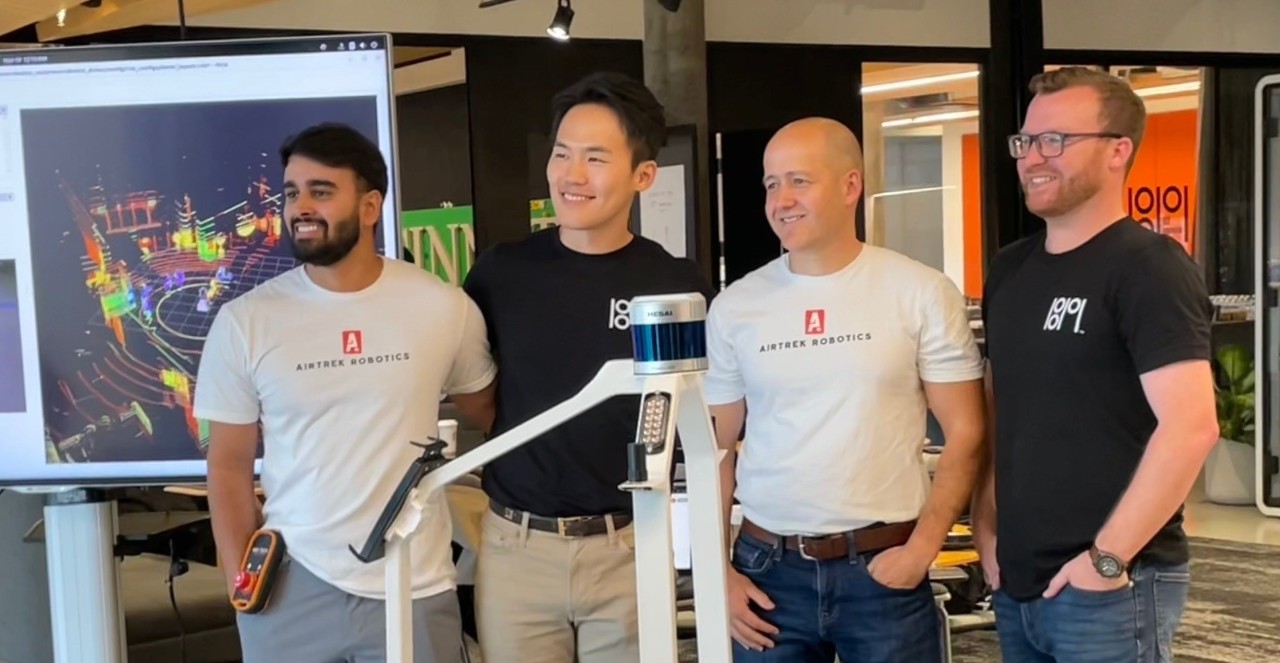
Meet the innovative airport runway Roomba pioneered at UC's 1819 Innovation Hub
Airtrek Robotics targets airport safety and maintenance issues

The multibillion-dollar aviation industry constantly balances operational costs, strict regulatory requirements and passenger safety. Often overlooked, however, are the risks facing ground crews who work around the clock to ensure smooth flight operations.
Enter Airtrek Robotics.
Spectrum News recently spoke with the Cincinnati-based startup founded by engineers Chris Kyoochul Lee, Jon Taylor and Huzefa Dossaji, who are determined to revolutionize aviation safety with cutting-edge technology.
Groundbreaking solutions under one roof
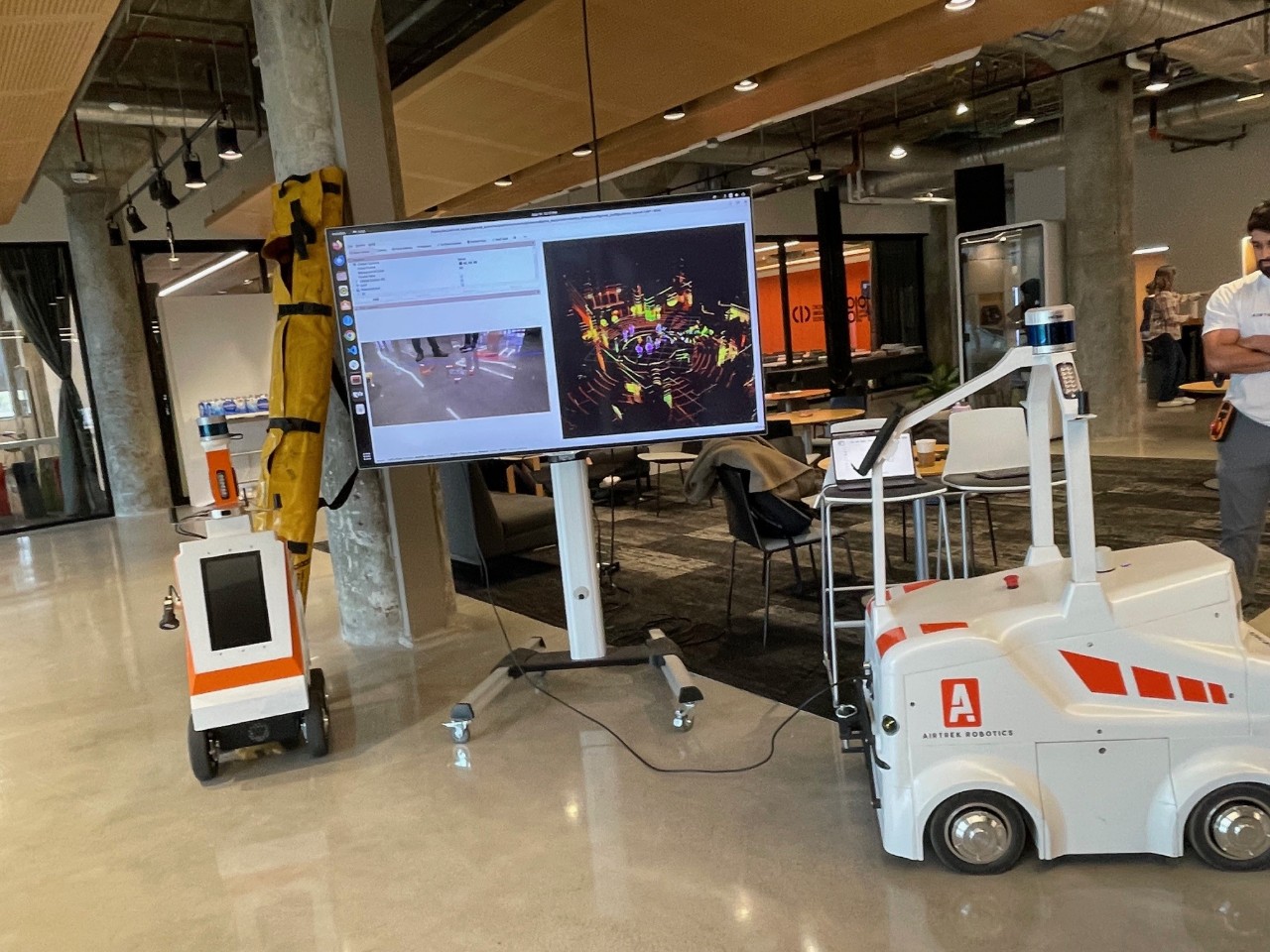
The first prototype of Airtrek robot on the left and the larger, redesigned Airtrek robot on the right created in the UC Groundfloor Makerspace at 1819 Innovation Hub. Photo/Diana Lara
Airtrek's founders initially joined the UC Venture Lab program at the 1819 Innovation Hub, where they took their concept from vision to reality. The Innovation Hub’s resources — including the 1819 Ground Floor Makerspace, equipped with top-tier tools and training facilities — enabled the team to build a prototype and refine its groundbreaking robot.
Airtrek also has secured multiple grants, including one from Main Street Ventures (MSV), a nonprofit partner inside the 1819 Innovation Hub. Known as the Entrepreneurial Launch Funding grant, MSV’s support was instrumental in helping Airtrek find the resources needed to launch its startup.
This month, Airtrek won $55,000 in the “5 Across Entrepreneur Pitch Competition” in Lexington, Kentucky, hosted by Awesome Inc.
“Our partnership with the 1819 Innovation Hub gave us access to invaluable resources, funding and mentorship. Now, we’re excited to bring this technology to airports nationwide,” said Lee. “Airtrek is like a Roomba for aviation and aims to modernize outdated ground handling processes with autonomous technology."
How it works
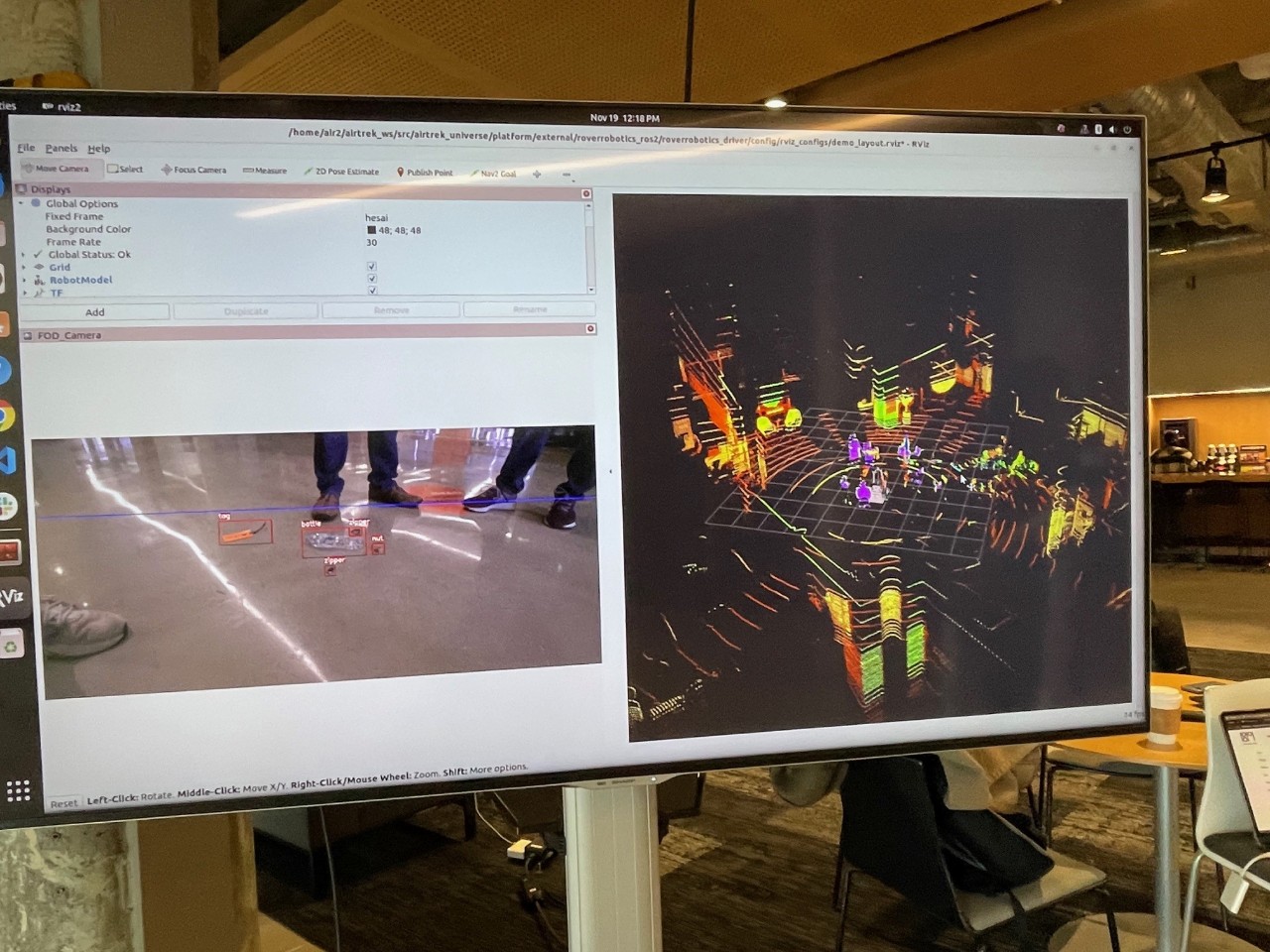
The Airtrek robot demonstrates how it identifies, tracks and reports foreign debris in real time. Photo/Diana Lara
Airtrek’s innovation leverages advanced sensors and artificial intelligence to identify debris and deliver a precise, automated, cost-effective solution for enhanced safety and efficiency. The robot autonomously supports critical ground handling tasks like aircraft marshaling and foreign object debris (FOD) management, creating a safer environment for both aircraft and personnel.
FOD damage costs the global aviation industry approximately $22.7 billion annually, according to a 2023 study by the U.S. Federal Aviation Administration. Airtrek Robotics’ autonomous solution, powered by advanced sensors and AI, is designed to reduce these risks by detecting and removing debris with precision, efficiency and enhanced safety.
Industry-backed pilot program
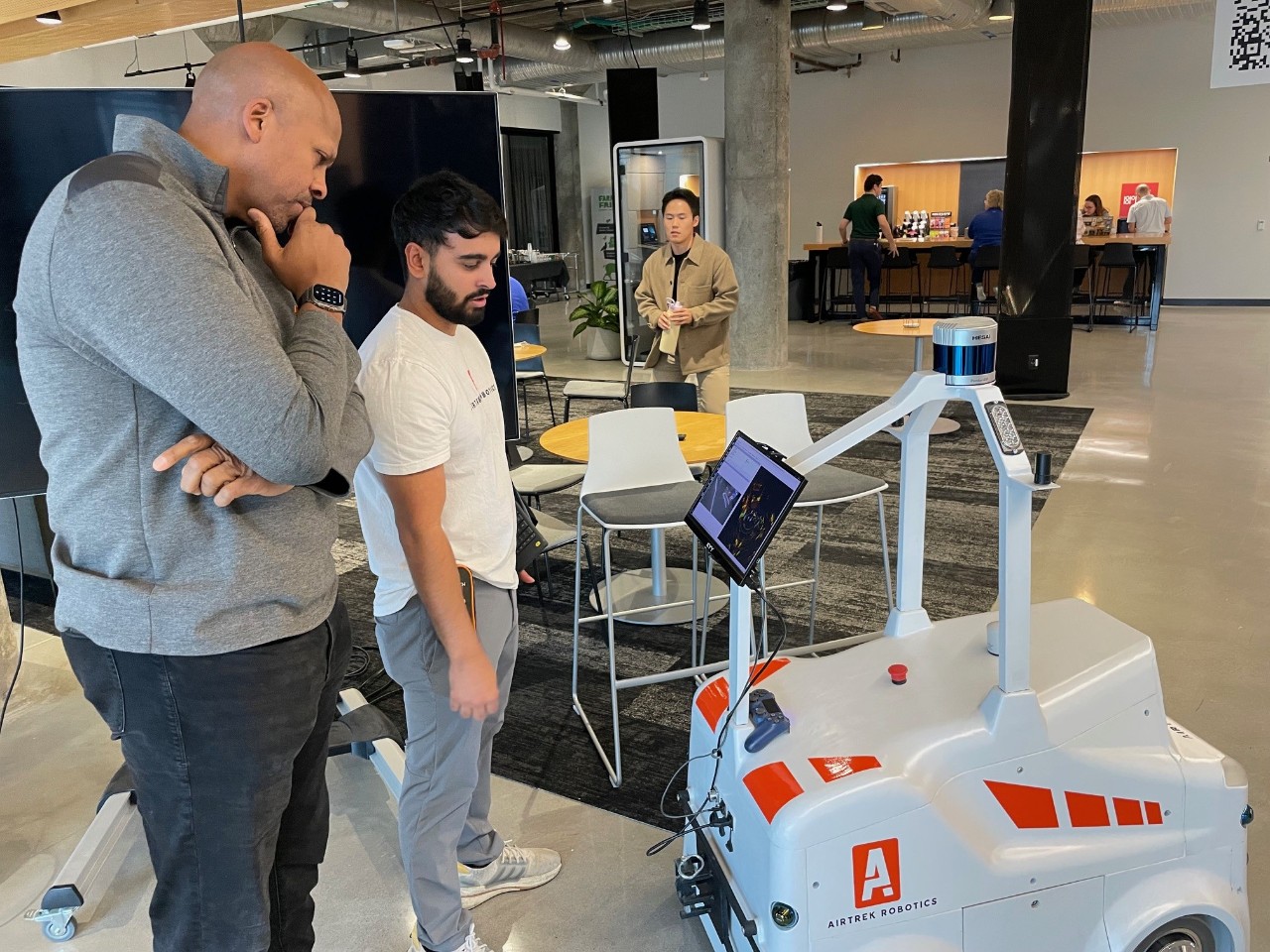
Huzefa Dossaji demonstrates the Airtrek robot to UC 1819 startup partner, Rob Richardson, Disrupt Now. Photo/Diana Lara
Following an intensive development phase, Airtrek Robotics earned a spot in the prestigious Ford Launchpad for Innovative Technologies and Entrepreneurship (FLITE) program, where it recently returned from a successful paid pilot demonstration at Gerald R. Ford International Airport near Grand Rapids, Michigan.
Partnering with Southwest Airlines and other key industry players, Airtrek showcased the robot in a real airport environment, underscoring its game-changing potential for tarmac safety and FOD management.
Featured image at top: Airtrek cofounders and engineers. Photo/Diana Lara
Innovation Lives Here
The University of Cincinnati is leading public urban universities into a new era of innovation and impact. Our faculty, staff and students are saving lives, changing outcomes and bending the future in our city's direction. Next Lives Here.
Related Stories
Is Cincinnati building new homes fast enough?
September 22, 2026

Gary Painter, professor and academic director of the Real Estate Center at UC's Lindner College of Business, offers comments on affordability issues in Cincinnati.
Engineering graduate student developing intelligent AI systems
September 21, 2026
Artificial Intelligence is on the rise, and researchers are working harder than ever to understand, develop, and improve it. Aneesh Deshmukh, computer science M.S. student at the University of Cincinnati, is working on AI systems modeled after human brain functionality. Deshmukh's goal is to help these robots understand their surroundings and take this knowledge to navigate unfamiliar environments in the future. For this work, he has been named Graduate Student Engineer of the Month by the College of Engineering and Applied Science.
UC expert explains geology of Mammoth Cave
September 21, 2026

UC Associate Professor Dylan Ward and UC geosciences graduate Rachel Bosch joins an episode of OutSCIder Classroom to talk about weathering in caves found in places such as Mammoth Cave National Park.