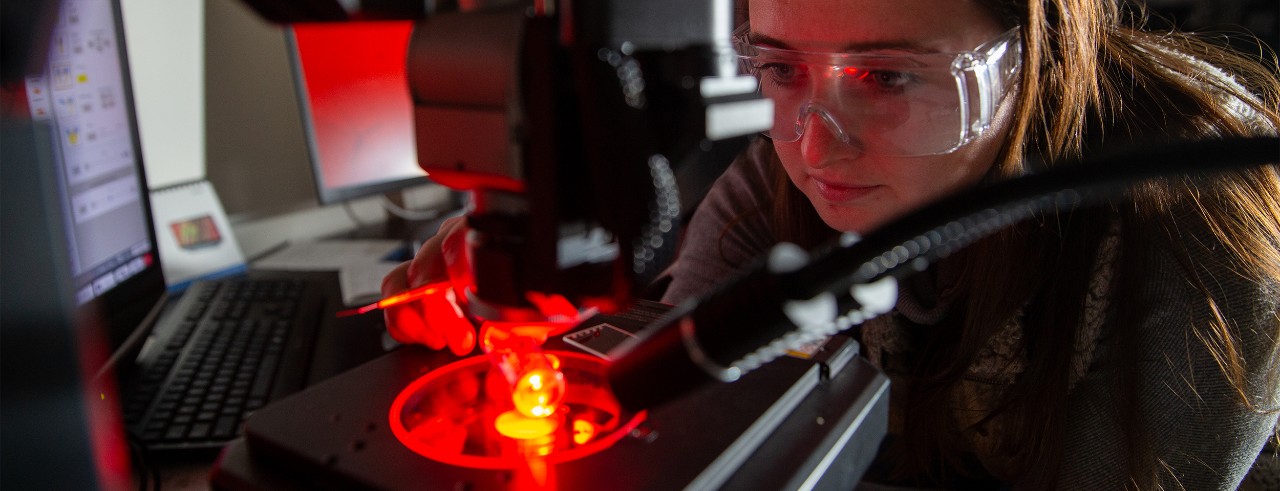
UC students explore reactions of crystals that explode in light
Spectrum News highlights UC's groundbreaking research in chemistry

Spectrum News highlighted groundbreaking work by chemistry students at the University of Cincinnati to explore the bizarre properties of crystals that react to light.
UC College of Arts and Sciences Professor Anna Gudmundsdottir and her students are on the frontiers of discovery in the field of photoexplosive crystals. When exposed to light, the lab-grown crystals exhibit strange properties: They bend, twist, bounce and sometimes explode.
“There are only a few labs in the United States that do photodynamic crystals, which is what we’re mostly working with,” UC doctoral student Fiona Wasson told Spectrum News. “We’re the only ones that are studying azide photodynamic explosive crystals.”
The research is funded through the National Science Foundation. Gudmundsdottir said the crystals' properties could be used to improve air safety or create new light-powered sensors.
Gudmundsdottir told Spectrum News the research also gives students valuable scientific experience.
“It makes them a lot more employable because they’ve been at the forefront of discovery,” she said.
Related Stories
These teeny spiders are social media stars
August 28, 2026

The New York Times turned to a University of Cincinnati professor to explain the appeal of jumping spiders on social media.
An internal divide among unions on AI impacts the Wisconsin gubernatorial race
August 28, 2026

Anne Lofaso, a professor in the Donald P. Klekamp College of Law at UC, spoke with Wisconsin Public Radio, about the schism among unions over AI and whether it is a plus, a negative, or somewhere in between when looking at job creation.
UC, NKU renew longstanding partnership supporting Army ROTC cadets
August 26, 2026
The University of Cincinnati Army ROTC and Northern Kentucky University (NKU) have renewed a longstanding partnership that supports students preparing to become Army officers and leaders in their communities. The universities formalized the renewed agreement during a signing event Aug. 11 at NKU.