
In Memoriam: Andrew Barth, Ph.D.
Aerospace engineer developed autonomous robotics for use in space

Andrew Barth, a two-time University of Cincinnati graduate and an assistant professor in the Department of Aerospace Engineering and Engineering Mechanics, died Feb. 9, 2025. He was 49.
In January, Barth joined his alma mater as a faculty member. In late 2024, he completed his doctoral degree in aerospace engineering in the Intelligent Robotics and Autonomous Systems Lab of UC aerospace engineering professor Ou Ma, Ph.D.

Andrew Barth joined UC's aerospace engineering faculty in January. Photo/Corrie Mayer/CEAS Marketing.
Barth first came to UC as an undergraduate student, earning his bachelor’s degree in aerospace engineering in 1999. He went on to work as an engineer in Houston, spending five years at Hernandez Engineering and 10 years at Lockheed Martin. Working with these companies, he provided engineering support to NASA on the International Space Station, Hubble Robotic Vehicle and Orion programs. He was named certified principal engineer for the re-entry guidance performance for the Orion Exploration Flight Test 1 spacecraft.
Barth returned to Cincinnati in 2018 and began to pursue his doctorate in aerospace engineering at UC.
During his graduate studies, Barth collaborated with his mentor, Ou Ma. Barth’s research focused on intelligent robotics for space applications, developing solutions for satellite inspection and servicing through autonomous spacecraft with dexterous robotic manipulators. He was driven by the challenge of addressing the inability to repair satellites after launch, aiming to bring innovative solutions to reality.
In 2023, Ma nominated Barth for the UC College of Engineering and Applied Science Graduate Student Engineer of the Month, which he was awarded.
Ma said Barth played a pivotal role in the development and success of the space robotics lab during his doctoral program. Barth assisted Ma in managing research projects totaling over $13 million in federal funding. His ability to maintain strong relationships with industry partners was invaluable.
“Andy’s passion for teaching and advising students was evident in everything he did,” Ma said. “Whenever a student approached him with questions, he would stop his work to provide patient and thorough explanations. He also initiated and inspired many capstone projects that motivated and trained undergraduate students.”
“Beyond his professional accomplishments, Andy was an exceptional human being. He was humble, quiet, and hardworking, often shying away from the spotlight despite his significant contributions to my lab and research program,” Ma said.
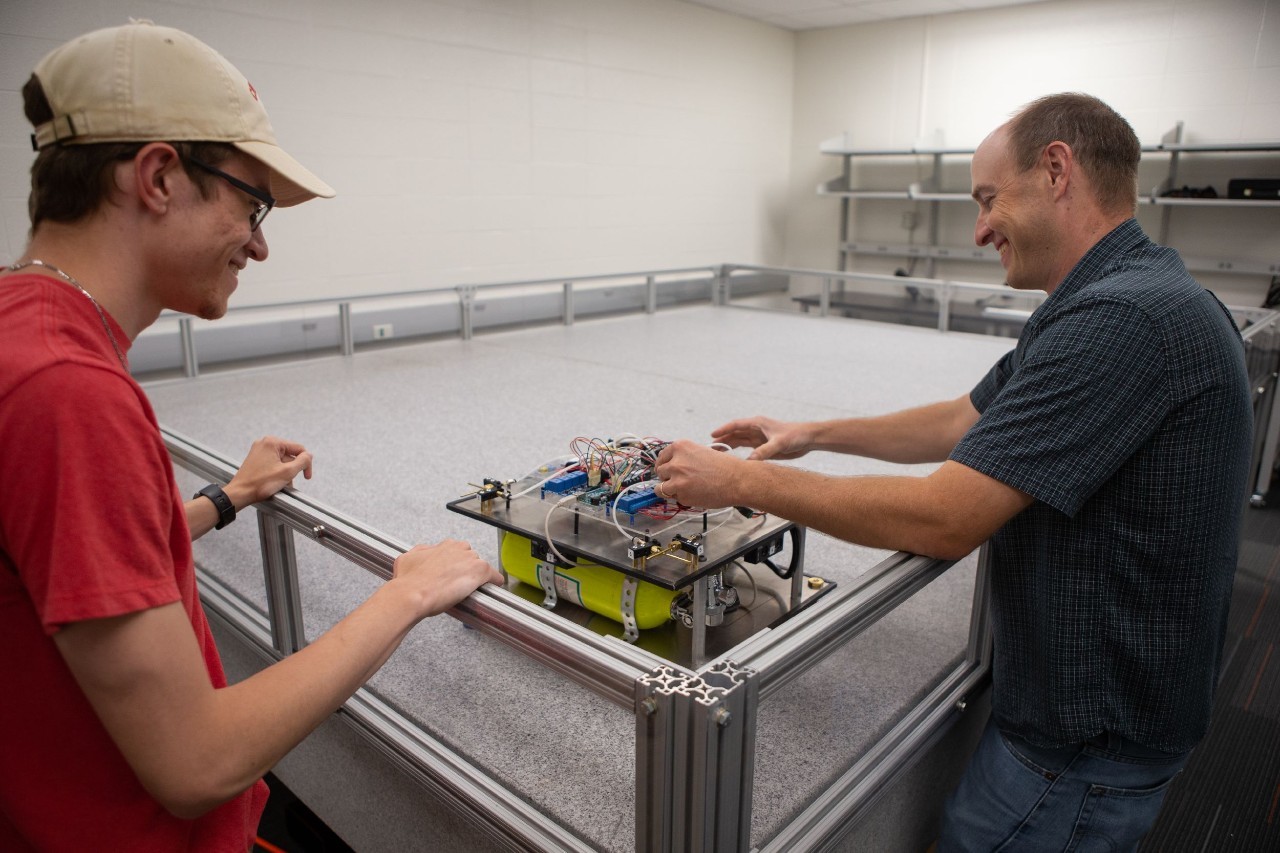
As a doctoral student, Andrew Barth played a vital role in Ou Ma's Intelligent Robotics and Autonomous Systems Lab. Photo/Andrew Higley/UC Creative + Brand.
Dylan Roach, a doctoral student who worked with Barth for the last three years in Ma’s lab, said Barth’s kindness and expertise were evident while working with him and also watching him work with others.
Barth had the ability to engage with students across various engineering disciplines, including aerospace, mechanical, electrical, and computer engineering. Roach observed that Barth "never seemed out of place in the discussion" and was always open to collaboration, demonstrating a genuine love for sharing his knowledge and experience.
Roach shared that Barth was Ma's “go-to guy," playing a crucial role in maintaining the day-to-day operations and research activities within the lab. Roach highlighted Barth's dedication to supporting all members of the lab, from full-time researchers to co-op and capstone students.
"Every day he met with these students, gauged their progress, and assisted them in any way he could," Roach said. “There is not a single person in the lab who has not benefited in some way due to Andy’s help.”
Kelly Cohen, Ph.D., professor of aerospace engineering, first met Barth when he joined UC as a doctoral student. Barth took Cohen’s class, “Soft Computing Based on AI.” In 2021 they wrote a joint paper titled “A fuzzy logic approach for spacecraft site selection,” which earned an honorable mention for student paper with a cash prize. Cohen also served on Barth’s PhD defense committee.
“I was excited to have Andy join our ranks as assistant professor and to collaborate on an exciting project,” Cohen said. “I’ve been a strong support of Andy and it was a joy working closely with him.”
Barth enjoyed spending time outdoors, hiking, biking, horseback riding, or tending to his farm. A devoted Cincinnati sports fan, he enjoyed cheering on his teams, including the Bearcats, FC Cincinnati, Cincinnati Bengals and Cincinnati Reds.
Barth met his wife, Stephanie (Bingle) Barth ’03 at UC when they were both engineering students.
In addition to his wife, Stephanie, he is survived by his mother, Dorothy Barth, his in-laws, Jill and Bill Bingle, and extended family.
In lieu of flowers, Barth’s family requests memorial donations in his name to University of Cincinnati Department of Aerospace Engineering & Engineering Mechanics, Hoxworth Blood Center or Shared Harvest Food Bank.
Read more about Andrew Barth in UC News:
Featured image at top: Andrew Barth earned two degrees from UC and started in January 2025 as assistant professor of aerospace engineering. Photo/Colleen Kelley/UC Creative + Brand.
Related Stories
UC Foundation celebrates 2026 philanthropy winners
October 23, 2026
The University of Cincinnati Foundation recognized its Outstanding Philanthropic Volunteer Award honorees at the George Rieveschl Recognition Dinner on October 22, 2026.
AI breast cancer survival model from Cancer Center could improve accuracy and personalize care
October 23, 2026
UC Cancer Center researchers, including lead author Wedad Alatebi, developed a deep learning survival model for breast cancer that combines detailed clinical and genetic information, potentially offering physicians a more accurate tool to guide treatment decisions.
UC Biomedical Engineering student launches mobile healthcare platform
October 22, 2026
As a fifth-year biomedical engineering student at the University of Cincinnati College of Engineering and Applied Science, Amelia Wares has been a trailblazer in nearly every area imaginable — and this is only the beginning of her journey.