
Study looks to optimize pain management, reduce opioid use after mastectomy
Ride Cincinnati, Cancer Center pilot grant funds clinical trial

A multidisciplinary team of University of Cincinnati Cancer Center researchers is leading a new clinical trial aimed to optimize pain management and reduce the need for opioids after mastectomy procedures.
Alicia Heelan, MD, and Bradley Budde, MD, are leading the trial, funded by a $50,000 pilot grant supported by contributions from Ride Cincinnati through the Cancer Center Pilot Project Award Program.
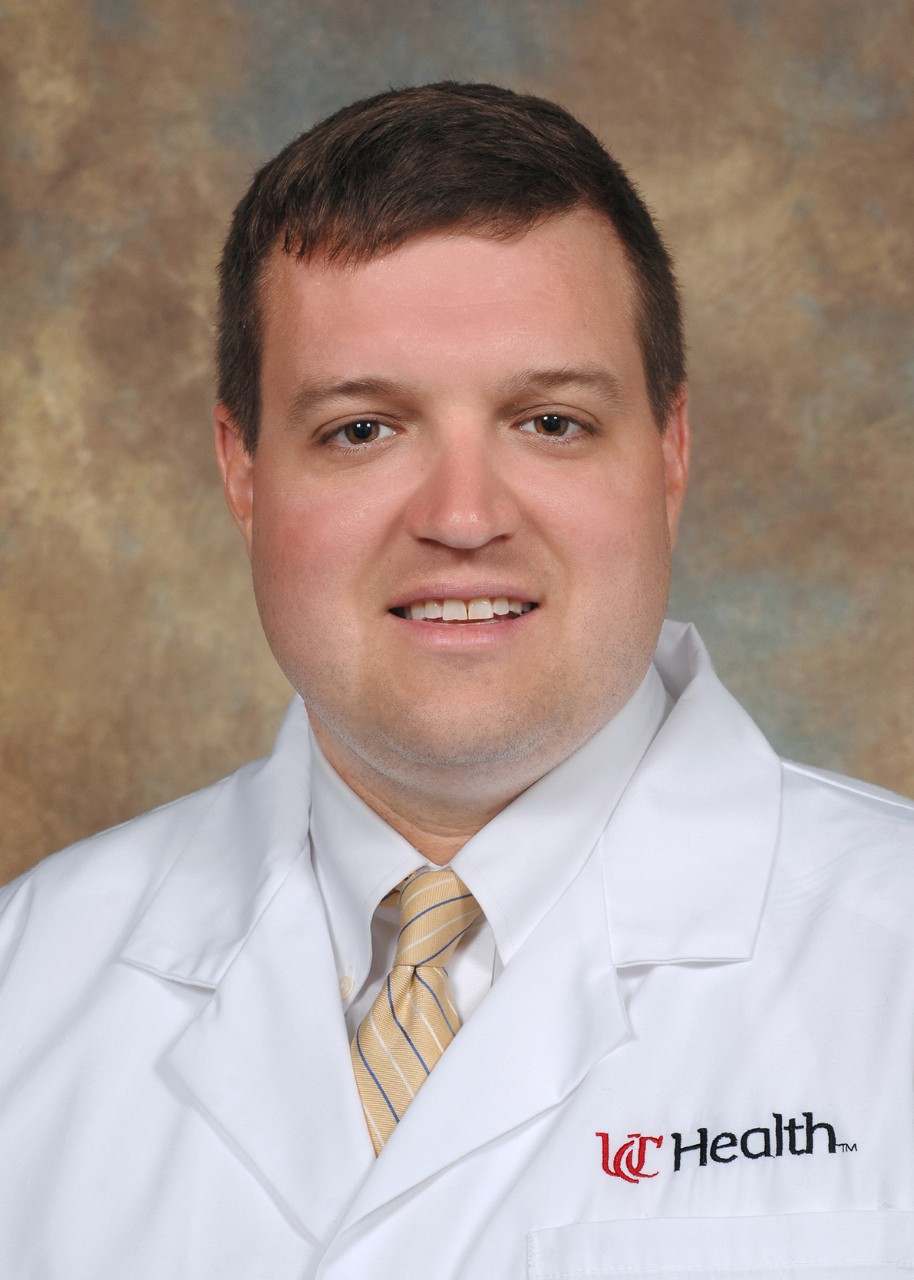
Bradley Budde, MD. Photo/University of Cincinnati.
Patients undergoing a mastectomy often receive a pectoralis nerve block (PECS block), a pain management tool containing either bupivacaine or Exparel (liposomal bupivacaine) — both of which are approved by the Food and Drug Administration to be used for mastectomy pain management.
PECS blocks can either be administered by anesthesiologists before surgery under ultrasound guidance or by the surgeon after the mastectomy while the patient is still asleep. While both drugs and both ways to administer the PECS blocks are standards of care, no study has examined the optimal combination that is best at managing pain for patients.
The trial will enroll approximately 100 patients who will be randomized to either bupivacaine or Exparel, administered either before or during surgery. Patients will also be given non-opioid analgesic medications such as acetaminophen or ibuprofen before and after surgery to help manage their pain.
Patients undergoing single or double mastectomy for breast cancer treatment or as risk reduction for breast cancer are eligible to enroll — regardless of whether they are having reconstruction.
“The idea is how can we add different things to this so that we don’t need to use opioids exclusively, which is the way things were 10, 20 years ago in health care,” said Budde, a Cancer Center physician researcher and associate professor in the Department of Anesthesiology in UC’s College of Medicine. “If we can minimize the amount of opioids they use, patients will ultimately do better. I think this is a really cool approach to see if timing matters and if the medication used matters.”
Alicia Heelan, MD. Photo/University of Cincinnati.
In addition to the primary goal of maximizing patient pain control and minimizing the need for opioids to manage pain after surgery, researchers will study how the different combinations affect patient satisfaction, time of surgery and time in the hospital, among other metrics.
“I do emphasize with patients that these are all standards of care and we’re still going to treat their pain. It doesn’t mean that if they’re enrolled in the study that we’re not going to give them pain medications,” said Heelan, a Cancer Center physician researcher, vice chair for quality and assistant professor in the Department of Surgery in UC’s College of Medicine. “We’re trying to take away some of the pain as much as we can when it’s already a tough process.”
Budde noted even if all combinations of delivering PECS blocks are found to be equally good at managing pain, it is useful for clinicians to know moving forward.
The Cancer Center’s Pilot Project Award Program pools funding from several sources to offer two streamlined funding cycles per year that are designed to be easy to navigate for researchers and reviewers. One of the program’s goals is to increase collaborative interactions across disciplines to foster innovative research such as this trial.
“The grant was a great opportunity to move forward and be able to conduct the study, because I certainly know I couldn’t do it without the resources of the grant,” she said. “That really allowed us the opportunity to conduct the study.”
For more information on eligibility or how to enroll in the trial, please call 513-585-8222.
Stay connected with the Cancer Center
Interested in learning more about the University of Cincinnati Cancer Center? Keep up to date by signing up for communications and newsletters based on your specific interests. Sign up for Cancer Center communications.
Featured photo at top of pink Breast Cancer Awareness ribbon. Photo/Lludmila Chernetska/iStock.
Related Stories
UC aerospace engineer leads global computational fluid dynamics taskforce
October 21, 2026
The American Institute of Aeronautics and Astronautics' CFD 2030 Integration Committee has announced the formation of the Computational Fluid Dynamics (CFD) Vision 2045 Team, a multi-institution working group tasked with defining where the field of computational fluid dynamics should be by 2045 to align with the changing and evolving needs of the aerospace industry. The University of Cincinnati's Prashant Khare, Bradley Jones professor and head of the Department of Aerospace Engineering, is leading this specialized group.
Still the top ‘cat
October 20, 2026

The University of Cincinnati Bearcat mascot was voted Cincinnati’s favorite mascot in a Cincinnati Enquirer reader poll, earning 45.1% of the vote and topping other local favorites.
How will Ohio's minimum wage bump impact businesses and their employees?
October 20, 2026

UC economist Michael Jones spoke to WVXU's "Cincinnati Edition" on if Ohio's latest minimum wage increase will actually impact employees and businesses as inflation continues to rise.