
UC celebrates Earth Day with greener, bolder moves
New tree groves, bike programs, public engagement boost a year of sustainability on campus, beyond

At the University of Cincinnati, Earth Day isn’t just a moment on the calendar — it’s a mindset. From bioswales to bike shares, from faculty-led public science initiatives to community hikes, UC is digging deep into sustainability, quite literally reshaping the campus landscape.
This year, UC’s Earth Day celebrations honor a growing portfolio of eco-conscious achievements that stretch across the main and regional campuses. In a university-wide effort that bridges environmental science, design and community action, Bearcats are proving that green isn’t just a color — it’s a culture.
Where invasive insects once left a hillside bare near Langsam Library, a new grove of 19 trees now stands tall, planted by student volunteers as part of a campuswide tree restoration effort. This project, completed in March, transforms the site of once-decimated ash trees into a living example of urban resilience. New ground cover plantings, selected to absorb runoff and fight erosion, flank the grove — quietly combating climate change, one root system at a time.
This is just one piece of a growing arboreal puzzle. UC’s landscape architect John Martini has helped lead multiple tree-planting events this spring, culminating in the university being named a “Tree Campus USA” by the Arbor Day Foundation for the third year in a row. The national designation, set to be formally awarded on April 24, recognizes campuses that effectively manage their trees and engage students in conservation.
Microforests, rain gardens and more
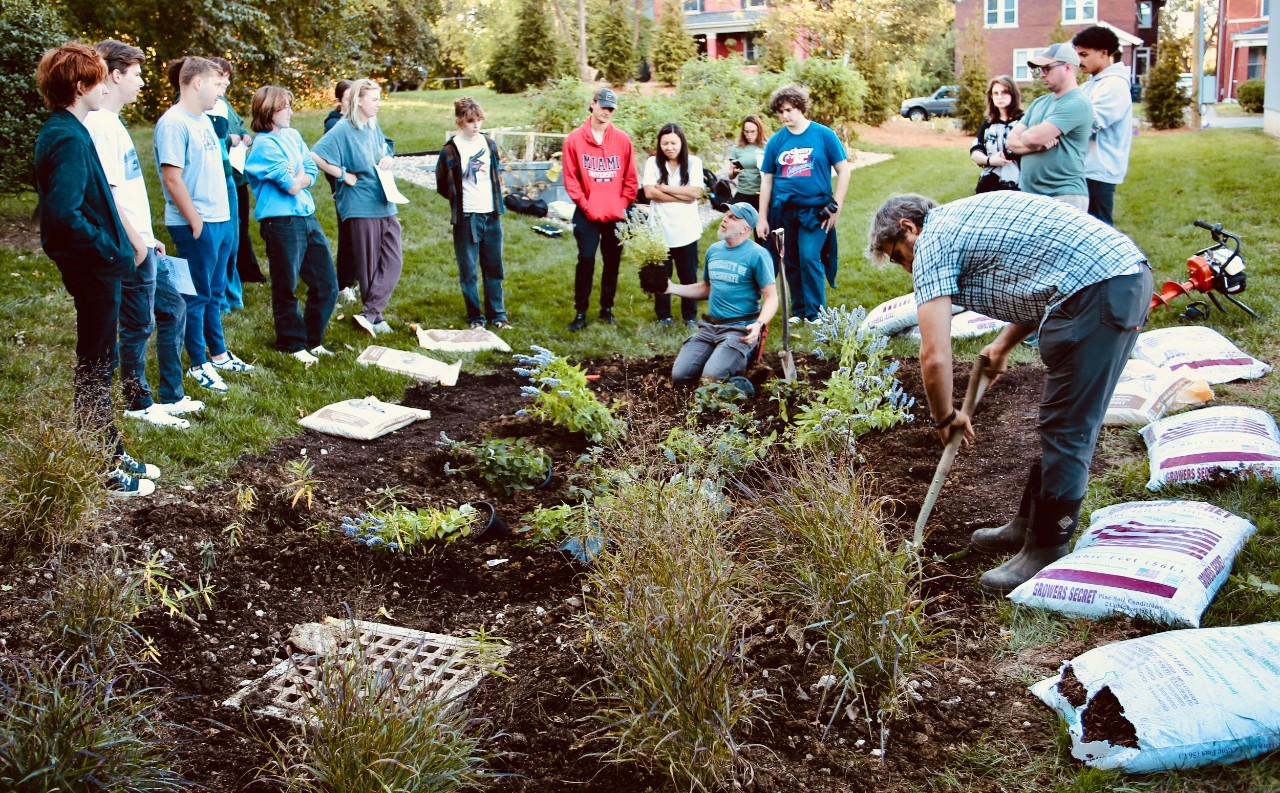
Professor Brian Grubb (plaid shirt on right) helps prepare the soil as horticulture instructor James Hansel (kneeling) explains how established root systems in rain gardens can enhance water filtration and storm water management. Photo Melanie Schefft
The commitment to sustainability is built into UC’s very foundation — literally. Across campus, rain gardens, bioswales and gold and silver LEED-certified (Leadership in Energy and Environmental Design) buildings serve as testaments to environmentally mindful design. These aren’t just features; they’re functional responses to stormwater runoff, heat island effects and habitat loss.
Now, the university is planting microforests — densely packed groves of native trees that grow quickly and support biological variability. Ralph Brueggemann, adjunct professor at UC’s College of Engineering and Applied Science says, these living labs allow students to learn from, and within, the landscape.
Two wheels, infinite possibilities
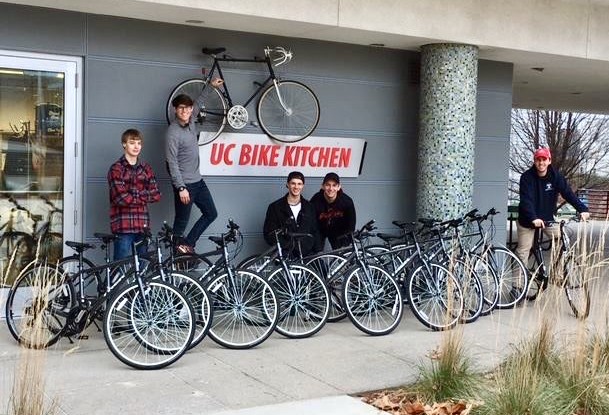
UC's Bike Share Program is located in the Bike Kitchen inside Daniels Hall. Photo provided
Meanwhile, UC’s Office of Sustainability is keeping students mobile and eco-friendly. In the coming months, 10 to 15 new bicycles — complete with helmets and bike locks will be added to UC’s Bike Share Program. Drop into UC’s Bike Kitchen and use your Bearcat card to enjoy one of the university’s sustainable transit options to the campus community.
And for those less interested in cycling and more into recycling: Bearcat Recycling was in full swing inside the Fifth Third Arena during basketball season and will roll right through the football calendar throughout Nippert Stadium, underscoring the university’s commitment to waste reduction.
New model for public engagement with science
Sustainability at UC goes beyond trees and trash — it lives in classrooms, labs and public forums. The UC Center for Public Engagement with Science (PEWS) is pioneering a shift in how science connects with society. Moving past just fact-sharing, PEWS emphasizes back-and-forth dialogue and an understanding of how science interacts with politics, trust and culture.
With monthly events throughout the Tristate region, the center is bringing science into community conversations. One such project: a pilot grant awarded to Assistant Professor Sangyong Cho of UC’s College of Design, Architecture, Art, and Planning helped develop low-cost environmental sensors. Developed in collaboration with community groups and public health experts, the sensors offer a window into neighborhoods known as environmental justice areas in Cincinnati, particularly those that are most at risk from toxic exposures such as air and water pollution.
Honoring champions of change
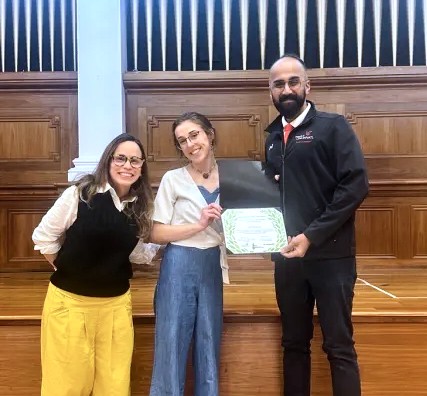
UC alum and staff member Sid Thatham receives the 2025 UC Sustainability Staff Award. Photo provided
This year’s UC Sustainability Awards recognize those making the green vision a reality. Winners include:
- Sid Thatham (Staff Award)
- Victoria Carr and Bob Hyland (Faculty Awards)
- Daniel Murphy (Research Award)
- Sofia Ferrigolo (Student Award)
Their work reflects the university’s core values of academic excellence, urban impact and innovation — all grounded in sustainability.
Celebrate outside the classroom

Earth Day events include hikes through Burnet Woods and exploring restored streams and birding habitats with Green Umbrella. Photo Gaspar Zaldo courtesy of Unsplash
The celebration extends beyond the classroom and campus this week:
Greenspace hike at Twin Creek Preserve (April 18, 3-4 p.m.)
Explore restored streams and birding habitats with local collaboratives Green Umbrella and Mill Creek Alliance.Spring Fest 2025 at Burnet Woods (April 19, 12-4 p.m.)
Live music, yoga and nature education turn one of Cincinnati’s oldest parks into a green gathering ground.Barrows Conservation Lecture Series (April 30, 7 p.m.)
Join wolf expert Rick McIntyre at the Cincinnati Zoo for a deep dive into Yellowstone’s wolf packs.
Looking ahead, UC is also a key planning partner for the Midwest Regional Sustainability Summit, taking place June 5. With more than 650 attendees expected, the summit unites entrepreneurs, government leaders, scholars and ordinary people around practical solutions for a sustainable future.
As UC continues to lead by example — from planting roots to planting ideas — its Earth Day message rings clear: Sustainability isn’t a sideline, it’s the main event.
Featured image at top: Hands holding new flora growth. Photo by Noah Buscher courtesy of Unsplash
Impact Lives Here
The University of Cincinnati is leading public urban universities into a new era of innovation and impact. Our faculty, staff and students are saving lives, changing outcomes and bending the future in our city's direction. Next Lives Here.
Related Stories
UC Foundation celebrates 2026 philanthropy winners
October 23, 2026
The University of Cincinnati Foundation recognized its Outstanding Philanthropic Volunteer Award honorees at the George Rieveschl Recognition Dinner on October 22, 2026.
UC Biomedical Engineering student launches mobile healthcare platform
October 22, 2026
As a fifth-year biomedical engineering student at the University of Cincinnati College of Engineering and Applied Science, Amelia Wares has been a trailblazer in nearly every area imaginable — and this is only the beginning of her journey.
UC aerospace engineer leads global computational fluid dynamics taskforce
October 21, 2026
The American Institute of Aeronautics and Astronautics' CFD 2030 Integration Committee has announced the formation of the Computational Fluid Dynamics (CFD) Vision 2045 Team, a multi-institution working group tasked with defining where the field of computational fluid dynamics should be by 2045 to align with the changing and evolving needs of the aerospace industry. The University of Cincinnati's Prashant Khare, Bradley Jones professor and head of the Department of Aerospace Engineering, is leading this specialized group.