
Spider’s visual trickery can fool AI
Like us, computers see a wasp’s face in some Australian jumping spiders

Some jumping spiders mimic predatory wasps so well that images of them can fool artificial intelligence.
The spiders look so much like wasps that scientists named them for the predatory insects, which ironically feed on spiders.
But University of Cincinnati biologists wondered: Do these mimics really look like insect faces or is it just our own perceptual bias? After all, we see faces everywhere: tree trunks, rock outcrops, clouds.
So when travel restrictions from COVID-19 shut down field research, UC biologists decided to turn to an objective third party, a computer.
They presented digital portraits of jumping spiders, praying mantises and wasps to see if a computer algorithm could identify them correctly from shapes and patterns each contained. And surprisingly even the computer was fooled about 20% of the time.
The study was published in the journal Behavioral Ecology.
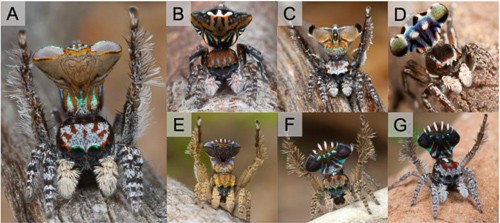
The backs of jumping spiders resemble predatory insects like wasps and praying mantises that can fool even AI. Graphic/Olivia Harris with photos by Jurgen Otto
“The original idea was inspired by one species, a peacock jumping spider called Maratus vespa, which is Latin for wasp,” UC student and study lead author Olivia Harris said.
This jumping spider lifts its abdomen during an elaborate courtship display to reveal a colorful wasp-shaped back. The illusion is made all the more realistic by raising flaps on its sides that give the spider the familiar guitar-pick shape of a wasp’s face.
Researcher Jurgen Otto discovered, described and photographed the species in Western Australia in 2015 with co-author David Knowles.
“That got us thinking,” Harris said. “Why would a spider want to look like a wasp, which is a predator of spiders, especially as a primary element of its courtship display?”
It turns out that when spiders see distant insect predators, they tend to freeze in place and give their undivided attention to the potential threat. And that attention could give male jumping spiders the opportunity they need to begin courting the female.
This is the only case we’ve found of males mimicking a predator visually.
Olivia Harris, UC doctoral student
Researchers used computer vision techniques and machine learning and neural network algorithms to see if artificial intelligence properly classifies images properly as spiders,wasps, praying mantises or flies. The AI got it wrong across all 62 species nearly 12% of the time. And it correctly identified 13 species every time.
But the AI misidentified Maratus vespa and several other spiders more than 20% of the time and typically as wasps. Researchers said the next step would be to test their hypotheses with behavioral experiments with live female jumping spiders.
Deception is not unheard of in animal courtship. Some male moths simulate the sounds of echolocating bats to discourage potential mates from taking flight. And antelopes called topi have been documented warning does of phantom predators to discourage them from fleeing their territories.
“But this is the only case we’ve found of males mimicking a predator visually,” she said.

UC Associate Professor Nathan Morehouse uses microspectroscopy to study spider vision in his biology lab. Photo/Jay Yocis/UC
UC Associate Professor Nathan Morehouse, a study co-author, said the spiders appear to be using sensory exploitation to their advantage.
“Sensory exploitation is very common. It fits in a body of theory about how animals use deception or confusion to their advantage,” Morehouse said.
These scare tactics can’t persist or the female eventually would run away or attack the intruder.
Morehouse said they found that the predator illusion works best at greater distances or in the female spider’s periphery, where she relies on eyes that see only in monochrome green. But once the male gets closer, the female’s front-facing, color-discerning eyes take over.
“Females will not be fooled forever. If they were, they would be robbed of the ability to make mate choices, which would put the species at a long-term disadvantage,” Morehouse said. “It’s beneficial for the males to break the illusion.”
To that end, Morehouse said, males typically lift their front legs, framing their colorful displays for the female while simultaneously hiding some of their more waspy features.
“They use predator cues to manage attention and put the female on her back foot — or feet,” Morehouse said. “There’s a lot of nuance to this interaction for the males to remain safe and for the courtship to have beneficial outcomes for both.”
Featured image at top: Researchers always thought the backs of some jumping spiders resembled a hornet's face. It even fools AI. Photo/Backiris/iStockPhoto

UC College of Arts and Sciences Associate Professor Nathan Morehouse studies spider vision in his lab. Photo/Jay Yocis/UC
Related Stories
UC study correlates increased physical activity with slower Parkinson’s progression
October 7, 2026
Higher levels of physical activity were associated with slower declines in thinking and memory as well as slower worsening of movement symptoms for people with Parkinson’s disease, according to a new study led by University of Cincinnati researchers published Oct. 7, 2026, in Neurology.
Should we appreciate bats?
October 6, 2026
UC associate professor Joe Johnson explains why bats matter during Bat Appreciation Month and invites the public to Ohio Bat Fest, where families can learn about bat conservation, ecology and wildlife research.
UC Clermont's Valentine Johns expands student support through AI
October 6, 2026
Valentine Johns, PhD, associate director of the UC Clermont College Learning Commons, was inspired to champion artificial intelligence through its potential to make academic support more accessible and responsive to students’ needs.