Cancer Center researchers scrutinize effects of higher, more precise radiation
Altered approach to treating pancreatic cancer tested in Phase 3 NRG Oncology trial

The University of Cincinnati Cancer Center is a site for a new Phase 3 national clinical trial testing a higher, more precise dose of radiation therapy for patients with locally advanced pancreatic cancer.
Jordan Kharofa, MD, site principal investigator at the Cancer Center, said tumor location disqualifies many patients in this cohort from surgery.
Current standard of care includes chemotherapy alone or in combination with a low dose of radiation, but Kharofa said these treatments typically only slow down tumor growth and have not shown a significant impact on patient survival. For patients in this cohort, three-year survival rates are approximately 15%.
“There’s really been no great standard to treat these patients,” said Kharofa, senior advisor and chair of the Protocol Review and Monitoring System at the Cancer Center and professor and vice chair of research in the UC College of Medicine’s Department of Radiation Oncology.
Current radiation treatments for these patients are limited to low doses to protect healthy surrounding tissues and organs, including the bowel. But a new radiation technique has doctors place markers on the tumors endoscopically to more precisely target the tumors mid-treatment with confidence that they are not harming the bowel.
“We’ll have the patient hold their breath, typically, and while they’re holding their breath, we can see on the X-rays while they’re on the machine that the markers are in exactly the right spot,” Kharofa explained. “So with all that confidence in localization, we can increase the radiation dose. We can carve various deep shapes around the bowel, and with more confidence deliver these ablative, or cancer-killing, radiation doses.”
There’s a lot of excitement about this, and hopefully it will become a standard option if it’s successful.
Jordan Kharofa, MD
Patients enrolled in the trial will be randomized to either receive the new high-dose radiation treatment guided by the tumor markers or the current standard treatments of chemotherapy with or without standard dose radiation. Approximately 350 patients across the country will be enrolled in the trial.
“So if patients are in the randomized arm getting the newer ablative dose, the dose is high enough that we hope it can meaningfully impact the tumor compared to what we’ve been able to do in the past,” Kharofa said.
Researchers will primarily be reviewing three-year survival rates to measure the success of the trial. Kharofa said promising early results from Memorial Sloan Kettering Cancer Center, where this technique was pioneered, showed survival rates for patients with locally advanced unresectable tumors similar to those who have had their tumors removed surgically.
“There’s a lot of excitement about this, and hopefully it will become a standard option if it’s successful,” he said.
Stay connected with the Cancer Center
Interested in learning more about the University of Cincinnati Cancer Center? Keep up to date by signing up for communications and newsletters based on your specific interests. Sign up for Cancer Center communications.
The trial is sponsored by NRG Oncology. For more information on trial eligibility and enrollment, please call 513-585-8222.
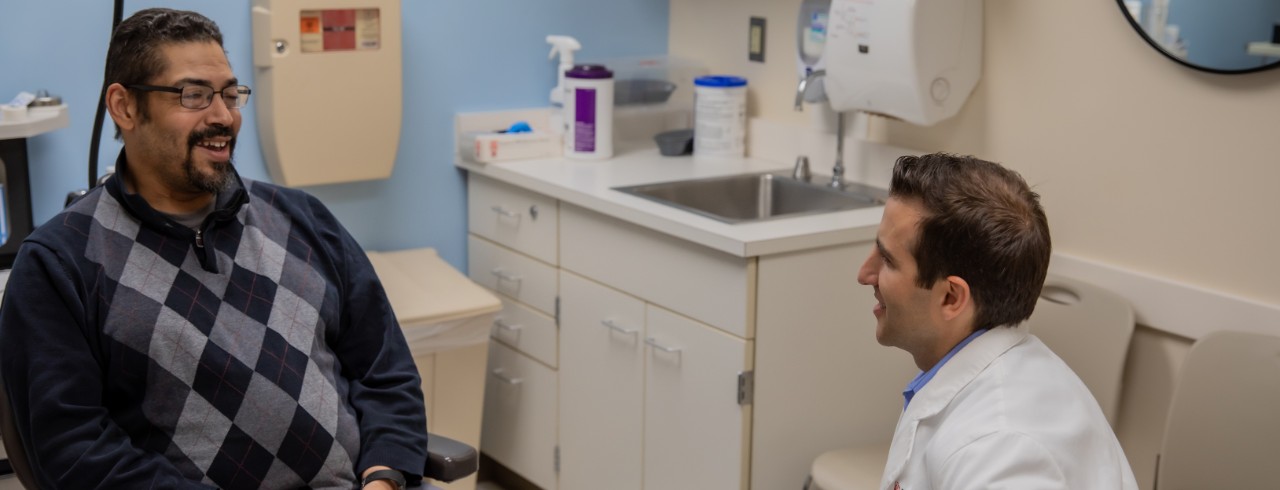
Featured photo at top of Kharofa with a patient. Photo/UC Health.
Related Stories
How phone scammers use your own voice against you
September 18, 2026

The Wall Street Journal recently did a deep dive on how artificial intelligence is making scamming people over the phone much easier, citing research by Kimberly Hyun, assistant professor of marketing at UC’s Lindner College of Business.
UC Blue Ash to host two fall open houses
September 18, 2026
The University of Cincinnati Blue Ash College will host its fall open houses on Thursday, Oct. 15 and Thursday, Nov. 5. Both events will be from 5-7 p.m. in Muntz Hall on the UC Blue Ash campus.
Gas prices spike... Again
September 18, 2026

UC economist Gary Painter goes through the tactics companies use to keep their consumer bases amid rising oil costs.