UC pride on display at Bearcats/Innovate Philadelphia
Accomplished alumni connect, reflect and explore collaboration

One doesn’t need to search hard for a common thread uniting accomplished, Philadelphia-based professionals in the business, academic, music, athletics, and medical fields: a shared affinity for the University of Cincinnati.
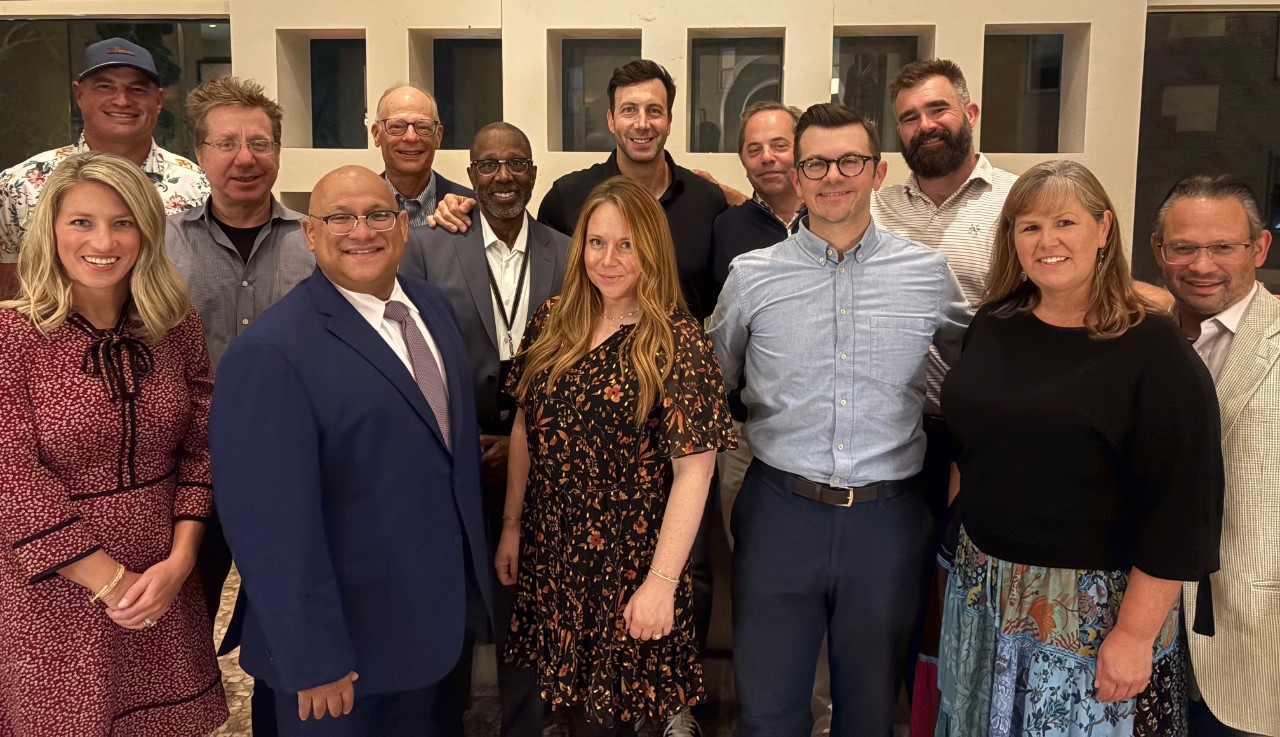
Earlier this fall, 11 Bearcats who’ve put down roots in the City of Brotherly Love gathered for a Bearcats/Innovate alumni dinner event. On the menu: discussion of their respective professions; the past, present and future of their alma mater; higher education’s shifting landscape; and potential avenues for collaboration.
Attendees included graduates and former students from Arts & Sciences, the Carl H. Lindner College of Business and College-Conservatory of Music.
- Connor Barwin, A&S ’18, Head of Football Development and Strategy, Philadelphia Eagles; Retired NFL Player
- Brent Celek, Bus ’07, Brent Celek Real Estate; Retired NFL Player
- Dave Corwin, Bus ’82, AVP Tax, CHUBB (Retired)
- Curtis Gregory, PhD, A&S ’84, Associate Professor of Management, Temple University
- Jason Kelce, Bus ’10, Co-host, New Heights podcast; Analyst, ESPN Monday Night Countdown; Retired NFL Player
- Dara Morales, CCM ’96, ’98, Assistant Principal Second Violins, Philadelphia Orchestra
- Jesús Morales, CCM, Member, Dalí Quartet
- Ricardo Morales, CCM, Principal Clarinet, Mito Chamber, Saito Kinen and Philadelphia Orchestras
- Stephen Porter, Bus ’08, Executive Vice President, Winnie Capital; Partner, Beahr
- Mark Strobeck, PhD, Med ’99, CEO/Founder, Rockwell Medical
- Karl Zipser, CCM ’85, Web Development
Post-event, a handful of attendees were polled to share their takeaways, as well as individual questions related to their professional field and/or UC.
Aside from a shared affinity for UC, what do you feel were the common threads shared between attendees?

Dara Morales, CCM '96, ’98, Assistant Principal Second Violins, Philadelphia Orchestra. Photo provided.
Dara Morales: “As we were talking, I became aware of how many commonalities there exist in the pathways of professional athletes and musicians, and really, specialists of any genre. We had all invested so much time in our areas becoming excellent before college, and our opportunities at UC launched us into the professional arenas (quite literally for the athletes). UC found that balance for us as to how to negotiate our schedules to have enough time to specialize, while giving separate time to experience a liberal arts education in the larger university setting.”
- Curtis Gregory: “What stood out to me was a shared commitment to preparing the next generation of students for success beyond graduation. Many attendees emphasized the importance of equipping students with strong foundational skills — such as effective communication, financial literacy, critical thinking, and emerging competencies in generative artificial intelligence.”
- Stephen Porter: “Every city thinks it is special, and many are. But I've lived all over and can say that Philadelphia is truly one of a kind. I got the strong impression that everyone in attendance either moved to Philadelphia, or decided to stay in Philadelphia, out of choice rather than obligation. It's rich with history, culture, and food, and also incredibly challenging. I'm a believer that those things go together. The most interesting places are born of the tension brought on by complexity and diversity. The same could be said of people.”
- Mark Strobeck: “The night was an amazing collection of graduates that have used their UC education and experiences to follow their passions into successful careers in many different fields.”
As a CEO, how do you view co-op and experiential learning as potential separating factors for students?

Mark Strobeck, PhD, Med ’99, CEO/Founder, Rockwell Medical. Photo provided.
Mark Strobeck: “Co-op and experiential learning are critical to set students apart during the job recruiting and interviewing process. A student having spent time working in a company, gaining real-world experiences, reduces the early education process time when entering a new job and allows both the employer and employee to hit the ground running making the hire more valuable for the company. It's one of the most distinguishing factors a student can bring to an employer and at our company, we look specifically for students with co-op experience when we seek to hire.”
As someone whose career path has been defined by interdisciplinary collaboration, how would you characterize the importance of this skillset to current/prospective students?
Stephen Porter: “It's everything. Even experts rely on collaboration across fields and disciplines. Many people leave college with a narrow view of the professional world because they've spent the prior few years focused on a major while primarily surrounded by classmates studying similar subjects. That's not a great model to prepare for the next phase of life in the modern economy. Students at UC have the opportunity to get ahead, though, through the amazing co-op program, and also through proactive engagement across colleges. One of the most formative experiences of my time at UC was a studio between the Lindner College of Business and the industrial design program in DAAP. It was incredibly challenging for a finance student like me to work with a design student on a graded project, given our intense differences in temperament and background. It was absolutely formative, and I'm so thankful to have had that experience when I did.”
How can you tell the difference between students who have co-op'd and/or have real-world experience, and those who have not?

Curtis Gregory, PhD, A&S ’84, Associate Professor of Management, Temple University. Photo provided.
Curtis Gregory: “Over the years, I have consistently observed a meaningful difference between students with significant real-world experience and those without it. Graduate students, for example, often enter their programs with clearly defined goals and a strong sense of purpose, which translates into higher levels of accountability, professionalism, and engagement in the classroom. Similarly, undergraduates who participate in robust cooperative education programs frequently demonstrate many of these same qualities. They approach their studies with greater focus, adaptability, and maturity, often bridging the gap between traditional undergraduate and graduate-level expectations.”
How do you see CCM preparing the next generation of musicians, and how is it evolving to keep classical music relevant for today’s students and audiences?
Dara Morales: “As I am navigating the college selection process with my current high school violin students, CCM is such an excellent choice because of this balance: a tight-knit conservatory at the highest level, embedded in a large university where you can escape into anonymity temporarily for your general education classes. However, to reach the uppermost echelons of the classical music industry, nothing substitutes for practice time, ensemble experience and rigorous coaching. Helping music performance majors stay focused on reaching their personal potential by creating the space and having the time needed to do that is crucial. Maintaining the world-class faculty of musicians and bringing in top guest artists to collaborate enables students to see their own pathway to a professional career. And CCM does all this at a much more competitive tuition cost, a secret not widely known across the industry.”
How do your UC experiences continue to influence your work and commitment to community impact?

Connor Barwin (right) with UC President Neville Pinto at a commencement ceremony. UC file photo.
Connor Barwin: "The values that I learned at UC — leadership, collaboration and service — still guide everything I do. My work revitalizing neighborhoods through the Make The World Better Foundation not only strengthens Philadelphia, but also exemplifies how UC alumni can use their education to make a difference. Further, UC’s continued innovation and excellence have only increased the value of my degree, which only bolsters my pride as an alumnus."
This is how breakthroughs happen
Your generosity has illuminated what’s next: Student success beyond the classroom. Bearcats winning on the Big 12 stage. The gift of discovery for the health of our community. When you give to the University of Cincinnati and UC Health, you invest in the problem-solvers of tomorrow.
Featured image (top row, from left): Brent Celek, Karl Zipser, Dave Corwin, Curtis Gregory, Connor Barwin, Mark Strobeck and Jason Kelce. Bottom row, from left: Lauren Jacquot, Ricardo Morales, Elaine Cox, Stephen Porter, Dara Morales and Jesús Morales. Photo/Grant Freking. Alumni answers may have been edited for length and/or clarity.
Related Stories
These teeny spiders are social media stars
August 28, 2026

The New York Times turned to a University of Cincinnati professor to explain the appeal of jumping spiders on social media.
Campus buzz returns as UC students experience their first week
August 27, 2026
Near-perfect weather, record first-year enrollment, Thrifty Move-In and a packed Involvement Fair mark the University of Cincinnati’s first week back as thousands of Bearcats move into campus housing.
UC Real Estate Center appoints new executive director
August 27, 2026
The UC Real Estate Center has announced Sean McGrory as its new executive director. McGrory succeeds Carl Goertemoeller, who retired.