
Parakeets ‘test waters’ of new relationships
It’s not easy to make new friends. This bird can show us how

Making new friends has its challenges, even for birds.
Researchers at the University of Cincinnati found that monk parakeets introduced to new birds will “test the waters” first with potential friends before approaching a potential friend and avoid risking increasingly dangerous close encounters that could lead to a painful or injurious bite.
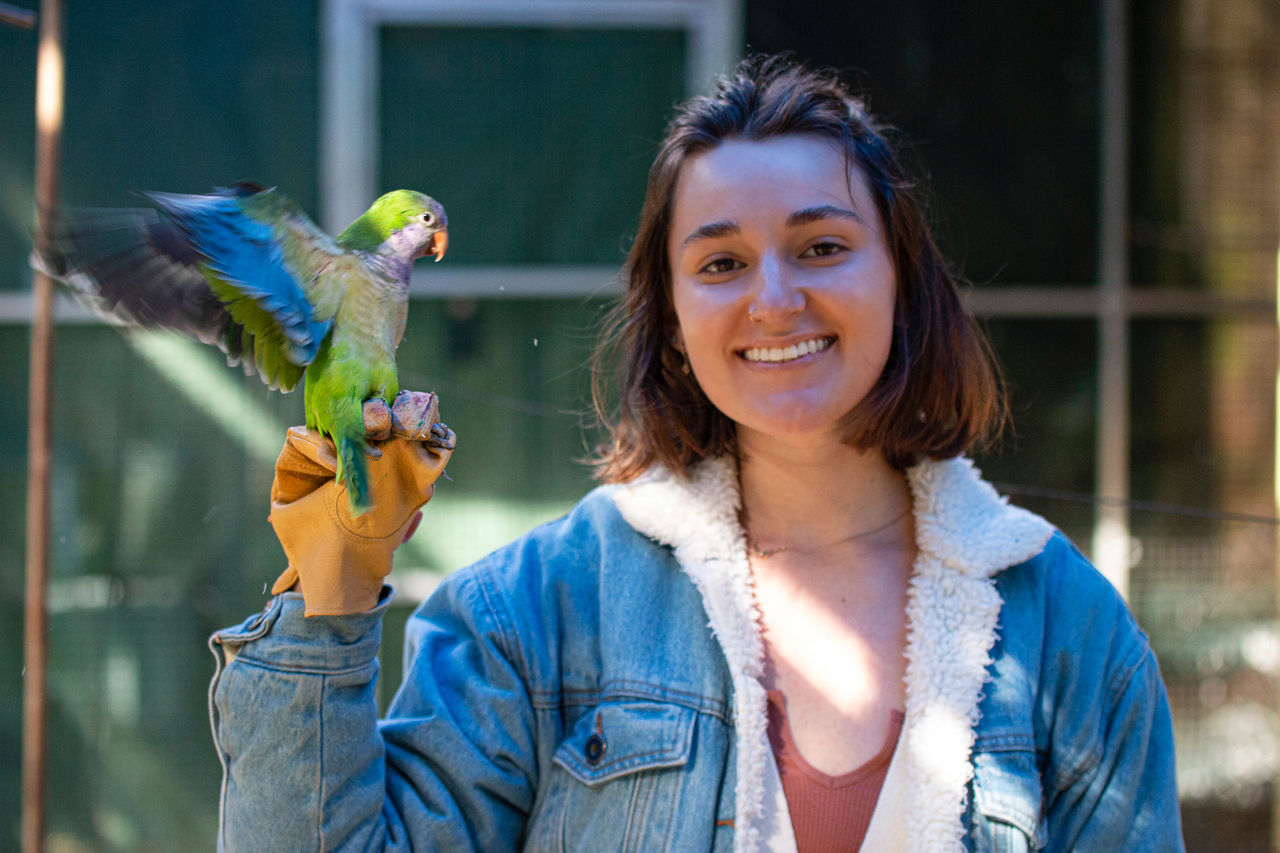
UC student Claire O'Connell holds a monk parakeet. O'Connell is studying the fascinating behavior of these social birds in UC Associate Professor Elizabeth Hobson's lab. Photo/Provided
They gradually approach a stranger, taking time to get familiar before ramping up increasingly risky interactions. The study was published in the journal Biology Letters.
“There can be a lot of benefits to being social, but these friendships have to start somewhere. Most of us have been in situations where we share space with new people, get comfortable and gradually build up trust. The parakeets seem to do something very similar,” said Claire O’Connell, the study’s lead author and a doctoral student in UC’s College of Arts and Sciences.
O’Connell collaborated on the study with UC Associate Professor Elizabeth Hobson, former UC postdoctoral researcher Annemarie van der Marel, and Princeton University Associate Professor Gerald Carter.
“Many parrots, for example, form strong bonds with one or two other birds. Partners often spend most of their time together, preen each other, or sometimes form reproductive relationships,” O’Connell said. “Generally, maintaining these strong social bonds is associated with decreased stress and higher reproductive success.”
What’s really fascinating about testing the waters is how intuitive it feels.
Claire O'Connell, UC biology student
But making that first contact carries risk, especially when animals are unfamiliar to one another, O’Connell said.
“We often observe what we call ‘quarreling,’ which may occur if a bird’s attempt to groom another bird’s feathers is not well received,” O’Connell said. “Quarreling is a mild type of aggression, and it may deter the bird from trying to groom them.”
O’Connell said birds that don’t welcome a newcomer’s attention can react aggressively, which can lead to injuries.
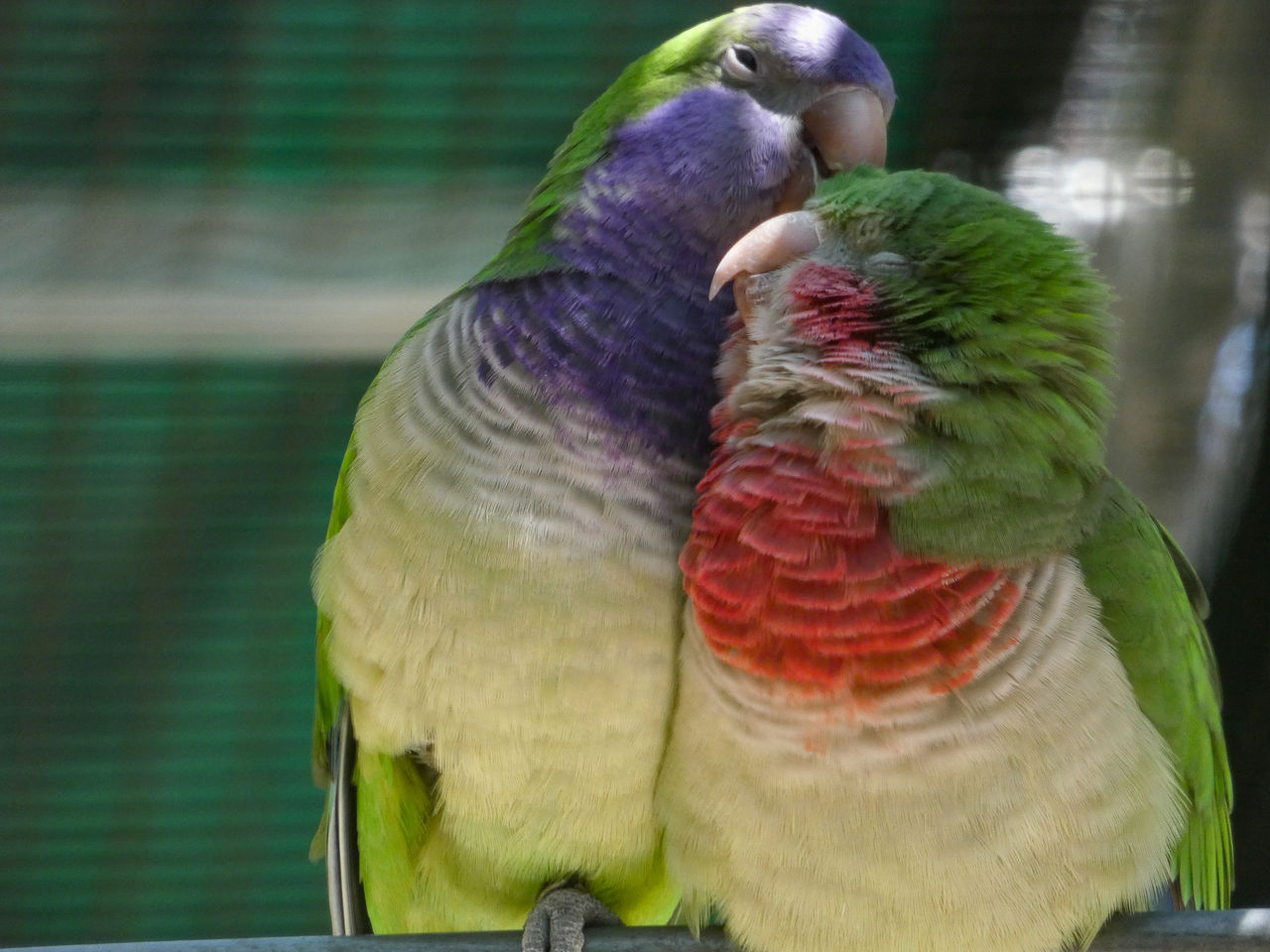
Grooming is a sign that monk parakeets are friendly toward each other. UC researchers say parakeets gradually develop close relationships over time. Photo/Claire O'Connell
Researchers combined groups of wild-caught parakeets in a large flight pen. Some parakeets were strangers to each other. They collected data on when and how new relationships formed by studying how close the birds approached over time and which birds groomed each other or engaged in other friendly behaviors.
Then they analyzed more than 179 relationships using computational methods and statistical models to determine whether relationship formation followed the pattern predicted by previous studies exploring the theory of testing the waters.
“Capturing the first moments between strangers can be challenging, so we were really excited that our experiments gave us the chance to observe that process up close,” O’Connell said.
They found that strangers were more likely to approach each other with caution compared to birds they knew. Stranger birds took time to share space before eventually perching shoulder to shoulder, touching beaks or preening others. Some strangers escalated further to sharing food or mating.
O’Connell said these tentative introductions might seem familiar to many people.
“What’s really fascinating about testing the waters is how intuitive it feels,” O’Connell said.
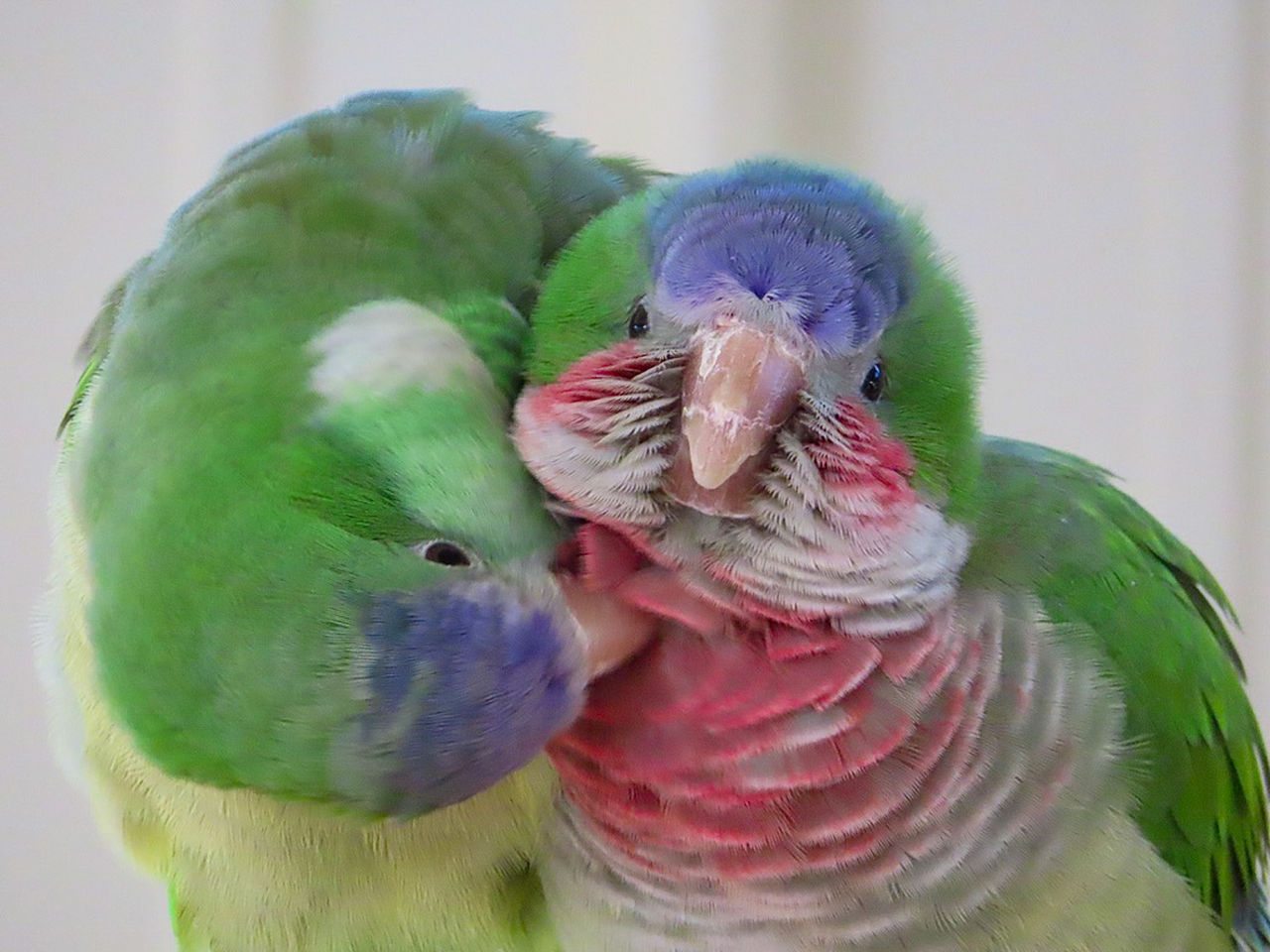
A parakeet grooms another. Researchers marked each bird with unique color combinations using nontoxic dye. Bird purple-green-green preens bird purple-orange-orange. Photo/Nina Conklin
“I can definitely relate! I started observing the parakeets shortly before I moved to Cincinnati to start graduate school,” she said. “I was excited but also a little nervous about making new friends. At the same time, I was literally watching the parakeets make new friends themselves, although some did better than others. I started realizing there may be something I could learn from the parakeets.”
The UC study had results comparable to a 2020 study of vampire bats that found that newcomers likewise test the waters, gradually escalating from social grooming relationships to food-sharing relationships with trustworthy partners. Testing the waters of relationships has an internal logic for animals that live in a complex society, she said.
“This process isn’t well documented outside of vampire bats and monk parakeets” O’Connell said. “We don’t know how common this process may be when developing new relationships in other social species.”
Studying relationship formation in other groups of parakeets, as well as in other species, can provide us with new insight into how friendship-like relationships form under a broader range of conditions.
“I am really looking forward to seeing who else may be testing the waters and what that can tell us about how animals or maybe even people build new relationships,” O’Connell said.
Featured image at top: UC researchers discovered that monk parakeets test the waters of new relationships before trying to become too familiar with strange birds. Photo/Svitlana Kolycheva/iStockPhoto

UC Associate Professor Elizabeth Hobson studies social behavior in animals such as bobwhite quail, vampire bats and parrots. Photo/Andrew Higley/UC
Related Stories
Humidity cycles steer insect behavior
June 22, 2026
UC researchers found insects track daily humidity cycles like light and temperature, responding even after humidity cues are removed in lab tests.
Parakeet males, females equally likely to fight
September 14, 2026
Researchers from the University of Cincinnati and Duke University studied captive monk parakeets and found that sex has little effect on who starts fights, who is targeted or who rises in the dominance hierarchy, as reported in Integrative & Comparative Biology.
Yahoo! News promotes UC botanist's solution for honeysuckle
February 10, 2026

Yahoo! News shared University of Cincinnati botanist Denis Conover's method for eliminating honeysuckle without using chemicals.