
Student entrepreneurship: Taking ideas to market
UC students and alumni tested business ideas at ADAAPT holiday market

When Ella Cronin unpacked her box of handmade ceramics and put them on display at a holiday pop-up shop, she had no way of knowing if anyone would want to purchase her artworks.
Her display featured approximately 30 home décor items, from coffee mugs to table lamps, that ranged from $15 to $100.
Two weekends later, the first-year University of Cincinnati student had only three items left for sale.

Ceramic home goods make by Ella Cronin nearly sold out at the ADAAPT holiday market. Photo/Cronin.
“As an artist to think that somebody cares enough this early on in my journey, and they like my stuff enough to buy it — it’s very, very rewarding,” Cronin said.
A communication design major, Cronin is one of a dozen College of Design, Architecture, Art, and Planning (DAAP) students selected to participate in the December 2025 pop-up at ADAAPT, a student-focused incubator space in Cincinnati’s historic Findlay Market.
The pop-up is one of many programs overseen through the college’s ADAAPT Innovation Studio, which helps students test, refine and showcase business ideas.
A logical move
Launched exactly a year ago, the retail space concept grew out of a vision by associate professor and DAAP creative entrepreneurial lead Steven Doehler, who sees DAAP as a student-driven “idea factory” well matched to thoughtful, meaningful shopping trends.
At the ribbon cutting, Doehler said: “At DAAP, we are fertile ground for idea cultivation. Every semester, the region’s most thought-provoking and innovative ideas sprout from our college’s classrooms in the form of conceptual reality.
For the application based holiday pop-up, participants received microgrants to cover materials, then spent weeks developing products and learning what it takes to sell them, from pricing and packaging to staffing and promotion.
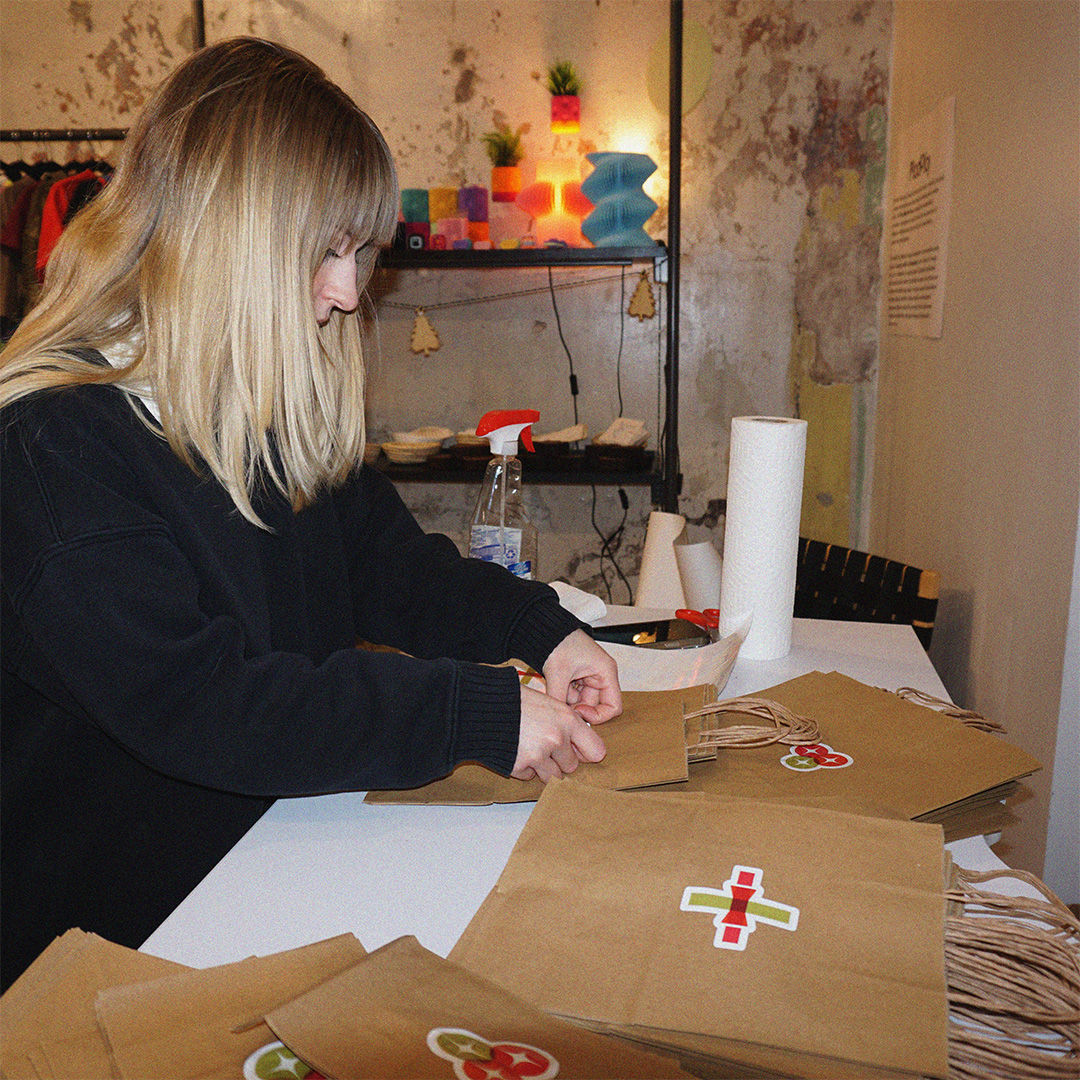
For Cronin, it was the push she needed. “I’ve actually wanted to make the lamps for at least seven years now,” she said. “This was a great time for me to kind of experiment and see what worked and what didn’t work.”
With $300 in funding for materials, Cronin said she turned a profit and now wants to explore the next steps.
“I learned that it’s feasible,” she said. “Now I’m looking at ways that I can scale up, especially the lamps. Those seem to be the biggest hit.”
Tangible first steps
That “idea-to-market” journey is exactly what Ben Booker is trying to make more visible for all UC students.
Booker, a UC alumnus who studied finance and real estate, serves as UC’s small business coordinator, splitting his time between the Center for Entrepreneurship in the Carl H. Lindner College of Business and the 1819 Innovation Hub.
UC’s programs are noted nationally, most recently earning a spot among The Princeton Review’s Top 50 undergraduate entrepreneurship programs.

Ben Booker, at Findlay Market, guides students to turn ideas into action. Photo/Booker
Booker describes ADAAPT as a student-facing space geared toward the arts and focused on creative artistry.
“It’s a dynamic retail storefront available for students and alumni to test, refine and scale their businesses,” Booker said. “People can both sell products there or can showcase and get feedback on products and projects there.”
Although he coaches students from across UC colleges and builds programs intended to reduce the friction that can keep creative students from testing their ideas outside the classroom, he keeps office hours at DAAP with a focus on the college’s students and alumni.
He said the December 2025 pop-up program was one of ADAAPT’s most tangible “first steps” — a market that brought together current students’ and alumni’s products, gave students a reason to build inventory and introduced them to the behind-the-scenes work that surrounds selling anything.
The brass tacks
For Gabrielle Ragusa, that behind-the-scenes work was the point.
A second-year Master of Landscape Architecture Degree student at DAAP who will graduate in the spring, Ragusa said she first connected with Booker after he attended a studio presentation tied to another project. She later worked with him during a summer co-op and decided she wanted to support ADAAPT’s mission.
Having a student-focused incubator space is a boon to folks of all disciplines.
Gabrielle Ragusa DAAP graduate student
This semester, Ragusa is vice president of a student chapter of the American Society of Landscape Architects. In the fall 2025 semester, she and a classmate applied for the holiday market grant opportunity alongside first-year students, with an eye toward skills building and club support.
Her group created laser-cut ornaments, Cincinnati-themed cards, garland and trinket boxes. Ragusa said the team’s product sales were modest, but she framed the experience as a practical training run for first-year students and a way to raise funds for model-making materials, conferences and professional development.
“It’s easy to see the many ways in which having a student-focused incubator space is a boon to folks of all disciplines,” Ragusa said.
She also emphasized that the pop-up’s learning value wasn’t limited to product design, but credentialing — earning their laser certifications through the 1819 Innovation Hub.
“It was a really great opportunity for folks to see how much has to happen outside of the product development portion of entrepreneurship,” Ragusa said, describing responsibilities that included packaging, staffing, tracking transactions — even finding change for the cash box.
A happy holiday
Across the broader holiday market effort, Ragusa said DAAP students collectively sold approximately $4,000 in merchandise over two weekends, with items ranging from low-cost stickers to the higher-priced lamps.
She said the standout moment was watching younger students step into entrepreneurship early, in public and in conversation with real customers.
“I think it’s a really brave thing to do to take on something of this magnitude in your very first year, very first semester of a program,” she said.
Cronin felt that same shift — the move from making something to realizing it can live in someone else’s home: “It’s gratifying,” she said.
What's next
Booker’s larger goal is to make those early wins easier to reach, even if the long-term success stories take time. He describes ADAAPT as part of a longer “entrepreneurial journey” — a series of stepping stones that can begin with pop-ups and grow into more sustained opportunities through UC’s Center for Entrepreneurship.
And Ragusa is already investigating what that next stage could look like.
“I’m experimenting with what a maker-in-residence program could look like so that we are open consistently and can keep the shelves stocked,” she said.
For students like Cronin, the next step is simpler but just as meaningful: to keep going.
Because for the first time, she says, her long contimplated idea didn’t stay on the shelf — it sold.
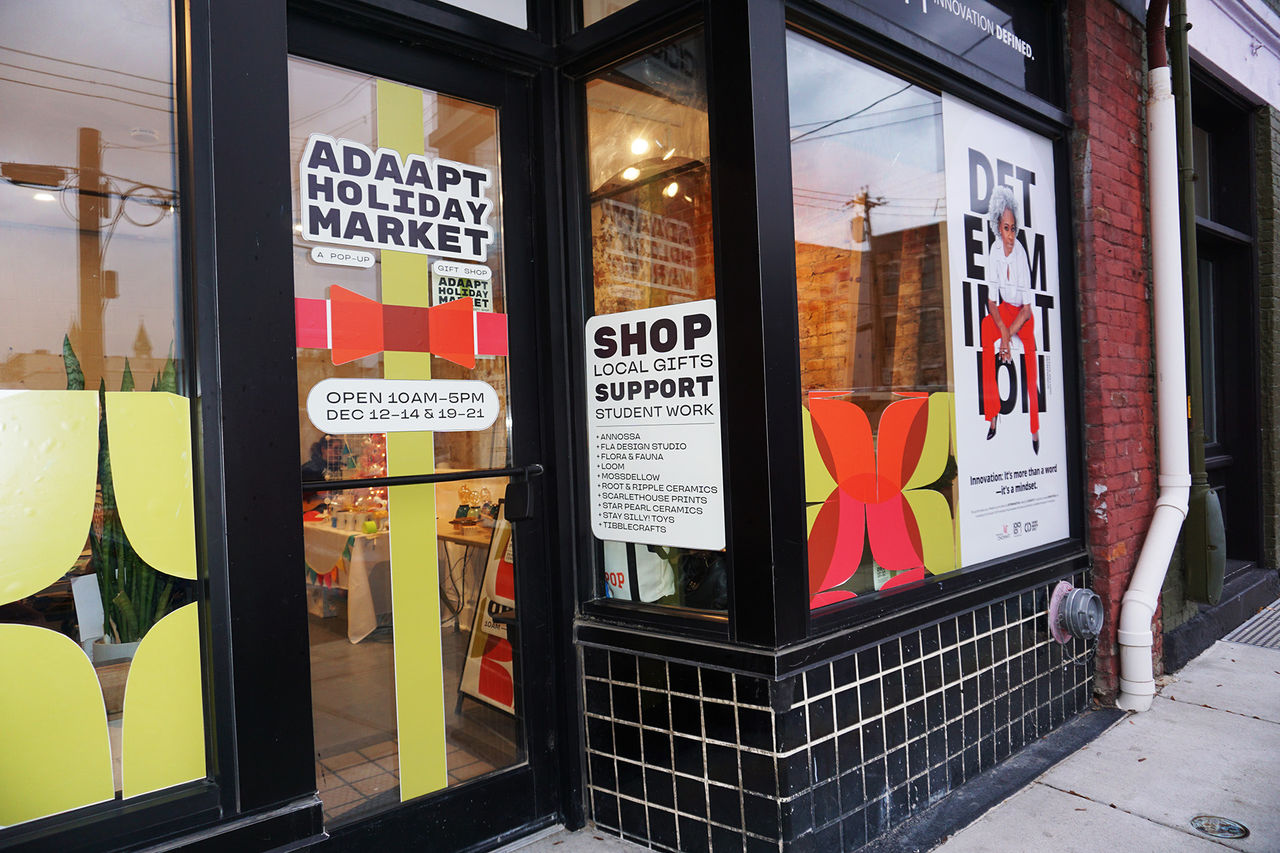
Featured image at top of ADDAPT storefront for winter holiday market. Photo/Cronin.
Your next big idea
Innovation is a daily practice at UC. The 1819 Innovation Hub is UC’s front door for industry, inventors, innovators and entrepreneurs. We foster bold thinking and collaborative breakthroughs that shape industries and improve lives — and we move at the speed of need to make them happen.
Related Stories
How the University of Cincinnati co-op program is shaping the future of work at SXSW
March 17, 2026
The University of Cincinnati served as a 2026 Workplace Track sponsor at the annual South by Southwest (SXSW) Innovation Conference March 12-18 in Austin, Texas, showcasing how co-op is redesigning the future of work.
DAAP students turn design skills into robotic solutions
August 26, 2026
Ten University of Cincinnati students joined 1819 Innovation Hub partner Sensory Robotics to test their design skills as part of the school’s Experiential Explorations Program
Co-op broadens horizons for architectural engineer
August 17, 2026
UC architectural engineering graduate Jeremy Ackley turned his co-op rotations with CMTA, a national engineering consulting firm in Texas, into a full-time role, showcasing the University of Cincinnati’s national co-op footprint.