
Scientists discover how snakes stand upright without limbs
Science outlets highlight research by UC expert on snake locomotion

Science outlets including Smithsonian magazine, Earth.com and Discover magazine highlighted a study co-authored by University of Cincinnati Professor Bruce Jayne, an expert in snake locomotion, examining how snakes can stand upright without arms or legs.
Jayne, a biologist in UC's College of Arts and Sciences, worked with physicists, mathematicians and other researchers at Harvard University on a study looking at the physics behind this remarkable ability. The research combines biology, mathematics and mechanical modeling to explain how snakes manage such a delicate balancing act.
Researchers discovered that snakes don't have to stiffen the entire length of their bodies to span a gap in a forest or reach up to a branch or ledge. Instead, the muscles become rigid near the base where the animal's weight is supported.
The key is the animal's strength in maintaining balance as it stretches up or outward, they found.
The study was published in the Journal of The Royal Society Interface.
Previously, Jayne has studied the many ways snakes navigate obstacles such as tunnels, sand dunes and branches. And in 2021 he discovered a unique way climbing snakes such as brown tree snakes scale wide-barreled objects like tree trunks or light poles that he calls lasso locomotion.
Read the Smithsonian magazine story.
Featured image at top: A cobra strikes a defensive pose. Researchers from the University of Cincinnati and Harvard University unlocked the secret behind a snake's ability to lift itself upright. Photo/DesignBase/iStockPhoto
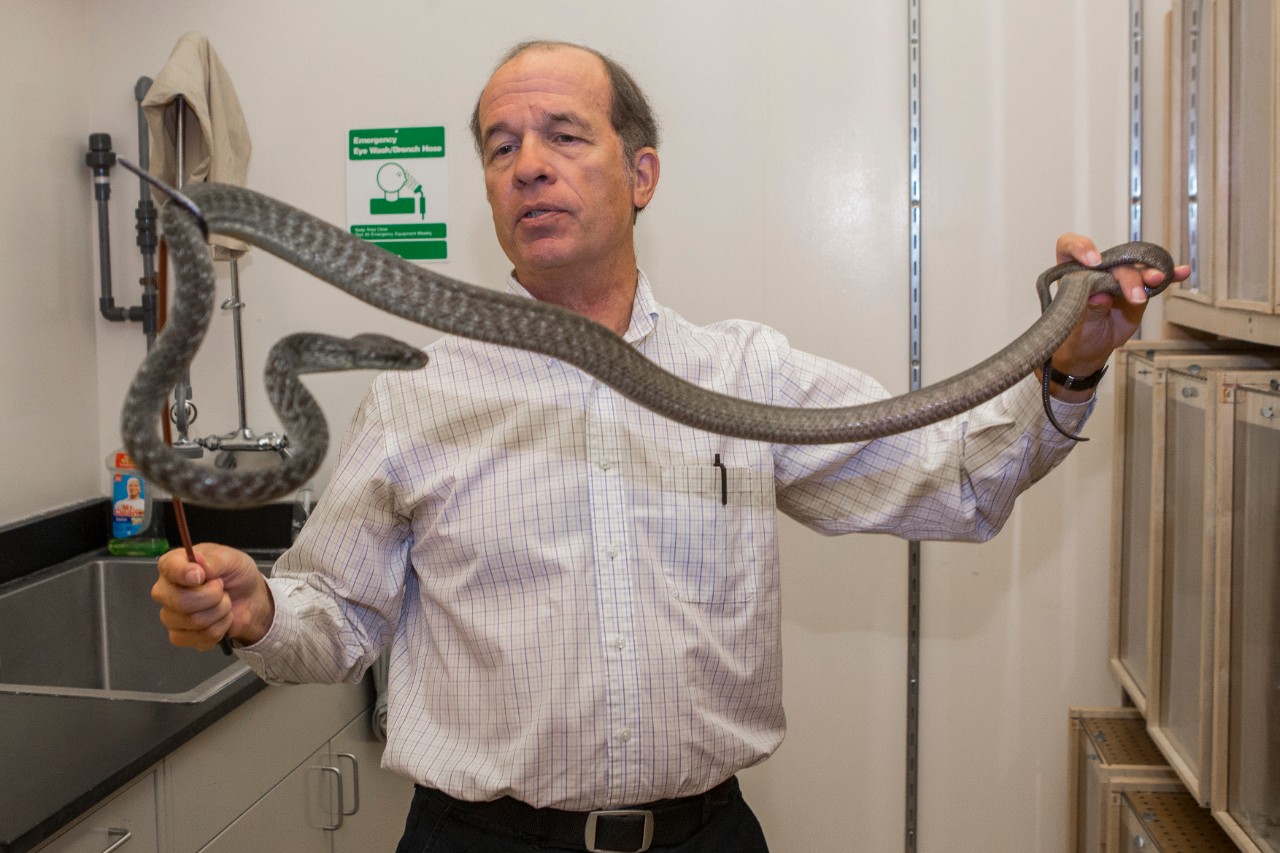
UC Professor Bruce Jayne holds a brown tree snake in his biology lab in this file photo. Jayne has unlocked many secrets of snake locomotion. Photo/Joseph Fuqua II/UC
Related Stories
These teeny spiders are social media stars
August 28, 2026

The New York Times turned to a University of Cincinnati professor to explain the appeal of jumping spiders on social media.
A robot bat sheds light on how they hunt in the dark
January 20, 2026

Popular Science and other outlets highlight an engineering-inspired biology study examining how bats find hidden prey in thick foliage at night.
This eyeless cavefish grows extra taste buds
August 21, 2024
Research led by Joshua Gross, PhD, in the UC Department of Biological Sciences, revealed the blind cavefish has a similar number of taste buds as surface fish from birth up to the age of 5 months. Then, these taste buds gradually increase in number and start appearing on the head and chin during adulthood, particularly at around 18 months of age.