
Mayor calls these UC students 'history makers'
CubeCats celebrate successful SpaceX launch of satellite they built

Cincinnati Mayor Aftab Pureval called Bearcat students “history-makers,” as reported by WCPO. And for the engineers who comprise the University of Cincinnati’s CubeCats team, the words landed at exactly the right moment.
After a week of setbacks, uncertainty and unsettled housing arrangements, the CubeCats’ compact satellite, LEOPARDSat-1, built almost entirely at the UC Ground Floor Makerspace inside UC’s 1819 Innovation Hub, launched into orbit aboard a SpaceX mission from NASA’s Kennedy Space Center, a day after Artemis II successfully landed.
29 students, 1 rocket, 0 hotel nights


CubeCats pile into the Airbnb common room, squeezed onto air mattresses and sleeping bags while navigating a full-blown housing cat-astrophe. Photo/CubeCats
Originally scheduled for April 8, the launch was delayed, an all-too-common reality in space missions.
Anticipating this possibility, the students had built in a buffer of a few extra days in Florida to stay flexible for watching the launch. When the date shifted to April 10, they were still on track, with plans to begin their 18-hour drive back to Cincinnati that same day.
But as fate would have it, the weather pushed the launch back to Saturday, April 11. The change left some students confronting an unexpected challenge: whether they would even have the means to stay an additional day to witness the moment their 10-year project finally left the launchpad.
A surprise message from home

CubeCats gather in front of the big screen the Airbnb to watch a surprise message from Cincinnati. Photo/CubeCats.
On Friday night before the launch, a few students had to pack up and head home. The moment weighed heavily on the tightly bonded team, but in true Bearcat fashion, the CubeCats responded with empathy and support for their teammates rather than frustration or disappointment.
“Every time something fell through, someone on the team would find a way to push us forward,” says Sam Kohls, CubeCats’ satellite program director. And that’s exactly what happened.
Just as emotions were running high, CubeCats president Nathan Nguyen called everyone’s attention to the TV monitor. What followed was a surprise message from Cincinnati, recorded by Mayor Aftab Pureval.
“I just wanted to say congratulations, a huge congratulations, to the CubeCats. We are so incredibly proud of you,” the mayor said. “You are history-makers, not just the first student-led satellite to launch in UC’s history, but also the state of Ohio’s history.”
For the students, who had been navigating burnout and uncertainty in the final stretch, the timing of the mayor’s message couldn’t have been better. Those preparing to leave, like Everett Metzler, were reminded that, even if they weren’t present for the launch itself, “Hearing Mayor Pureval’s message gave us a second wind. It reminded us that we were still an essential part of the moment, having contributed to this satellite project together, and being part of history in the making.”
The mayor also praised the CubeCats' role in putting Cincinnati talent on the national stage for space innovation.
Mission (almost) impossible
The CubeCats’ satellite represents both a major technical milestone and the culmination of years of design, testing, troubleshooting and late nights spent building something far bigger than themselves. “This was a hands-on engineering project where a decade of students designed and tested CubeSat-class spacecraft systems,” Kohls says. “We were learning aerospace fundamentals while contributing to a real-world space mission.”
That resilience was tested again in the final hours before liftoff. With less than 15 hours until launch, housing challenges and limited funding forced several students to vacate one of their Airbnbs, adding another layer of stress to an already emotional week.


Running on little sleep, the team rose early to arrive at Kennedy Space Center by 6:45 a.m. Only a handful of students were granted access to the NASA’s special viewing area, while others made their way to the beach to watch the rocket soar.
Meanwhile, in Cincinnati at the 1819 Innovation Hub, Bearcats gathered for a watch party, including Metzler, the student who had to leave Florida before the launch. Determined to share the moment with teammates who couldn’t be there in person, Reece Whitaker, Kevin Horstman, Mani Kuruva and Luisa Moehlecke joined live from Florida, turning their cameras toward the launch so everyone in the conference room could experience the historic view together.


‘5, 4, 3, 2, 1, liftoff!’
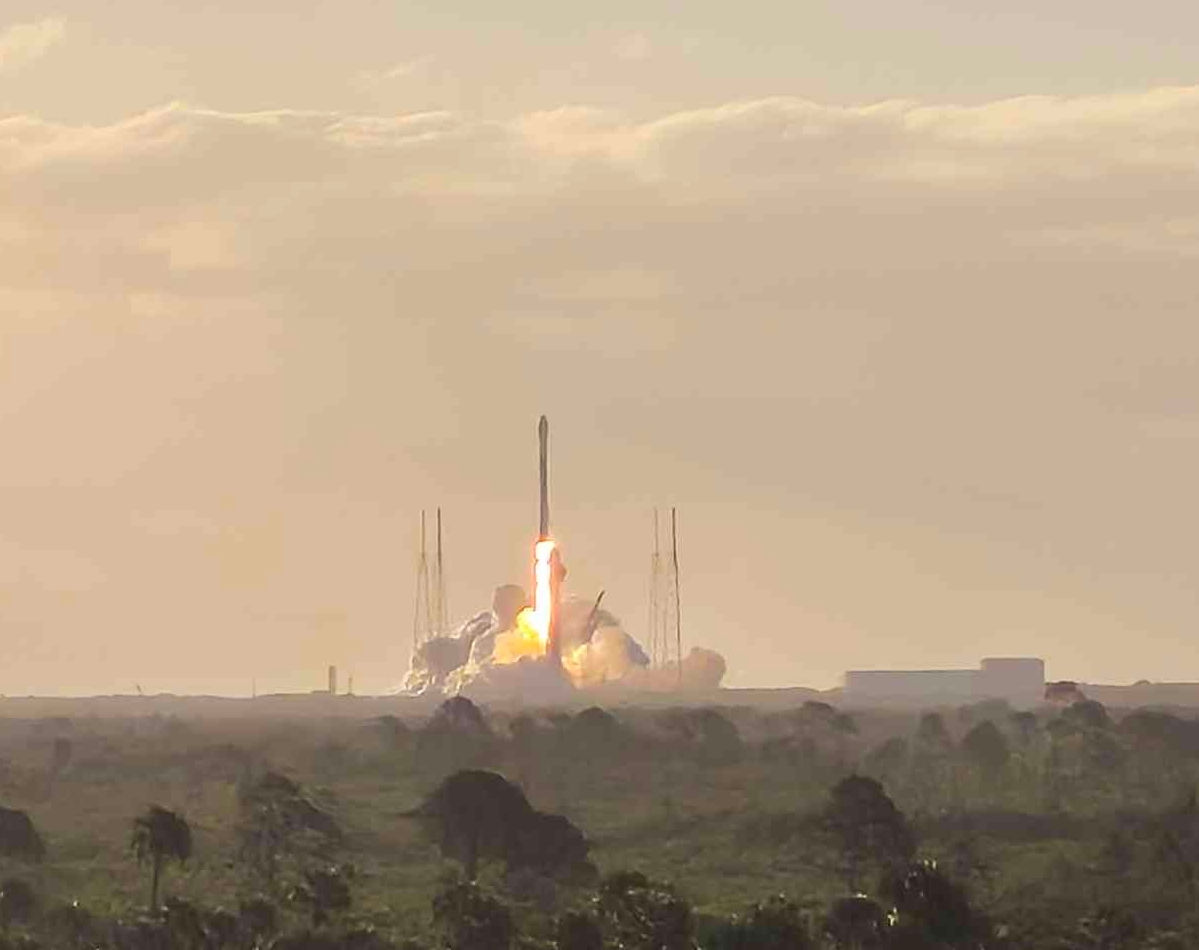
SpaceX leaves Earth with the CubeCats LEOPARDSat-1 on board. Photo/CubeCats
At T-0, the rocket roared to life. The ground trembled as a plume of exhaust engulfed the launchpad, and the CubeCats’ satellite finally left Earth aboard SpaceX.
In Florida, students lifted their phones to capture a moment that felt almost unreal: their legacy, LEOPARDSat-1, rising into the sky. Soon after, the satellite was captured by the International Space Station, where it will begin collecting data to evaluate how lightweight carbon-based composites can help shield astronauts from space radiation.
Back home at UC’s 1819 Innovation Hub, the room erupted in cheers and high-fives as relief and pride swept through it. The launch marked a defining moment for the team.
"It was one of the most fulfilling things in the world to see it all come together,” says Mike Carovillano, an MBA student who heads sponsorships and corporate relations for CubeCats. “And the looks on all the students' faces and all your friends and colleagues as almost a full decade of work blasts into space and makes history."


There were cheers. There were tears. And there was a shared understanding that something permanent had just happened, not only in space, but in their own lives. The CubeCats are now forever connected through a project spanning nearly a decade.
"We are touching the realms of impossibility and pushing that boundary as far as possible,” Nguyen says. "If you told me five years ago that we'd actually send something into space and put our 'own star into the night sky,' that's not something that I would have imagined that I would be ever doing.”
Being called “history-makers” wasn’t just a compliment from the mayor of Cincinnati.
It was a summary of everything the CubeCats had already become.
Cover image: CubeCats tour Kennedy Space Center. Photo/CubeCats
Innovation Lives Here
The University of Cincinnati is leading public urban universities into a new era of innovation and impact. Our faculty, staff and students are saving lives, changing outcomes and bending the future in our city's direction. Next Lives Here.
Related Stories
UC Aerocats soar to new heights in elite flight competition
March 30, 2026
The University of Cincinnati Aerocats club built a plane from scratch and flew it all the way to a fourth-place finish in the regular class during the SAE Aero Design East Competition in Lakeland, Florida.
1819 makerspace transforms into innovation boot camp
January 21, 2025
Kinetic Vision selected the Ground Floor Makerspace at UC’s 1819 Innovation Hub as the perfect place to provide Bearcat co-ops with advanced engineering skills.
UC CubeCats satellite makes hiss-tory at NASA
April 2, 2026
UC Students Launch First Satellite April 8. Help Send Bearcats to NASA Liftoff as they make history for UC and Ohio.