
Bringing deadly ‘Sweeney Todd’ to life
All hands on deck for CCM’s cross-discipline production

“Sweeney Todd: The Demon Barber of Fleet Street” not only stars the titular “demon” barber, but is famously a monster of a show.
It’s such a grand team lift across its dozens of cast members, special effects and a multistory set that most productions cut it down to a small-scale adaptation.
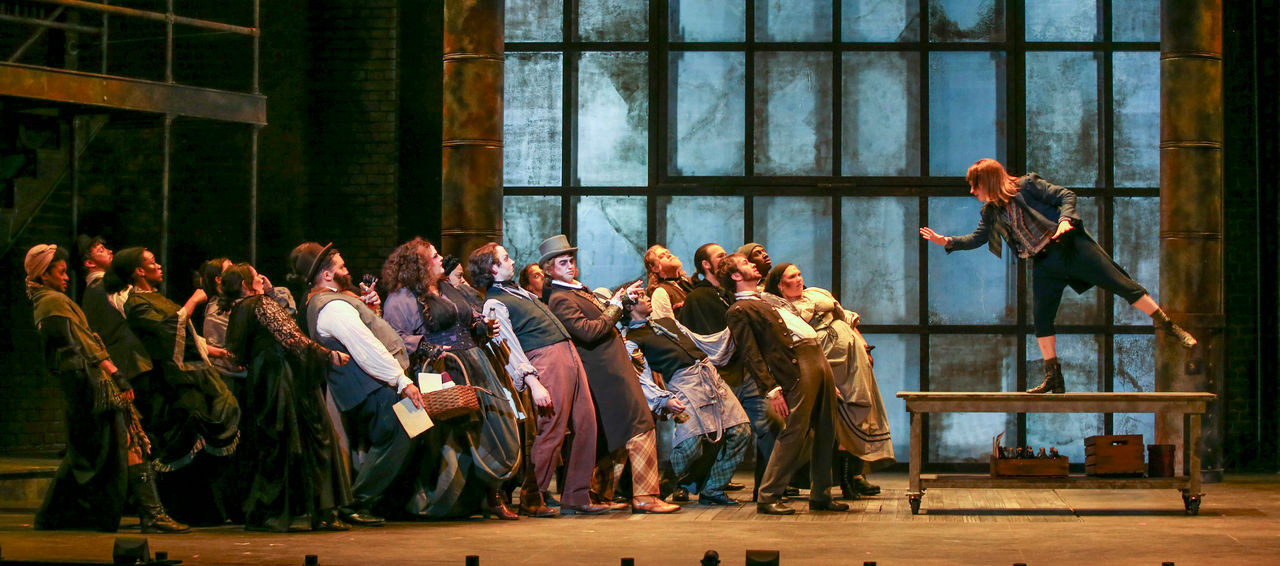
But the University of Cincinnati’s College-Conservatory of Music is stepping up to the challenge of putting on a full-scale performance of the classic, gory tale. Debuting on Broadway in 1979, the show is almost 50 years old, with countless revivals and adaptations of the vengeful barber Sweeney Todd and his co-conspirator, pie shop owner Mrs. Lovett. CCM’s performance, with a double cast and three-story set, is just as huge and bloody as the original.
“This is a real bucket-list show,” said scenic designer and professor Mark Halpin. “It’s one of the classic Sondheim musicals that will be around 100 years from now.”

Halpin's set design purposefully makes the characters feel small in their world. Photo/Mark Lyons
CCM’s production is double cast with musical theatre and opera/voice students taking turns in the lead roles in alternate performances, with an ensemble including students from both programs. Cincinnati print and digital publication Movers & Makers wrote that CCM’s production is “a perfect choice for merging the disciplines.”
“Often when you see ‘Sweeney Todd,’ it’s being reconceived or cut down into a chamber production,” Halpin explained. “It’s pretty rare outside of a New York or London revival to actually see the show done the way it was meant to be done with a large cast and a full orchestra in a big space like Corbett, and with the mix of musical theatre and opera voices you want for it. It’s a really, really unique opportunity to come see this how it was meant to be seen.”
Building the huge, imposing set
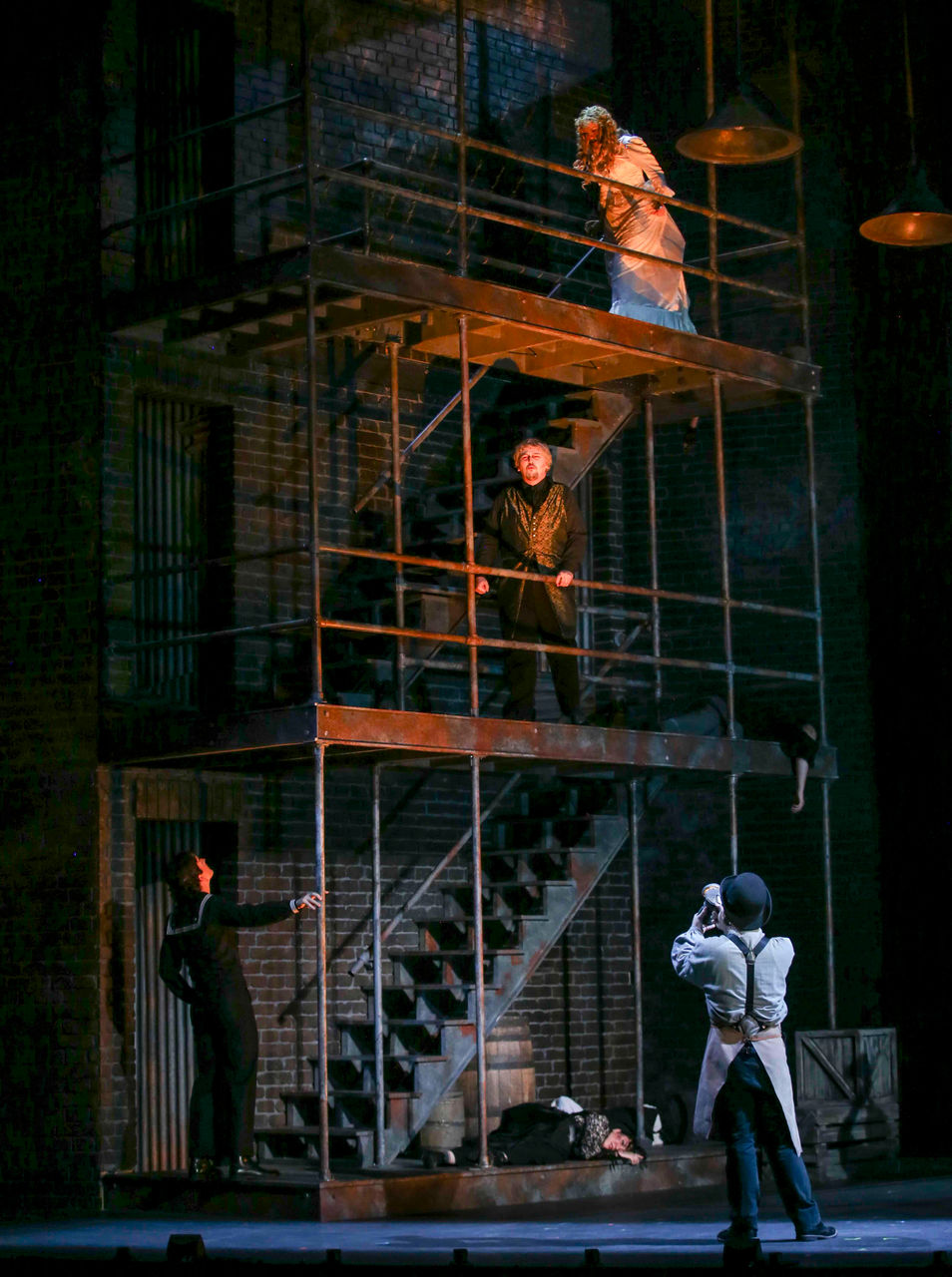
The oppressive set is three stories tall. Photo/Mark Lyons
The grimy streets of Victorian London are recreated in UC’s Corbett Auditorium, towering over the actors at 32 feet tall with three stories of platforms.
“People like to say it’s such a ‘big show.’ And I prefer to think of it as a ‘Corbett-scale show.’” Halpin said. “It’s not big for the sake of being big. It’s big because we’re trying to match the material.”
In designing the show, Halpin wanted to match the feeling the characters bring to the setting. In the song “No Place Like London,” Sweeney Todd famously describes the town as “a hole in the world like a great black pit.” The dark, moody set sells that sentiment to the audience.
CCM has never done anything like this, even when I was a student here.
Missy J. White, adjunct instructor of wig and makeup design
And Sweeney’s famous barber chair hides a trap door all designed by students for actors to fall five feet when he “kills” them, complete with fake blood.
“Sometimes it’s a struggle because we’re all students and we’re all learning,” technical director Paloma Robles said. “But we worked really well with each other the whole way. I’m proud of that.”
The chair and trap door are Robles’ biggest and final project at CCM. An undergraduate studying technical production, Robles specializes in carpentry.
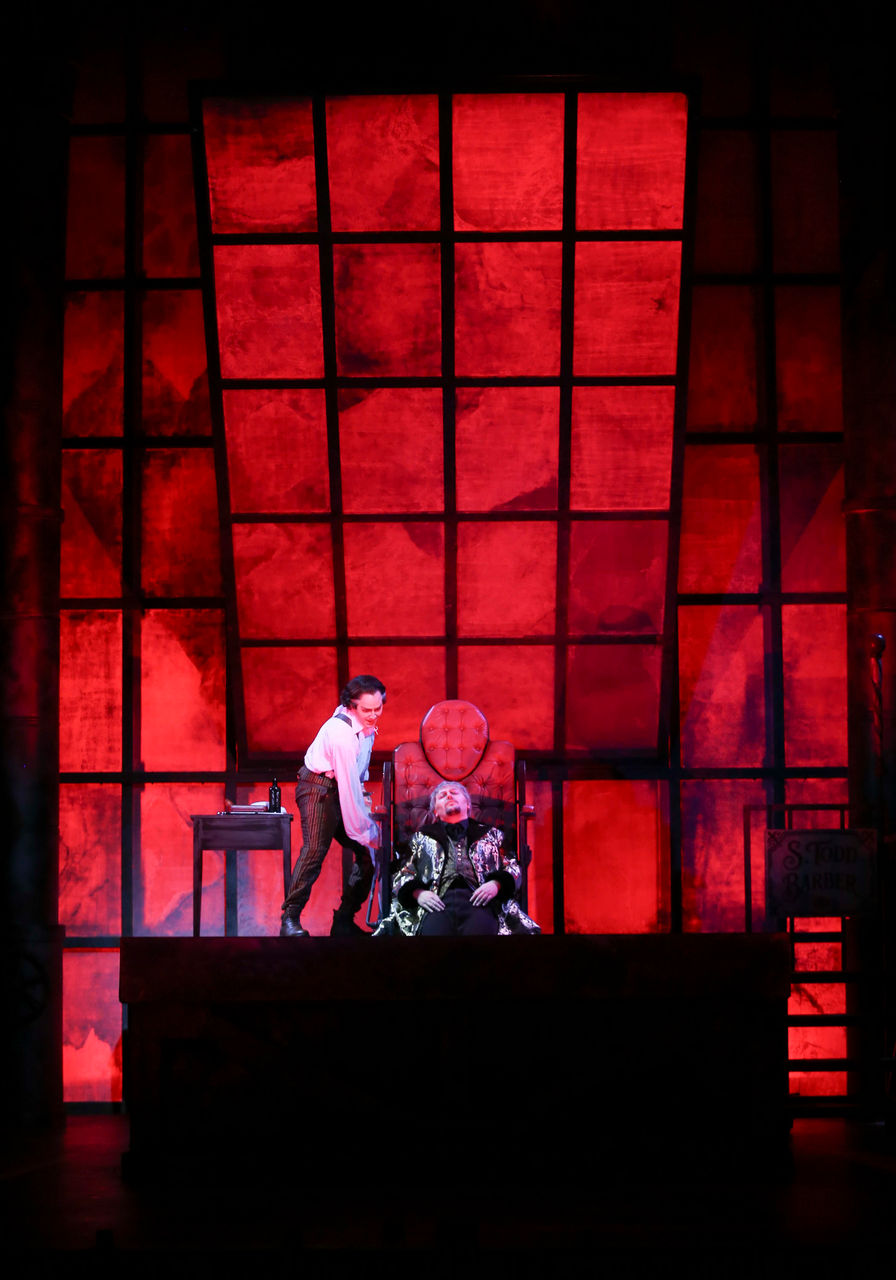
The team behind the scenes operates the chair's mechanics. Photo/Mark Lyons
“The chair is my capstone. That unit is my baby,” Robles said. To reduce variables, Robles opted to have the trap door controlled by an operator behind the scenes instead of actually having the actor’s pulling of a lever set the device in motion.
“The trap opens, the chair deploys, the actor slides about five feet and then they’re caught on the platform and two crew members slowly let them down,” Robles said.
Then came construction of the chair: How can it be comfortable and safe, yet flashy?
“It’s a pretty simple pneumatic actuation: A leg gets pulled out and the back of the chair collapses.” Robles said. But with such a steep slide, Robles had to come up with a belay system like the type rock climbers use to safely descend cliffs to catch performers and slow their descent.
Actors fall fast at first, but once they’re out of view from the audience, safely hit the ground.
A bloody good show
What really sells all the death in the musical is the blood. More specifically, fake blood made mostly of laundry detergent. Ben Wright, an undergraduate studying scenic design and properties, took the lead on blood design and concocted a blood “recipe” specifically for this show.
“I don’t think people realize that when you want blood on stage, that means at least ten hours of meetings and even more time testing,” he said.
That included creating multiple fake blood recipes to find one that didn’t stain costumes and props. His final product included liquid laundry detergent not only for the texture, but to help in washing the blood off of costumes between each of the six shows.
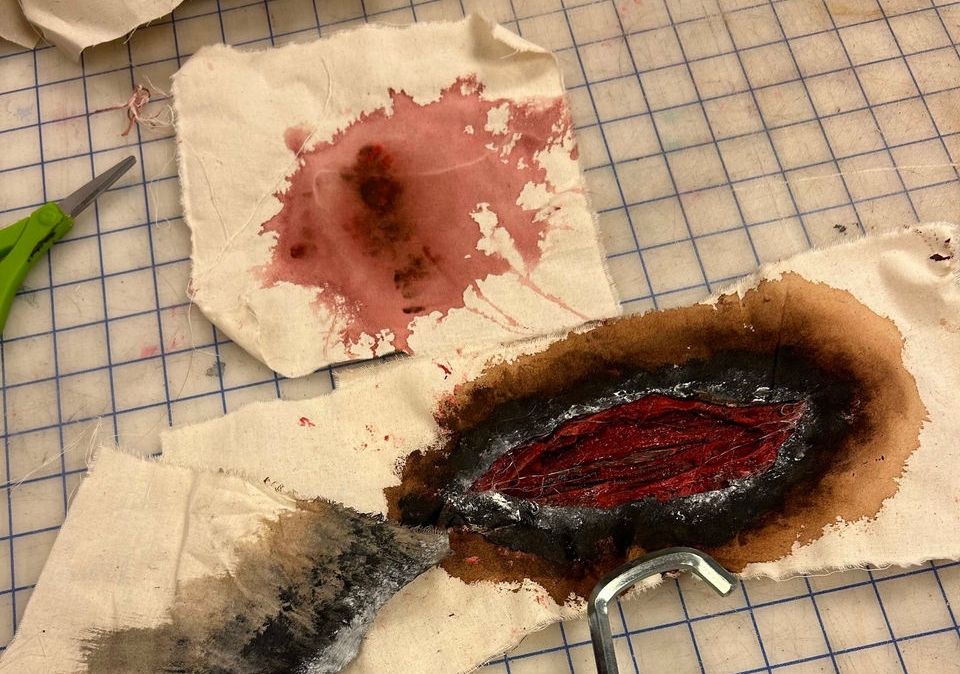
Permanently gory costumes, like Mrs. Lovett's corset, had their own blood recipes. Photo/Emily Glass
“There’s been a lot of back-and-forth communication on if it will stain pants or shirts. If blood gets on stage, we have to talk to the paint team about if it’s going to affect the treatment they’ve done on the floor,” Wright explained. He even had to consult with technical director Robles to make sure his blood recipe didn’t make going down the slide unsafe.
Wright also worked closely with the costuming team to design a blood pouch for each of the two actors playing Sweeney Todd’s gory death at the end of the musical. Wright said a neck rig would make it too hard to sing, and there’s not enough time for the actors to run backstage to get special makeup on before the big scene.
Stitching it all together
“We decided to attach tubing to his shirt collar that stays on the actor at all times,” Wright explained. “With his shirt buttoned up, there’s a bladder of blood right at his chest level. It sits just low enough that it can’t accidentally come out earlier in the performance.” The setup gives the effect of blood coming from Sweeney’s neck, but it’s actually pouring out the collar of his crisp, white shirt.

Sweeney's blood rig is invisible to the audience. Photo/Mark Lyons
“It’s not just Ben Wright and his faculty adviser. It’s also me and my assistant Norah Jeziorowski who are building the rig,” said CJ Kelly, visiting assistant professor and costume designer for “Sweeney Todd.” On top of that the two performers have to learn how to activate the rig and the people backstage have to fill it and transport it without making a mess among 20 ensemble members in Victorian costume.
Second-year undergrad student Jeziorowski, studying costume design and technology, is spearheading the costume design for Mrs. Lovett’s final outfit. The pie seller also has a death scene, but not a lot of time offstage to prepare for it.

Each character needed two wigs and two costumes for each actor. Photo/Mark Lyons
“We have two completely separate costumes for each actress playing Mrs. Lovett,” she said. “The good thing is, everything is seen from the stage, which affords me a bit more grace.” Her design for Mrs. Lovett involves a corset that the actress can wear the whole show that looks bloody and beat up.
“We have to make it look gory, but still flat enough to go underneath the costume and not be seen,” professor Kelly said. “Any element of the show you pick out, there are five different departments that have had at least a pinky toe in it.”
Moire Seger, in her final year studying scenic design and properties, is the props manager that handles all the other potentially staining materials, including edible pie props and shaving cream. She also had to work closely with the costumers on stain testing.
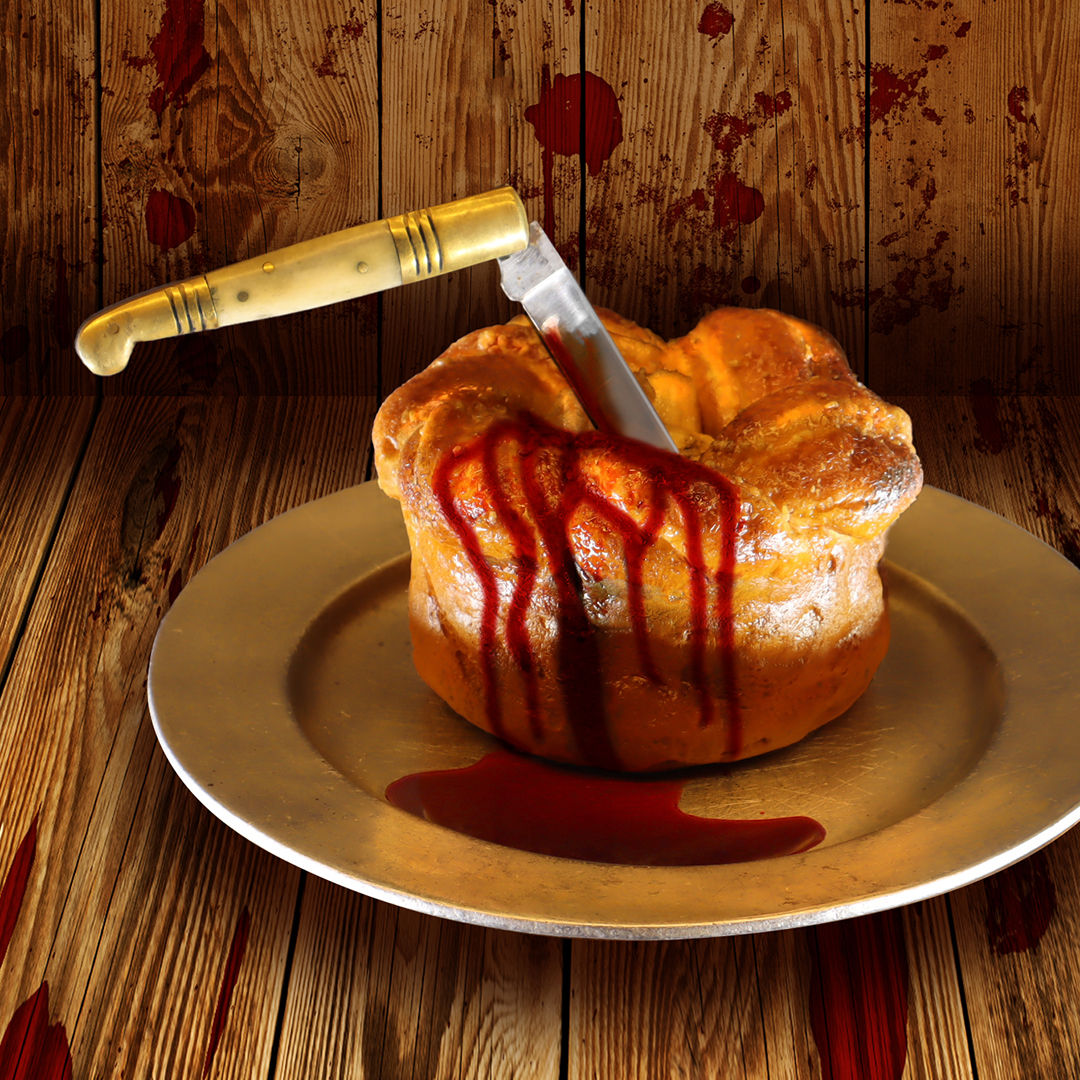
The pies are both edible and easy to wash out of clothes. Photo/Ashley Crockett and Ben Wright
“We gave them samples of our consumable pies for the show so that, in case the food gets on the costumes, they can see what’s not going to be a nightmare to get out of the clothes,’” she said. “We also did a shaving cream test to see which was easiest to get out of shirts with just water backstage.”
Prop manager Wright said that the team effort has been surprisingly seamless. “A lot of times in theatre, everybody looks for somebody to blame when something goes wrong. That has not happened on this show,” he said. “Everyone has been very understanding that we’re all in this together.”
A Bearcat for Life behind the scenes
“CCM has never done anything like this, even when I was a student here,” said hair and makeup designer Missy J. White. She noted how students across disciplines, who may not have ever met otherwise, are coming together for this show. “It’s very cool to see such a unified artistic creation.”

White (right) earned her undergraduate degree at DAAP before returning for her master's at CCM. Photo/Jenna Adkins-Manuel
White is a true Bearcat for life: She’s currently a UC adjunct instructor of wig and makeup design, and she earned both her undergraduate and graduate degrees at UC. She even has multiple Bearcat family members, including her mother, grandmother, an aunt and an uncle.
“I’m a full Bearcat, through and through,” White said. One thing that she loves about UC is the quality and caliber of shows that CCM offers.
White explained that it took lots of collaboration to create a unified vision. Photo/Mark Lyons
“CCM always felt Broadway level,” White said. “When I was a student, and even coming back, it always feels like we have Broadway standards. CCM is world-renowned.” She expressed that coming back as an instructor was surreal for her, and unique in the sense that she was literally in her students’ shoes.

Some wigs include handmade removable facial hair. Photo/Jenna Adkins-Manuel
“Vincent DeGeorge is just such an incredible director,” White said, speaking of the UC Patricia A. Corbett Distinguished Chair of Musical Theatre. “He very much respects every individual department. I feel very much seen by him as a designer.”
White’s wig and makeup designs are realized by her two graduate students, Claire Bonnette and M O’Donnell. The small but mighty team hand-sewed individual hair strands into multiple wigs per character due to the dual casting. “We make magic happen for sure,” White said.
Bearcats for Life
Join us as we redefine what it means to be Bearcats — where every learner is supported, valued and equipped to tackle the challenges of tomorrow. It’s our promise.
See more Bearcats for Life stories and share your own.
Featured image at top of the cast of "Sweeney Todd" on stage with the titular character doused in fake blood. Photo/Mark Lyons
Tags
- College-Conservatory of Music
- Make-up and Wig Design
- Performances and Public Events
- Opera and Voice
- Experience-based Learning
- Musical Theatre
- Student Experience
- Technical Production
- Arts & Culture
- Stage Design, Props and Scenic Arts
- Alumni Association
- Costume Design and Technology
- Theatre Design and Production
Related Stories
See a concert or show at CCM: Fall schedule of major events now available
August 15, 2023
Experience world-class performances by the next generation of performing and media artists at the University of Cincinnati College-Conservatory of Music (CCM)! The college’s fall 2023 schedule of ticketed events is now available; tickets are on sale beginning 1 p.m. Tuesday, Aug. 15 through the CCM Box Office website.
CCM shares fall 2022 schedule of performances and public events
August 12, 2022
Audiences are invited to return to the University of Cincinnati College-Conservatory of Music’s (CCM) concert halls and theaters to experience world-class performances and presentations by the next generation of performing and media artists! The college’s fall 2022 schedule of free and ticketed events is now available. Tickets go on sale beginning on Monday, Aug. 22, through the CCM Box Office website.
Giving Tuesday: Support CCM health and wellness
November 26, 2024
For the UC College-Conservatory of Music (CCM) community, Giving Tuesday offers a unique opportunity to make a significant impact by supporting Student Health and Wellness. As our students dedicate themselves to the arts – pursuing rigorous schedules filled with practice, performance, and academic study – their mental and physical well-being is crucial.