
RaMP-ing up: University Honors Program kick-starts students in STEMM research
Undergraduates find hands-on lab experience at College of Medicine and Cincinnati Children’s

“I love this,” Stacey Lefton said, before launching into a description of how immunofluorescence was used to stain the cultured muscle cells incubating in the room next door.
The second-year medical sciences major has spent the Spring 2026 semester participating in the Biomedical Research and Mentoring Program (RaMP), one of the University Honors Program’s (UHP) best-known, pre-approved honors experiences. Along with first-year medical sciences major Marisa Poff, Lefton has devoted much of her semester to the Cornwall / Goh Lab at Cincinnati Children’s Hospital Medical Center, learning hands-on research techniques under the mentorship of Qingnian Goh, PhD.
Abhinaya Durairaj, a second-year neuroscience major and Spring 2026 RaMP participant, described the program as “a stepping stone… so I could see if I really love research enough to do it for the rest of my life.” Along with first-year medical sciences major Avi Maun, Durairaj has spent her semester in a lab at UC’s College of Medicine, where she is mentored by Yasmin Sahlloul, a PhD student in UC's neuroscience graduate program.
A pathway to research
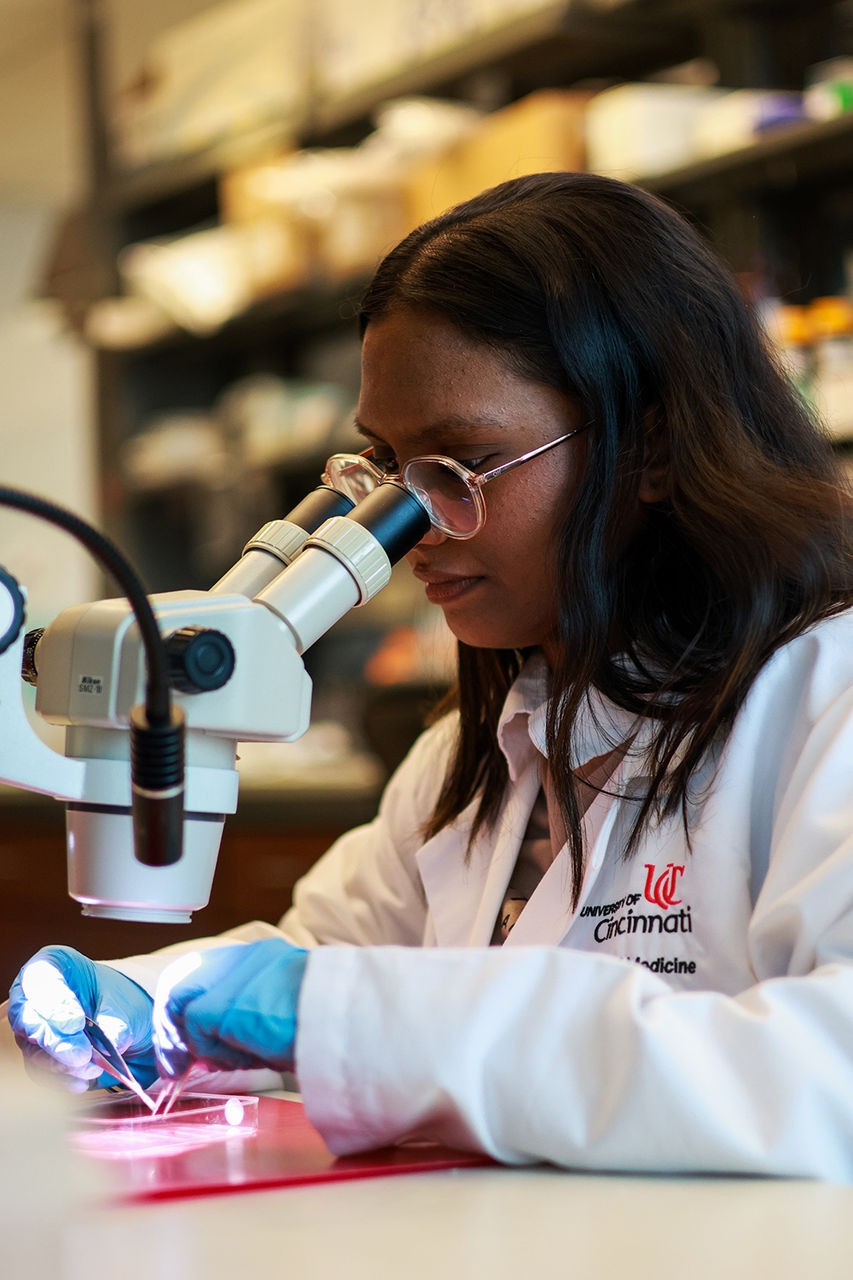
Abhinaya Durairaj. Photo/Provided.
Every spring, RaMP places UHP students in participating labs at the College of Medicine and Cincinnati Children’s Hospital Medical Center for a semester of intensive, hands-on skill development and mentorship from postdoctoral fellows and graduate students. A wide range of labs partner with the UHP to offer the experience. While any students curious about STEMM research are encouraged to apply, the RaMP application process is competitive and typically of greatest interest to those exploring a future in biomedical research or in PhD, MD or MD/PhD programs in biomedical-related fields.
“RaMP serves as a unique opportunity for students to bridge classroom learning and real-world biomedical research,” said Tori Cullen, assistant director of research and global opportunities at the UHP, who manages and coordinates the experience. “Students gain early, meaningful exposure to scientific inquiry, a professional mentor and a personal growth that spans beyond the academics.”
Under the microscope
Most students participating in RaMP are in their first or second year at UC, and the program is typically their first experience in a working lab. For Poff and Lefton, this meant — among other things — learning essential wet lab skills involved in the cell culture process, such as microscopy, pipetting and immunofluorescent staining. Maun and Durairaj were also trained in microscopy and pipetting as part of their work this spring; Durairaj even learned an RNAscope protocol, which requires carefully timed stages during a seven-hour duration. “Wet lab involves lab coats, gloves, you know, all the ‘scientific’ stuff you see in the movies,” said Maun.
Both labs also incorporate digital research techniques into the RaMP experience. Poff has been trained to capture images of the muscle cells that she and Lefton helped culture, and to use specialized software to record additional information about them based on those images.
Maun had the opportunity to help parse recent publications from other labs that are connected to the work of his host lab. He said it's the most valuable aspect of his time in RaMP. “It’s not just something I’ll do for this lab, it’s everywhere in life — learning how to take a big block of text and information and simplify it in your own head and analyze it,” said Maun.
RaMP participants are able to describe their host labs’ overall projects, including the human impact they hope the research will make on a larger scale. Lefton offered a “30,000-foot view” of the Cornwall / Goh lab’s interest in neonatal brachial plexus injuries and the resulting muscle contractures: “What our lab does is study, at a basic science level, how those muscles grow lengthwise… so Marisa and I are analyzing different genetic factors that may influence that.” Poff added, gesturing to a nearby tray of RNA on ice: “If you lower a specific gene’s level of expression, what will happen?”
Maun and Durairaj, whose host lab (under the direction of Temugin Berta, PhD) investigates the connection between inflammation and pain in conditions such as fibromyalgia, both cited the exploration as deeply connected to their own interests in medicine and neuroscience, respectively.
Connecting to futures in clinical research
The first thing many RaMP students mention when talking about their experiences in the program, however, isn’t the techniques they’re learning in the lab. Instead, they jump to describe a sense of community within their host labs, a deep gratitude to their mentors and a growing confidence that they’re interested in research for the long term.

Stacey Lefton (L) and Marisa Poff (R). Photo/Provided.
For Maun, that means a sense that he’s “meaningfully contributing to this scientific community”. Durairaj, similarly, expressed appreciation for Sahlloul’s guidance through the earliest and most “intimidating” stages of acclimating to lab work. She’s become more resilient along the way. “You don’t get the right data every week, but you just have to be patient and keep trying... If you want to hurry up, that’s not going to work in research.”
Durairaj hopes to embark on graduate study in neuroscience after finishing her undergraduate degree. Lefton, Poff and Maun all aspire to become physicians. They agreed that their experiences this spring have confirmed that they’re on the right professional path, while also shedding light on paths to continued clinical and biomedical research such as the MD/PhD program.
“In their labs, students not only develop technical skills but also the confidence and identity of an emerging scientist,” said Cullen.
Sustaining partnerships

Avi Maun. Photo/Provided.
RaMP mentors, too, are clear about the program’s positive impact on mentees and host labs alike. Sahlloul said energy and curiosity comes from bringing undergraduates into the lab: “When you talk about science, it's nice in theory. But when [RaMP participants] get to see the results firsthand, it's a completely different feeling,” she said.
Goh, for his part, views mentorship as an integral aspect of his work and as a practice that enriches the lab’s intellectual community. “A lot of pre-med students come through here,” he said of the impact on participants, “and we really help them prepare along their academic journey to medical school. We also have success helping students who decide not to pursue medical school... research helps them develop general skills in thinking, asking questions and making judgments, and of course in learning to communicate about their work.” Goh, who has been mentoring RaMP students since 2019, also has had participants stay on for an extension of the initial RaMP semester (a process that is also considered a pre-approved experience within the UHP) and even make arrangements to continue their involvement with the lab beyond that timeframe.
Cullen also sees RaMP as a partnership that serves mentors and participants alike: “This reciprocal relationship strengthens the research community while cultivating the next generation of leaders in science and medicine,” she said. “The UHP is incredibly lucky to have strong partnerships with the University of Cincinnati College of Medicine and Cincinnati Children’s Hospital Medical Center, where some of the top researchers in their fields are working with our students.”
Sharing knowledge, sustaining growth
RaMP concludes with a day of presentations, as this spring’s cohort describes their host labs’ projects and share what they’ve learned within the program. This year’s presentations will take place on Wednesday, April 22; interested UC community members are welcome to stop by TUC 400A and B between 9-11 a.m. to hear directly from the students about their mentored semesters of research.
Featured image: Stacey Lefton (L) and Marisa Poff (R). Photo/Provided.

Interested in learning more about RaMP or participating in Spring 2027?
Contact Tori Cullen, University Honors Program assistant director of research and global opportunities
Read up on RaMP
Related Stories
Learning more about how cancer affects stroke risk
October 16, 2023
A collaborative team led by University of Cincinnati, University of North Carolina and Duke University researchers is studying how specific cancers and treatments affect patients' risk of stroke.
UC receives grant for AI use in medical education
February 26, 2026

The University of Cincinnati is turning to artificial intelligence to help solve a problem in medical training. The College of Medicine was awarded a grant valued at more than $1 million to use AI in advanced physician training through personalized learning.
UC awarded $1.1 million grant to tailor AI use in medical education
January 16, 2026
The University of Cincinnati College of Medicine has been selected as a recipient of a $1.1 million American Medical Association (AMA) Transforming Lifelong Learning Through Precision Education grant.