
UC’s Action Research Center marks 20 years of collaboration and change
A year of celebratory events highlighted the center’s impact and vision for the future
On April 30, 2026, more than 50 faculty, current students, incoming students and community members came together for the Action Research Center’s spring gathering at Andy's Mediterranean Bar and Grille in Cincinnati's Walnut Hills neighborhood. The event provided an opportunity to celebrate the end of the semester and learn about one another’s work.
A highlight of the evening was a presentation of an app for youth participatory action research, developed by the Mantle Center and a current EDST doctoral student. This project is one of many that the Action Research Center (ARC) helps facilitate by connecting community strengths with university expertise. This gathering was the culmination of a year-long celebration of the ARC’s 20th anniversary year.
The milestone year kicked off on Sept. 15, 2025, in the Teachers-Dyer Complex (TDC), where many UC affiliates gathered for a fireside conversation between ARC’s newly appointed co-director Vicki Daiello, current co-director Miriam Raider-Roth and ARC founding director Mary Brydon-Miller. The anniversary event was titled “20 Questions at 20 Years.”
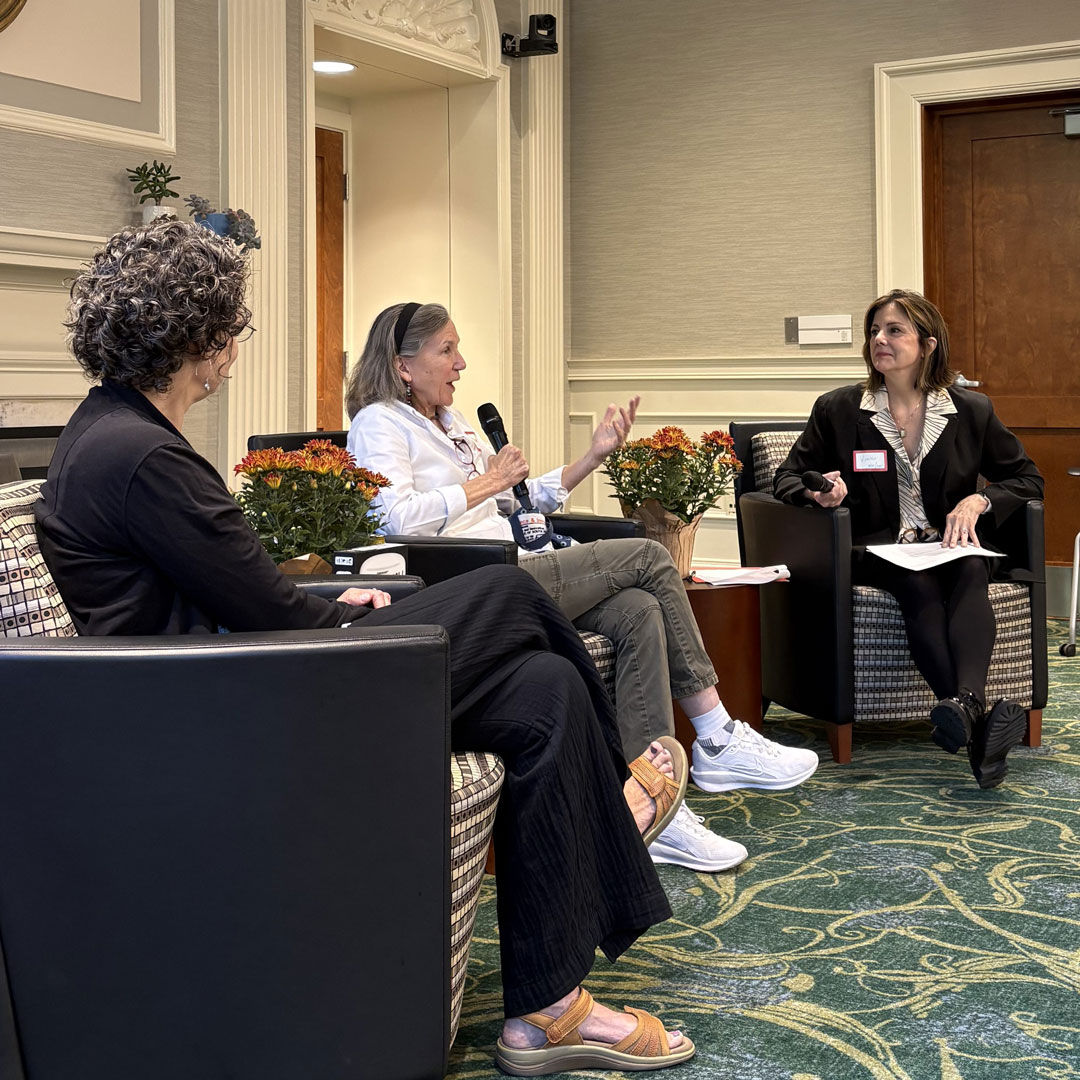
ARC co-directors Vicki Daiello and Miriam Raider-Roth discuss the center's history and mission with founding director Mary Brydon-Miller at September's fireside chat. Photo: CECH Marketing
The one-day, discussion-based event was presented by the College of Education, Criminal Justice, Human Services, and Information Technology (CECH) and organized by the Action Research Center (ARC). Prior to attending, registrants had the opportunity to submit questions about the history and evolution of the ARC, fostering a cooperative environment for scholarship.
As she sat among her team, Raider-Roth reflected on the powerful fruits of their labor — principles guided by the founding vision of Brydon-Miller. For them, the mission was always more than just research. It was about connecting with community members who believed that acquisition of knowledge can drive social transformation.
“Action research means research for social change,” says Raider-Roth. “It is a research orientation, a stance rather than a specific methodology that [holds] the belief that research has a purpose towards a social good and that the work we do needs to make change to improve the human condition.”
The history of the ARC starts in 2000, when CECH’s School of Education sought to hire a new faculty member, specifically an action researcher. Although action research (AR) was on the rise, those conducting these studies were scattered across the country. The school found the ideal candidate in Brydon-Miller who, after being added to the team, arrived on campus with the objective of bringing her AR connections together in a supportive environment for cooperative learning.
Action research means research for social change.
Miriam Raider-Roth Co-director, Action Research Center
With the goals of sharing knowledge, forming connections and global development in mind, the ARC was established within CECH in 2005. “Mary Brydon-Miller created the center in 2005 with the mission of trying to create a home for people doing this kind of work,” adds Raider-Roth.
A year later, the ARC received its first Faculty Development Grant to support the Action Research Workshop Series, which provided staff from multiple departments with foundations and skills needed to participate and engage in AR.
As interest and involvement in ARC continued to grow, so did its team. With the additions of Raider-Roth in 2006 and Lisa Vaughn in 2010, the center adapted its mission to reflect shared visions. Ambitiously, they wanted UC’s ARC to be home to a library of publications, certified programs and professional development opportunities for the greater community.
In the 20 years since its founding, the ARC has achieved many milestones. In 2012, the Educational and Community-Based Action Research (ECAR) concentration was created and embedded within the Educational Studies Doctoral Program. Today, ECAR is one of the only action research-oriented doctoral programs in North America. In addition the EDST MA program now hosts a Research for Social Change concentration.
Despite COVID causing widespread shutdowns in 2020, the ARC team remained persistent in broadening its projects and outreach, especially in response to social movements taking place during this moment in time. They continued to have monthly gatherings but transitioned to virtual spaces, sustaining connections when people felt isolated. Community has stayed at the center of their efforts, with over 400 people enrolled on an active listserv.
In the years that followed, the ARC hosted workshops and sessions that prioritized strengthening communication and understanding in educational settings. This shift not only maintained connections but also increased participation in AR on campus and beyond.
When Brydon-Miller departed in 2016, Raider-Roth stepped into the role of director, continuing the center’s commitment to collaboration and change. In 2025 the ARC entered a new phase with a co-directorship model between CECH and UC’s College of Design, Architecture, Art, and Planning (DAAP), establishing a partnership with action research at the heart.
“This relationship broadens the ARC’s network and sparks new interdisciplinary connections that advance meaningful societal change,” says Daiello, who serves as an associate professor of Art & Design Education with DAAP in addition to her co-directorship with the ARC. “We’re excited to facilitate a larger platform for DAAP’s artists, designers, architects and planners to engage in action research and envision how their work — alongside collaborators across UC and the community — can make an impact.
Daiello and Raider-Roth’s partnership has led to new initiatives and opportunities for the ARC. Through a visioning process facilitated by ARC member and emeritus faculty Stephen Kroeger, the ARC formed a co-creator committee including faculty, students and alumni. Additionally, the ARC moved into a new space on the Victory Parkway campus, realizing one of the central goals of their visioning process.
As the ARC marked its 20th anniversary through the fireside chat, monthly learning circles, “Feed Your Mind” virtual sessions and end-of-semester celebrations, the center is reimagining its capabilities while reflecting on 20 years of progress. This anniversary year celebrates two decades of ARC impact while sparking renewed curiosity and interest in connection across the university.
“This year, we have seen an amazing new energy in the ARC. Our co-directorship, the co-creating committee and our new space have brought university faculty and students together in exciting and creative ways,” says Raider-Roth. “We are co-connectors and network weavers. That’s our sweet spot.”
Featured image at top: ARC co-directors Vicki Daiello and Miriam Raider-Roth at a recent event celebrating the center's 20th anniversary. Photo: provided
Next Lives Here
Next Lives Here, the University of Cincinnati’s strategic direction, defines our moment and our momentum. More nimble and more robust than a plan, Next Lives Here announces our vision to the world—to lead urban public universities into a new era of innovation and impact.
Related Stories
University of Cincinnati recognized with 16 rankings in U.S. News & World Report’s Best Online Programs
January 29, 2026
U.S. News and World Report (the global authority in education rankings) published its 2026 Best Online Programs rankings on January 27, 2026, recognizing the University of Cincinnati with 16 spots in the list of degree-granting university programs that affordably serve the educational needs of distance learners in a reasonable timeframe. Programs within the College of Education, Criminal Justice, Human Services, and Information Technology (CECH) represent seven of these rankings.
Knowledge Nexus aims to empower new faculty with research capabilities
September 26, 2024
Knowledge Nexus is a series of workshops—presented in partnership with the University of Cincinnati's Associate Dean of Education Innovations and Community Partnerships and Associate Dean of Academic Affairs (Dean’s Office, CECH)—that outline common intricacies of research development at CECH and UC, which, as an R1 institution, absolutely values research activity.
CECH welcomes 25 new faculty members to the University of Cincinnati
October 3, 2024
With the 2024-25 school year at University of Cincinnati underway, the College of Education, Criminal Justice, Human Services, and Information Technology (CECH) welcomes 25 new faculty members to the classrooms and hallways of the Teachers-Dyer Complex for the fall semester. The newly hired instructors are teaching within all of the college's four schools, preparing undergraduate and graduate students to be essential changemakers, impacting their communities and the world in a variety of fields.