
Multidrug treatment using nanofibers shows promise for glioblastoma
UC's NanoLab partners with Johns Hopkins University on novel drug delivery system

Researchers with the University of Cincinnati and Johns Hopkins Medicine developed a potential treatment for brain cancer that uses nanofibers embedded with a combination of drugs that work in concert to target tumors.
The drugs proved more effective in combination than when administered alone and can provide both immediate and long-lasting doses to kill cancer cells.
“In our study, a three-drug combination showed strong synergistic effects across multiple glioblastoma models and significantly improved survival in animal studies,” said lead author Daewoo Han, an assistant professor in UC’s College of Engineering and Applied Science.
Han and Distinguished Research Professor Andrew Steckl incorporated the drugs into electrospun fiber membranes, creating a nanofiber drug delivery system. Steckl’s NanoLab at the University of Cincinnati is a leading developer of this technology that uses an electric field to create a multilayered fiber mesh for drug delivery, among other uses.
“This combination is pretty powerful,” Steckl said.
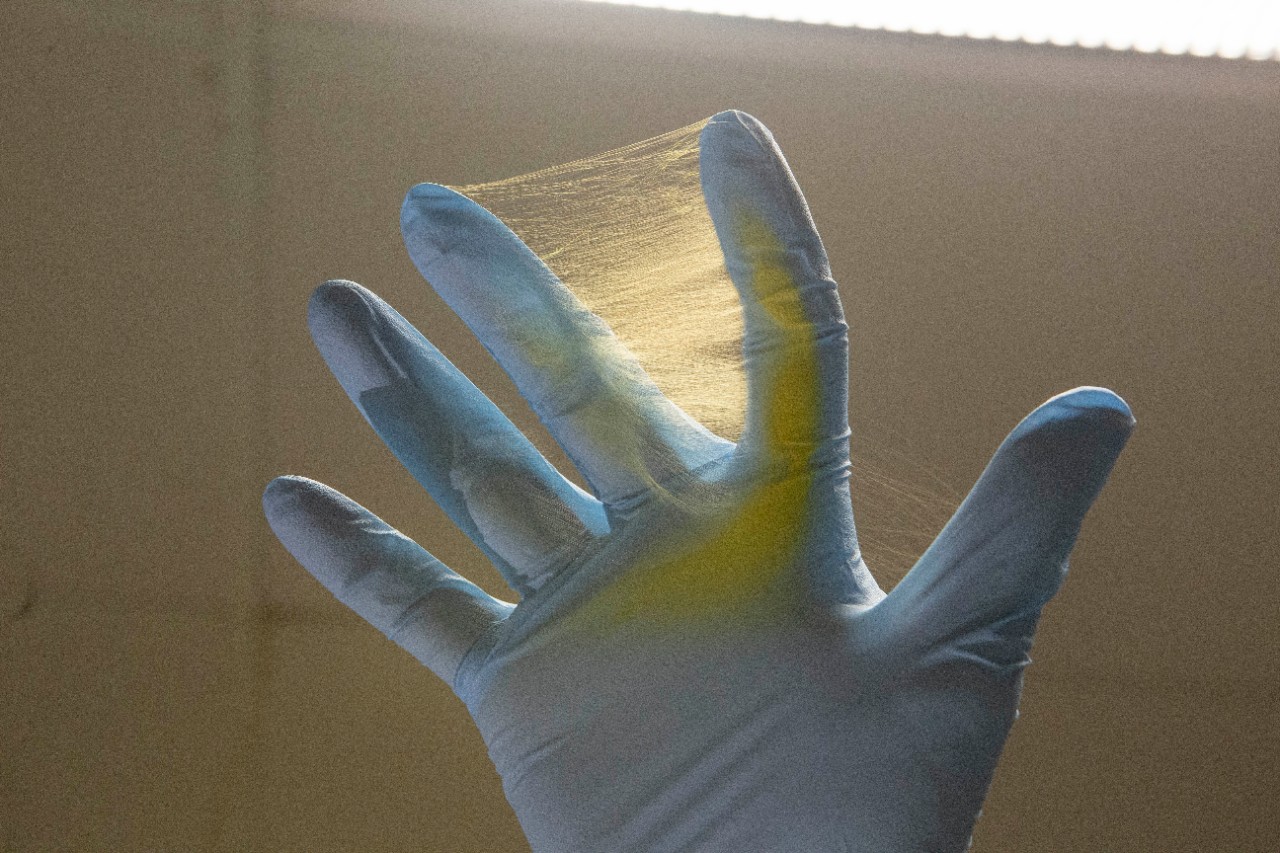
Researchers at the University of Cincinnati and Johns Hopkins University developed a promising treatment for glioblastoma using three drugs in combination embedded in a mesh made from electrospun nanofiber. Photo/Joseph Fuqua II/UC
What is glioblastoma?
Glioblastoma is the most common and aggressive form of brain cancer in adults. Researchers at UC and Johns Hopkins found that the three federally approved drugs used to treat glioblastoma (temozolomide, acriflavine and PT2385) work better in combination than they would alone, a pharmaceutical phenomenon called synergism.
“When you add them together, three things can happen,” Steckl said. “The combination is negative; the effect is additive, like one plus one equals two; or it’s synergistic, which is like one plus one equals three.”
The study on synergistic glioblastoma treatment was published in the journal ACS Biomaterials Science & Engineering. The research was supported with a grant from the National Institutes of Health.
Unfortunately, cancers know how to pivot, so we’re approaching treatment multidimensionally.
Betty Tyler, M.D., Johns Hopkins University
Why is glioblastoma difficult to treat?
Steckl said glioblastoma is extremely difficult to treat because its heterogeneous cells allow for mutations that help the cancer evade treatment.
“It’s tough to control,” Steckl said. “It comes in through the window and when you close the window, it comes through the door. And when you close that, it comes through the chimney.”
Glioblastoma also has high recurrence. And the blood-brain barrier limits the effectiveness of other traditional chemotherapies.
“Our NanoMesh system was designed to solve these issues by enabling localized long-term delivery of multiple synergistic drugs directly at the tumor site after surgery,” UC’s Han said.
UC researchers worked with a team at Johns Hopkins Medicine, including Betty Tyler, a professor of neurosurgery, and postdoctoral researcher Hasan Slika. Tyler said researchers are looking to attack the disease with combinations of therapies.
“Unfortunately, cancers know how to pivot to evade therapeutic treatment,” she said. “So we’re approaching treatment multidimensionally.”
Tyler has helped develop other cutting-edge therapies now commonly used to treat cancer.
“Current therapies have increased patient survival and given them more birthdays,” she said. “But we’re still working on improving options.”
In animal trials, all untreated mice with glioblastoma died within 19 days. But a majority of mice treated with the three-layer nanofiber mesh survived twice as long. And 40% survived past the 120-day conclusion of the experiment in a plateau that stretched for more than 80 days.
Han said using electrospun fiber mesh, doctors can precisely control the dosage and release and the implant geometry, which contribute to its effectiveness. And just as the blood-brain barrier protects the brain from toxins, the barrier also protects the body from the toxic side effects of the medicine applied to the brain, Han said.
UC researchers are now working on optimizing the long-term release of medicines using advanced nanofiber structures. And the delivery system has broad potential in applications for other difficult-to-treat diseases, Han said.
“What’s next will be very exciting,” Han said. “Our ultimate goal is moving forward to a clinically translatable system that improves both survival and quality of life for patients with difficult-to-treat cancers, including glioblastoma.”
Featured image at top: UC researchers partnered with doctors at Johns Hopkins University to explore new treatments for brain cancer that use three drugs embedded in a nanofiber mesh. Photo/Andrew Higley/UC

UC Distinguished Research Professor and Ohio Eminent Scholar Andrew Steckl poses with a statue of UC co-op founder Herman Schneider. Steckl teaches electrical engineering and is also active in biomedical engineering and materials science in UC's College of Engineering and Applied Science. Photo/Andrew Higley/UC
The next groundbreaking discovery
UC is a powerhouse of discovery and impact as a Carnegie 1 research institution. From pioneering medical research to transformative engineering and social innovation, our faculty and students drive progress that reaches across the world.
Related Stories
UC lab-on-a-chip devices take public health into home
May 8, 2025
University of Cincinnati engineers created a new device to help doctors diagnose depression and anxiety. The “lab-on-a-chip” device measures the stress hormone cortisol from a patient’s saliva. Knowing if a patient has elevated stress hormones can provide useful diagnostic information even if patients do not report feelings of anxiety, stress or depression in a standard mental health questionnaire.
Powerful new AI can predict people's attitudes to vaccines
March 18, 2024
A powerful new tool in artificial intelligence is able to predict whether someone is willing to be vaccinated against COVID-19.
New at-home test protects oral health
September 7, 2023
Engineers at the University of Cincinnati have developed a new device that can warn consumers about early risks of tooth decay from diseases such as gingivitis and periodontitis.