
Ancient warming event hints at potential climate tipping point
UC researchers show how modest warming triggered a dangerous feedback loop

Researchers say a spike in temperatures during an ice age 304 million years ago could inform what climate scientists are learning about rapidly changing conditions today.
Professor Thomas Algeo at the University of Cincinnati worked with a team of international researchers, including lead author Le Yao from the Nanjing Institute of Geology and Paleontology, to examine a period of rapid warming that occurred during the Late Paleozoic Ice Age, the second most recent ice age on Earth.
They found that a small spike in global sea surface temperatures led to a far bigger one fed by the release of methane into the atmosphere from melting permafrost. Global sea surface temperatures climbed by more than 7 degrees Celsius or 12 degrees Fahrenheit.
The study was published in the journal Proceedings of the National Academy of Sciences.
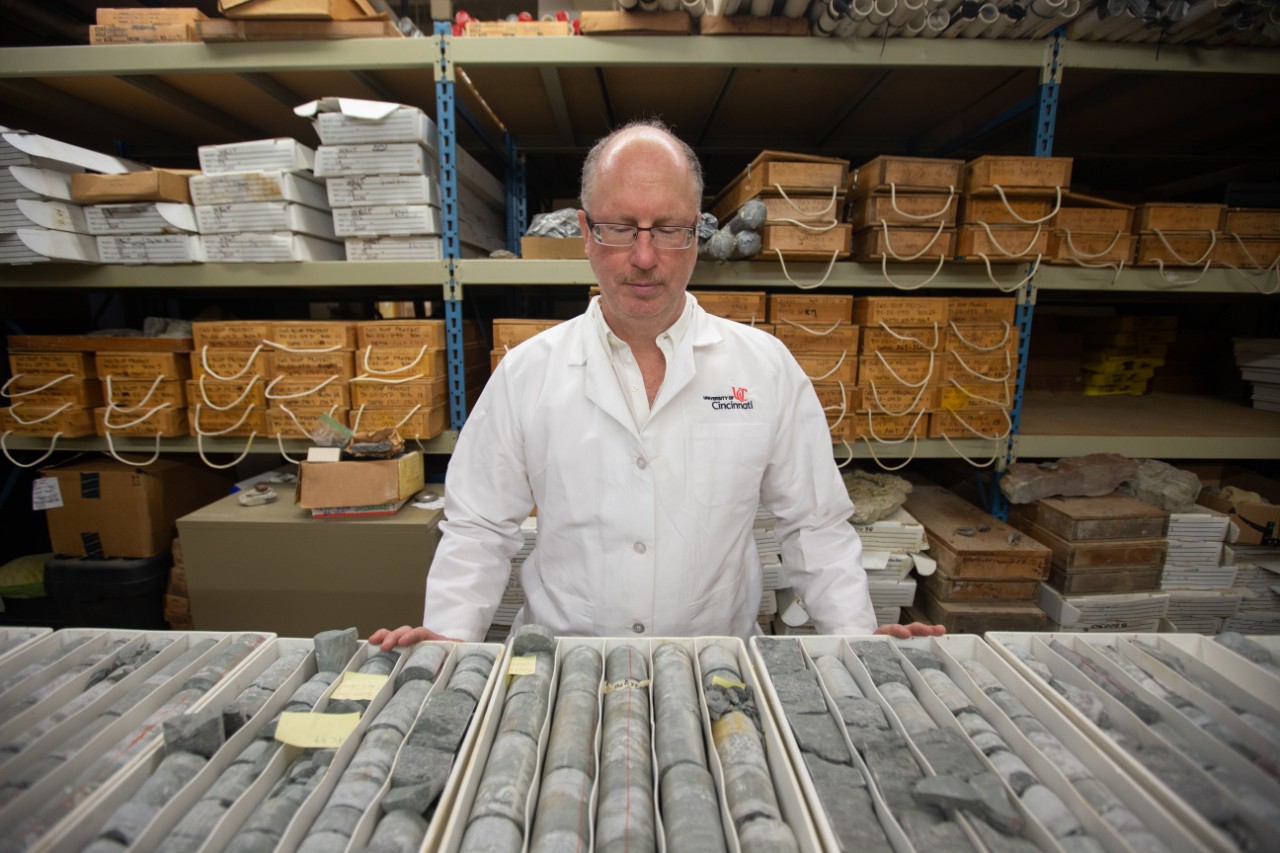
Professor Thomas Algeo at the University of Cincinnati in Cincinnati, Ohio, examines rock cores in his geosciences lab. Photo/Andrew Higley/UC
What 7.5 degrees in warming in last ice age could mean for today's climate
Algeo noted that the change occurred over tens of thousands of years at a rate of about a tenth of a degree Celsius increase every 1,000 years. By comparison, researchers today have observed a nearly 1 degree Celsius increase of sea surface temperature in just the past 100 years.
Possibly triggered by volcanic activity and aided by a cyclical variation in the shape of Earth’s orbit that influences the distribution of solar radiation, a modest release of carbon crossed a “climatic tipping point that led to massive carbon release and transient global warming,” the study said.
Researchers said an increase in temperatures today could speed melting of permafrost, releasing trapped carbon that could create a positive feedback loop that contributes to more warming.
Rapid warming on Earth more typically happens under what scientists call greenhouse conditions when the atmosphere contains high levels of methane and carbon dioxide that trap heat.
Algeo said some people are surprised to learn that all of recorded human history has taken place in the midst of the most recent ice age. Its last peak called a glacial maximum occurred about 20,000 years ago when woolly mammoths, cave bears and giant ground sloths roamed the Earth.
“We’re technically in an ice age because there are two continent-scale ice masses in Greenland and Antarctica,” he said. “What makes this warming event 304 million years ago unique is that it occurred during an ice age. That’s what makes this event important as an analog for modern-day climate warming.”
Featured image at top: UC Professor Thomas Algeo pulls out a chest of rock cores in his geosciences lab. Photo/Andrew Higley/UC
Frequently asked questions about UC's ice age warming study
What did UC's study find about ice age warming?
The study examined a rapid warming event about 304 million years ago during the last ice age, when global temperatures rose by 7.5 degrees Celsius over more than 100,000 years, likely from a feedback loop fueled by melting permafrost.
Why is methane release from permafrost important?
Methane is a powerful greenhouse gas. When warming causes permafrost to thaw and release trapped methane, it can accelerate climate change through positive feedback loops.
How does this ancient warming event relate to modern climate change?
While today’s warming is happening much faster, the Ice Age event shows how rising temperatures can destabilize frozen carbon stores. This helps scientists anticipate potential risks if current warming continues to melt permafrost and release methane.
What is UC learning about dark matter?
UC physicists are learning a lot about dark matter from experiments at CERN and other particle accelerators around the world. They theorize that dark matter accounts for 27% of the universe and does not emit, absorb or reflect light. And researchers are also using advanced space telescopes to try to observe the effects dark matter has on galaxies.
The next groundbreaking discovery
UC is a powerhouse of discovery and impact as a Carnegie 1 research institution. From pioneering medical research to transformative engineering and social innovation, our faculty and students drive progress that reaches across the world.
Related Stories
Telescope captures information about lonely Jupiter-like gas giant
May 13, 2026

Science outlets highlight a University of Cincinnati student's collaborative discoveries about an exoplanet 901 light years away.
Why do female caribou have antlers? They eat them
February 25, 2026

Scientific American highlighted a new study by the University of Cincinnati that unveils a new theory about why female caribou have antlers.
Last woolly mammoths offer clues to why they died out
August 26, 2024

UC geoscientist Joshua Miller talks to Science News Explores about a new study on a genetic bottleneck in the world's last woolly mammoths on Russia's Wrangel Island.