
Could a whale really swallow a person whole?
Maybe but one professor talks about another animal that has

Science News examined the question posed by the upcoming movie "Whalefall" — could a whale really swallow a person whole?
The survival thriller based on the novel by Daniel Kraus will be released Oct. 16. It examines the thalassophobia-inducing question of what happens to a diver who inadvertently gets swallowed by a hunting sperm whale.
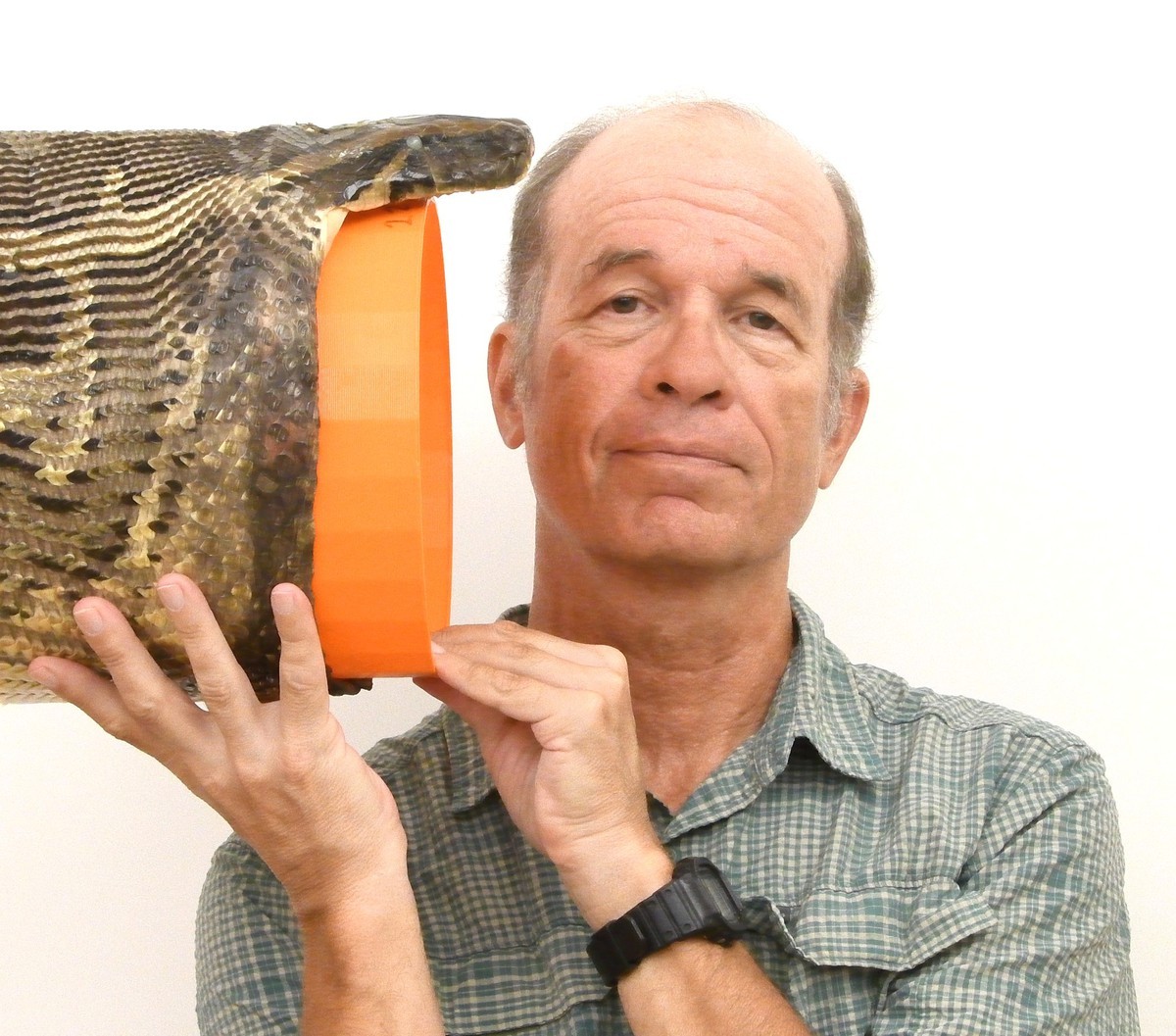
UC Professor Bruce Jayne studies the gape of snakes such as this python to determine its largest potential prey. Studies have found that nonnative Burmese pythons are decimating native wildlife populations in Florida. Jayne says some snakes are capable of swallowing people whole but those cases are extremely rare. Photo/Bruce Jayne
Biologists told Science News that an adult diver technically could fit down the gullet of a sperm whale. Unlike most large baleen whales that feed on tiny krill, enormous sperm whales actually do have a large enough throat to accommodate prey like giant squid or a hapless diver.
But scientists told Science News that there has been no documented case of a whale eating a person. In fact, when it comes to the food chain, only one animal has been documented to swallow a person whole, according to University of Cincinnati Professor Bruce Jayne.
Jayne told Science News that only the reticulated python has consumed an adult human whole.
He studies the gape of snakes in his biology lab to determine the maximum size of potential prey. Many snakes, including pythons and anacondas, have flexible jaws and stretchy skin that allow them to swallow prey much larger than their heads.
Still, it's very rare for people to be on a snake's menu, Jayne told Science News.
“Humans are very difficult for snakes to swallow,” he said. “Just because an animal has the physiological capacity to do something doesn’t necessarily mean that they will.”
Featured image at top: The movie "Whalefall" asks what would happen if a diver were swallowed by a sperm whale. Photo/Ventura Romero
More UC biology news

Students work with reptiles in UC's Herpetology Club.
Related Stories
College of Arts & Sciences research centers uniting for impact
September 4, 2025
UC’s College of Arts and Sciences is home to 12 research centers, which are moving forward study of machine learning and AI, environmental sciences, cyber strategy, urban policy, civility in public discourse, and more. Each center has impact on our local communities and beyond. But what if they joined forces to expand their impact—locally, regionally and beyond? The new A&S Action Collaborative is setting out to answer that question.
UC‘s College of Arts and Sciences taps innovative new leadership
December 20, 2023
The College of Arts and Sciences announced Ryan J. White and Rina Williams as the newest divisional deans of Natural Sciences and Social Sciences. White and Kennedy’s inclusion will bring new focuses and structure around student success and the college of Arts and Sciences’ advancement. Both will officially begin their new terms on Jan. 1, 2024.
What is UC’s 4 + 1 program?
December 4, 2023
You may be a UC student thinking about taking your education to the next level — UC’s College of Arts and Sciences has a pathway to help you do just that. A&S has no fewer than 15 five-year programs — from biological sciences to Spanish to psychology — where you can earn both your bachelor’s and master’s degrees in just five years, versus the traditional six-year track. The Bachelors and Master’s 4 + 1 Program is designed to increase your marketability and deepen your understanding of the subject matter. And in an increasingly competitive job market, you may want to investigate an additional year of study.