Researchers Receive Over $2 Million to Study Dialysis Access

But stenosis, or narrowing of the veins, often causes restricted access to the point in the body where blood is removed and then replaced during the dialysis process.
The UC nephrology division and the Cincinnati Dialysis Access Research Program (CAP) received two major grants to study why arteriovenous fistulas in hemodialysis patients are often unsuccessful.
Arteriovenous fistulas connect the artery and vein in dialysis patients and are essential for the removal and purification of blood during hemodialysis.
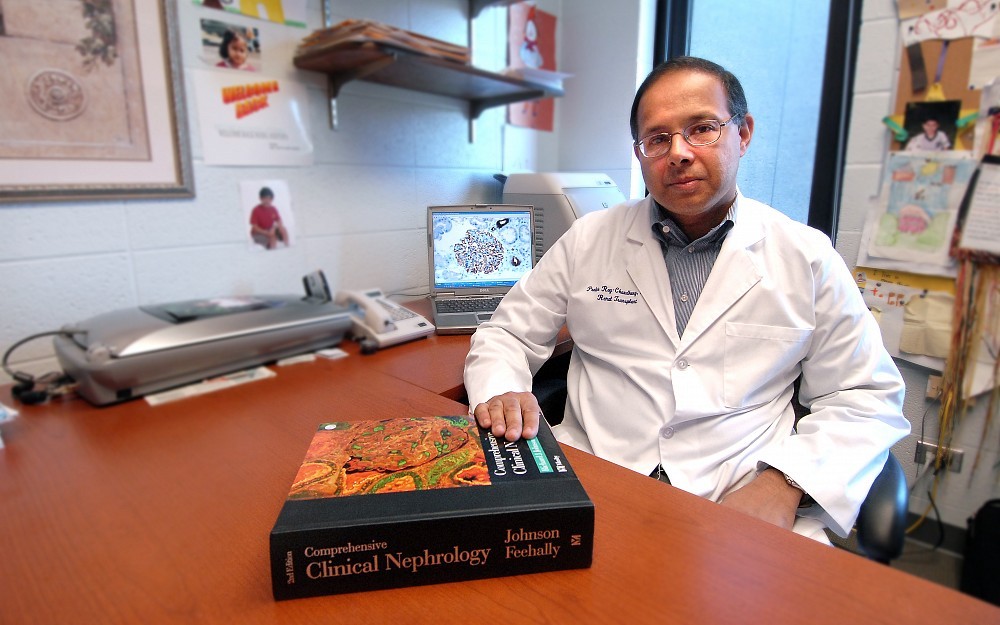
Prabir Roy-Chaudhury,
In addition, the team received a VA Merit Review grant$600,000look into the causes of fistula failure, such as blood flow abnormalities and cellular stress.
Unfortunately, a patients lifelineor dialysis accessis often compromised because of stenosis, Roy-Chaudhury says. As a result, hemodialysis vascular access dysfunction is currently the Achilles heel of hemodialysis, resulting in a significant morbidity, at a cost of over $1 billion annually.
Roy-Chaudhury, professor of medicine at UC and director of the CAP, says these grantswhich increase the funding of the CAP to almost $4 millionwill allow researchers to explore new pathways to prevent dialysis access dysfunction and improve the quality of life for dialysis patients.
The CAP is a translational, multi-disciplinary initiative that aims to improve dialysis access care through the application of new therapies.
Major collaborators include Rino Munda, MD, and colleagues from the department of transplant surgery, as well as physicians and researchers from the departments of nephrology, mechanical engineering, pathology, biomedical engineering, radiology, cardiology, pharmacy and community nephrologists.
This is a unique program in which we go from animal models to clinical trial research to clinical care, Roy-Chaudhury says.
Tags
Related Stories
On-site training in Speech & Hearing Clinic sets UC’s programs apart
August 27, 2026
At the University of Cincinnati’s Speech & Hearing Clinic, Doctor of Audiology and Speech-Language Pathology graduate students gain real-world experience while providing free speech and hearing services to the community.
Funding expands UC research into weight gain side effects of bipolar medication
August 26, 2026
University of Cincinnati researchers have been approved for funding by the Patient-Centered Outcomes Research Institute (PCORI) to expand the implementation of healthy lifestyle interventions and metformin prescription to help manage weight gain in overweight or obese youth taking second-generation antipsychotic medications.
One in four NFL players had CTE at death
August 25, 2026

Forbes cites research on concussions and football helmets by the University of Cincinnati in a report that found one in four NFL players had brain damage at death.