International Vasospasm 2011 Conference Could Be Springboard to Treatment Guidelines

CINCINNATICerebrovascular experts from around the world will gather in Cincinnati next month to discuss the science and clinical management of vasospasm, a dreaded, life-threatening complication of subarachnoid hemorrhage, while working toward an ambitious goal. They hope to generate the first set of guidelines in neurocritical care for the treatment of patients who have suffered a subarachnoid hemorrhage, or bleeding stroke.
The UC Department of Neurosurgery, UC Neuroscience Institute and Mayfield Clinic will host Vasospasm 2011: The 11th International Conference on Neurovascular Events after Subarachnoid Hemorrhage, July 21-23, at the Hilton Cincinnati Netherland Plaza.
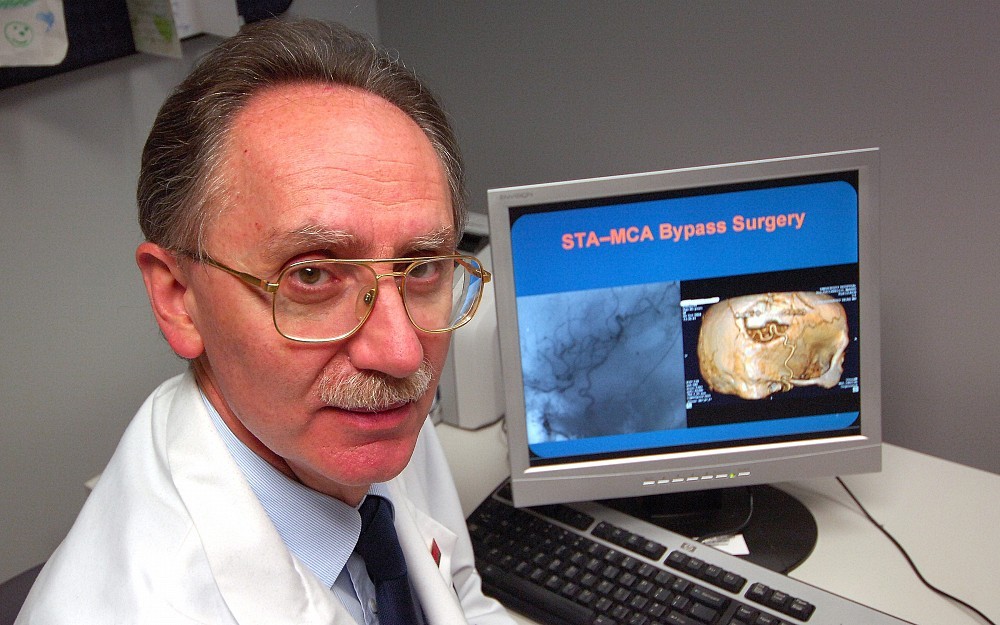
Mario Zuccarello, MD, Frank H. Mayfield Professor and Chair of neurosurgery, and Joe Clark, PhD, a professor in the neurology department, are the events co-chairs. The conference is sponsored by the Mayfield Education and Research Foundation.
Vasospasm (pronounced VAY-zoh-spasm) is a sudden spasm of a blood vessel, a phenomenon that occurs frequently after a ruptured aneurysm. When blood flows from the aneurysm into the subarachnoid space, a narrow, protective membrane around the brain, a subarachnoid hemorrhage (SAH) has occurred. Irritation resulting from the SAH can cause a nearby blood vessel to go into spasm and constrict. The closing down of the vessel, which can be likened to an open palm clenching into a fist, can lead to permanent brain damage or death.
Vasospasm remains mysterious and frustrating to doctors, who as yet have no optimal clinical management strategy. "Although improvements in neurocritical care have allowed us to make strides in managing vasospasm during the last few decades, Zuccarello says, "we remain firmly committed to finding effective new treatments. Vasospasm is a clear and obvious target because it is the leading, potentially treatable cause of death and disability following an aneurysm rupture.
The international conference, which is held every two to three years, will address clinical management strategies and basic science studies. The meeting will include plenary sessions, workshops and platform and poster presentations based on abstract submissions. Accepted abstracts will be published in a book dedicated to the late Frank H. Mayfield, MD, a UC professor and pioneer in neurosurgery who directed the graduate neurosurgical training programs at Christ and Good Samaritan hospitals from 1946 to 1977.
Awards to be presented at the meeting include Young Investigator, Bench to Bedside and Back Again and The Next Big Idea.
For the first time, the conference will involve neurocritical care specialists, whose patients include those who have suffered a subarachnoid hemorrhage. "During the conference we will try to produce a white paper that is comprehensive enough that it will be accepted by physicians in neurocritical care, neurosurgery and neurology, Zuccarello says. "It is an ambitious goal.
The conference also will include investigators from the Co-Operative Study on Brain Injury Depolarizations. Jed Hartings, PhD, research assistant professor in the neurosurgery department, is an expert on spreading depolarizations, also known as spreading depressions. These electrical disturbances, similar to short-circuits, occur in up to 75 percent of patients who have experienced subarachnoid hemorrhages. "Depolarizations may cause permanent brain damage and could be a target for new therapies, Hartings says.
Invited speakers are Tomio Sasaki, MD, professor and chair of the department of neurosurgery at the Kyushu University Graduate School of Medical Sciences in Fukuoka, Japan, and Costantino Iadecola, MD, chief of the division of neurobiology at Cornell University.
"This conference is a lot of fun and creates an opportunity for new ideas and cooperation, says Zuccarello, who has been an active participant since 1987. "It is a blend of science and clinical activities and friendships and good times.
For complete program information, visit www.vasospasm11.com

Joe Clark, PhD, professor of neurology

Vasospasm 2011 Flier
Tags
Related Stories
UC co-op earnings climb to $99.5 million
August 17, 2026
University of Cincinnati co-op students earned $99.5 million in 2025-26, a 5.69% increase, with 9,614 co-op enrollments and 1,798 employers across top industries.
Career fairs and resources for every Bearcat
August 11, 2026
UC's fall career fairs connect Bearcats with co-ops, internships, and jobs — plus free resume help, career coaching, and prep resources at the Bearcat Promise Career Studio.
UC radiation oncologist speaks with Local 12 news about clinical trial for head and neck cancer treatment
August 10, 2026

Dr. Sara Medek, a UC radiation oncology professor, speaks with Local 12 news about a new clinical trial aimed at reducing radiation in certain areas while still treating cancer effectively but with fewer painful side effects.