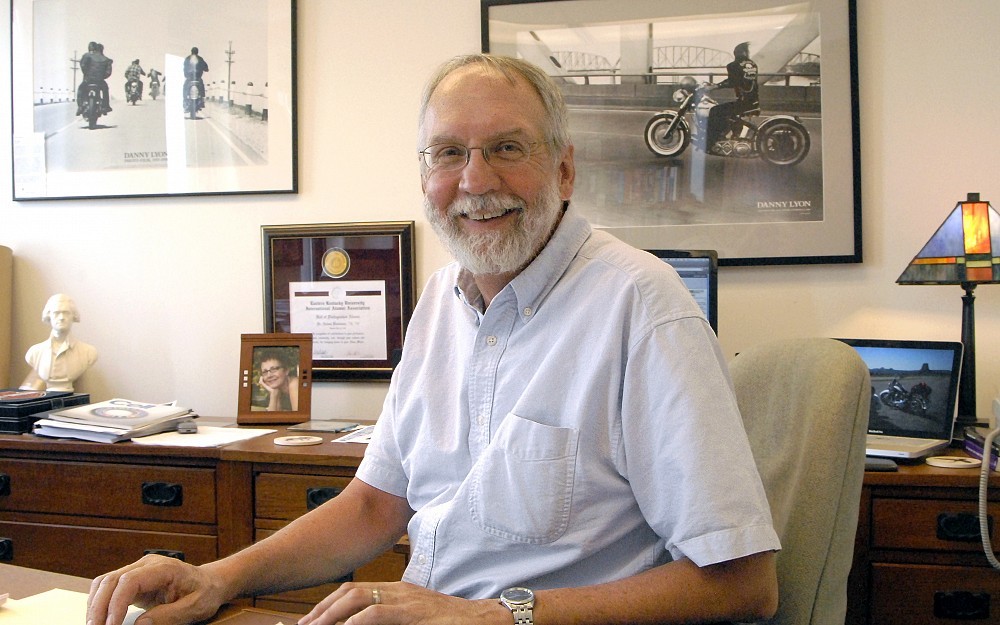
Focus on Science With Nelson Horseman, PhD

Focus On highlights faculty, staff, students and researchers at the UC Academic Health Center. To suggest someone to be featured, please email uchealthnews@uc.edu.
Nelson Horseman, PhD, came to UC in 1989 after nine years at Marquette University, where he was director of the Biological and Biomedical Research Institute. A native of Dayton, Ohio, he earned his bachelors and masters degrees at Eastern Kentucky University and then his doctorate at Louisiana State University. He was a postdoctoral fellow at Argonne National Laboratory from 1978 to 1980.
Horseman is a professor of molecular and cellular physiology and a Fellow of the Graduate School at UC.
Why did you come to UC, and what brought you here?
"I was pretty well settled as a faculty member at Marquette University, but my best friend was job hunting and came across an ad for the position here at UC. He knew I was originally from the area. The physiology department was looking for a physiologist who was also a molecular biologist, and at the time, we were pretty rare. Nowadays, you can buy a kit, download a sequence from the Internet and clone with your credit card, so everyones a molecular biologist. Im still a physiologist at heart. The chance to bring my lab to UC, where there was a much larger research enterprise, was really attractive to me and it ended up being a great move."
Share a bit about your current research focus.
"About 10 years ago, a postdoc in my lab (Manabu Matsuda, PhD) discovered to our complete surprise that the mammary glands synthesize and secrete serotonin during lactation. Since then weve been trying to understand all we can about this system. One of the main jobs of the breast serotonin system is to communicate how 'full' the gland is. If the milk is not removed by the baby or pumping, the serotonin signal ultimately gets so strong that it causes the gland to stop secreting more milk and begin to shrink. Recently, another postdoc, Laura Hernandez, PhD, who is now a faculty member at the University of Wisconsin-Madison, discovered a second function of breast serotonin. In this case, serotonin signals the body to absorb calcium from the mothers bones so theres plenty of calcium in the milk for the baby. This is a fascinating regulatory system, which can go awry very badly in breast cancer."
What implications might your research have on patient care?
"We have been pursuing two areas of significance for patient care. First, we found that the breast serotonin system can contribute to delayed onset of lactation in some mothers taking antidepressants. Two of my colleagues (Laurie Nommeson-Rivers and Karen Gregerson) are studying this phenomenon in breastfeeding mothers. Secondly, the serotonin system can contribute to some of the worst behavior of metastatic breast cancer. In particular, we have shown that breast cancer serotonin stimulates the factor that causes humoral hypercalcemia of malignancy. This is an extraordinarily painful and destructive consequence of breast cancer, and finding drugs that can relieve or prevent this process would be very important."
Tell us a bit about yourself (hobbies/interests/etc.)
"I figure Im about as lucky as anyone deserves to be. In addition to a great career doing fascinating science, I have a wonderful wife and four grown kids were very proud of. My two favorite pastimes are riding my Harley from spring through summer, alongside my wife on hers, and hunting birds behind my English pointers during the fall and winter. I always make sure not to mix either riding or hunting with my enjoyment of good beers, single malt scotches and Kentucky bourbons. With just a little self-discipline, theres a time and place for everything."
Tags
Related Stories
UC co-op earnings climb to $99.5 million
August 17, 2026
University of Cincinnati co-op students earned $99.5 million in 2025-26, a 5.69% increase, with 9,614 co-op enrollments and 1,798 employers across top industries.
Career fairs and resources for every Bearcat
August 11, 2026
UC's fall career fairs connect Bearcats with co-ops, internships, and jobs — plus free resume help, career coaching, and prep resources at the Bearcat Promise Career Studio.
UC radiation oncologist speaks with Local 12 news about clinical trial for head and neck cancer treatment
August 10, 2026

Dr. Sara Medek, a UC radiation oncology professor, speaks with Local 12 news about a new clinical trial aimed at reducing radiation in certain areas while still treating cancer effectively but with fewer painful side effects.