Researchers Win $3.7M Grant From Department of Defense

CINCINNATIResearchers from the University of Cincinnati (UC) have received a four-year, $3.7 million grant from the U.S. Department of Defense for investigations into circadian rhythms that could lead to enhanced understanding of disease treatments, trauma care and human combat performance.
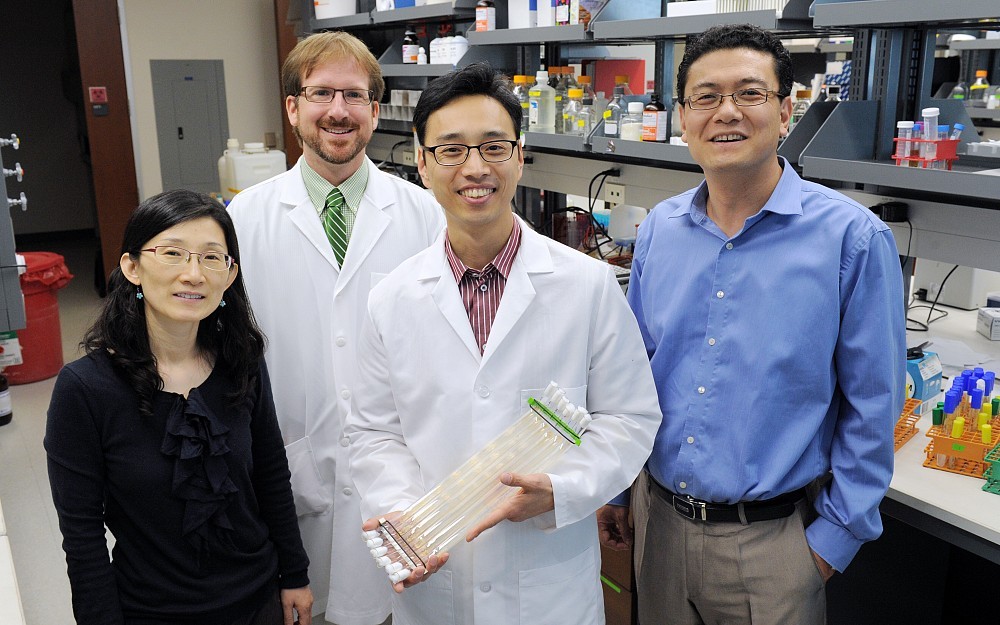
The research will be conducted by an interdisciplinary team led by Christian Hong, PhD, an assistant professor in the department of molecular and cellular physiology. The team includes Sookkyung Lim, PhD, an assistant professor in UCs mathematical sciences department, Seongho Song, PhD, an associate professor of mathematical sciences, and Sean Moore, MD, an assistant professor of pediatrics who conducts research at Cincinnati Childrens Hospital Medical Center.
The grant is from the Defense Advanced Research Projects Agency (DARPA), an agency of the Department of Defense. Founded in 1958 as a response to the Soviet Unions launch of Sputnik, DARPAs mission is to prevent and create strategic surprise.
"So many things cycle on a schedulefor instance, we anticipate getting up in the morning because there is an internal clock that communicates with other molecular mechanisms resulting in changes, says Hong. "Our body temperature, feeding rhythms, rate of metabolism, hormonal balanceseverything has a schedule, and we are interested in understanding these schedules at the molecular level.
"Soldiers are constantly moving around and facing interruptions in their circadian rhythms, such as sleep deprivation. Also, when soldiers get hurt, its important to understand the best time and target to treat themthe fastest solution at the given moment. So if we have a map of the temporal information, it could apply the appropriate regimen more readily.
Research goals are twofold, according to Hong: First, to investigate temporal information of four distinct yet interconnected cellular processes (circadian rhythms, cell cycle, DNA damage response and metabolism) using the filamentous (thread-like) fungi Neurospora crassa, and second, to establish general principles of coupled network dynamics from Neurospora and apply those principles to mammalian intestinal cell lines.
Researchers say the studies will elucidate potential methods to improve care for patients with abdominal trauma or exposure to gut pathogens.
Experimentally validated mathematical models from Neurospora will be used to make predictions in other Neurospora mutant strains and mammalian intestinal cells, focusing on responses to injury and nutritional deprivation.
"Each cellular mechanism is complex with multiple feedback loops, says Hong. "Therefore, we will use mathematical and statistical modeling to investigate network dynamics arising from these interlinked cellular responses.
Chong Ahn, PhD, Mitchell P. Kartalia Chair and Professor of Electrical Engineering in the College of Engineering and Applied Sciences School of Electronics and Computing Systems, is serving as a senior advisor to the research team. He has had two previous successful DARPA grants.
Related Stories
Career fairs and resources for every Bearcat
August 11, 2026
UC's fall career fairs connect Bearcats with co-ops, internships, and jobs — plus free resume help, career coaching, and prep resources at the Bearcat Promise Career Studio.
UC radiation oncologist speaks with Local 12 news about clinical trial for head and neck cancer treatment
August 10, 2026

Dr. Sara Medek, a UC radiation oncology professor, speaks with Local 12 news about a new clinical trial aimed at reducing radiation in certain areas while still treating cancer effectively but with fewer painful side effects.
Cancer Center director charts future based on collaboration, AI
August 10, 2026

David Gius, MD, PhD, was featured in a Cincinnati Business Courier article and The Cancer Letter’s “The Directors" podcast discussing his priorities and goals as he recently took the helm as director of the University of Cincinnati Cancer Center.