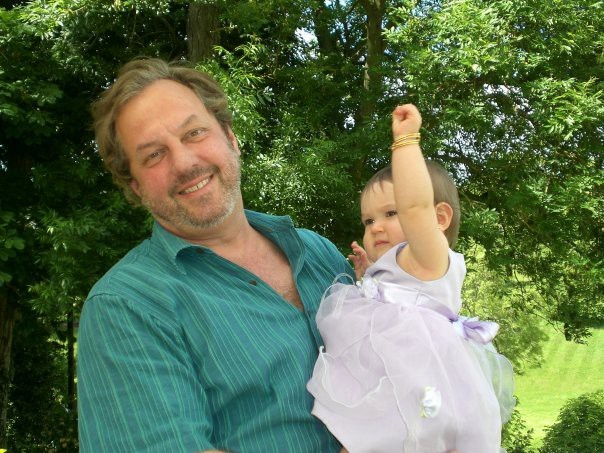
Ex-Journalist Sabine Spreading Message of Hope

Charles Sabine spent 26 years as a globetrotting journalist for NBC News, reporting on such topics as the Romanian revolution, the war in Iraq and the 2004 tsunami in the Indian Ocean.
Despite leaving NBC in 2008, hes still a world travelerbut now as a spokesman for freedom of scientific research (hes a dedicated advocate of stem cell research) and sufferers of degenerative brain disease. His own family has been ravaged by Huntingtons disease, a disorder passed down through families in which nerve cells in certain parts of the brain degenerate. Sabine has been tested and found to carry the gene for Huntingtons.
The Fellows of the Graduate School and Center for Clinical and Translational Science and Training (CCTST) will welcome Sabine for a special seminar at 5 p.m. Thursday, Sept. 27, in Kresge Auditorium. He will discuss, "The Pursuit of Hope and Dignity: Why Every Link in the Medical Chain Matters." The seminar is free and open to the public.
In advance of his visit, Sabinewho lives in Gloucestershire, Englanddiscussed via email his upcoming talk and his life after television.
On his talk:
"The central theme will be the importance to patients and their families of work that goes on within laboratories on their behalf, and the need for researchers to realize just how even unsuccessful research is of valuebecause, in a world of total darkness, the very faintest glimmer of light emboldens the human spirit to go on. I will also talk of my belief that the future of health care and research must involve greater collaboration between all key protagonists: researchers, governments, pharmaceutical companies, and patients and their families. I will also talk about the importance of freedom of scientific research in the face of religious dogma. Lastly, I will explain why every aspect of research, however far it may seem to be removed from the patient, is part of a greater good of aspiring to care for the infirmwhat Darwin called the noblest part of our nature.
On his decision to leave television news and take on a new role:
"I left my career in journalism because it occurred to me that because of the unique nature of Huntingtons disease, I had a window in which I definitely 'had' the disease but was still in command of the faculties my profession had taught me. Combined with the fact that Huntingtons disease had never historically had anyone to act as a spokesperson for its silent community, it suddenly became clear that I had a duty to do what I did. There are thousands of people who can go to Baghdad to do the job I was doing there. I was the only person alive who could do what I was about to do. Ironically, once embarked on my new life, I realized that in fact it gave a profound meaning to all that had gone before. All the extraordinary experiences I had been privileged to witness were simply unconnected experiences piled up upon one another. Now every one of them had a relevance to my new vocation.
On his message to families affected by Huntingtons disease:
"The most important message that I take to Huntingtons disease families is that the situation is not so black and white for them as they may have thought; there are things that they can do to improve their situation and even lengthen their lives. Most important is the relegation of the word 'incurable,' which has such a devastating effect on their psyches. Almost nothing in medicine has been 'cured'not cancer, not HIV, not influenza, not the common cold. We have merely found ways of managing these diseases. Once we apply the same ambition to Huntingtons disease, then our lot is not so desolate.
Tags
Related Stories
Campus buzz returns as UC students experience their first week
August 27, 2026
Near-perfect weather, record first-year enrollment, Thrifty Move-In and a packed Involvement Fair mark the University of Cincinnati’s first week back as thousands of Bearcats move into campus housing.
On-site training in Speech & Hearing Clinic sets UC’s programs apart
August 27, 2026
At the University of Cincinnati’s Speech & Hearing Clinic, Doctor of Audiology and Speech-Language Pathology graduate students gain real-world experience while providing free speech and hearing services to the community.
UC, NKU renew longstanding partnership supporting Army ROTC cadets
August 26, 2026
The University of Cincinnati Army ROTC and Northern Kentucky University (NKU) have renewed a longstanding partnership that supports students preparing to become Army officers and leaders in their communities. The universities formalized the renewed agreement during a signing event Aug. 11 at NKU.