New Program Tests, Trains Residents Before Day One

For three days at the end of June, 141 new residents crowded into the UC Simulation Center to be evaluated on their competency in patient diagnosis, care and communication.
The evaluation, better known as the Baseline Resident Assessment of Clinical Knowledge (BRACK), was first piloted in June 2011 and received approval from UCs Institutional Review Board in 2012. It was created by a team of Graduate Medical Education faculty at the College of Medicine to both gather data on resident knowledge and provide new residents with direct feedback before they begin clinical rotation on July 1.
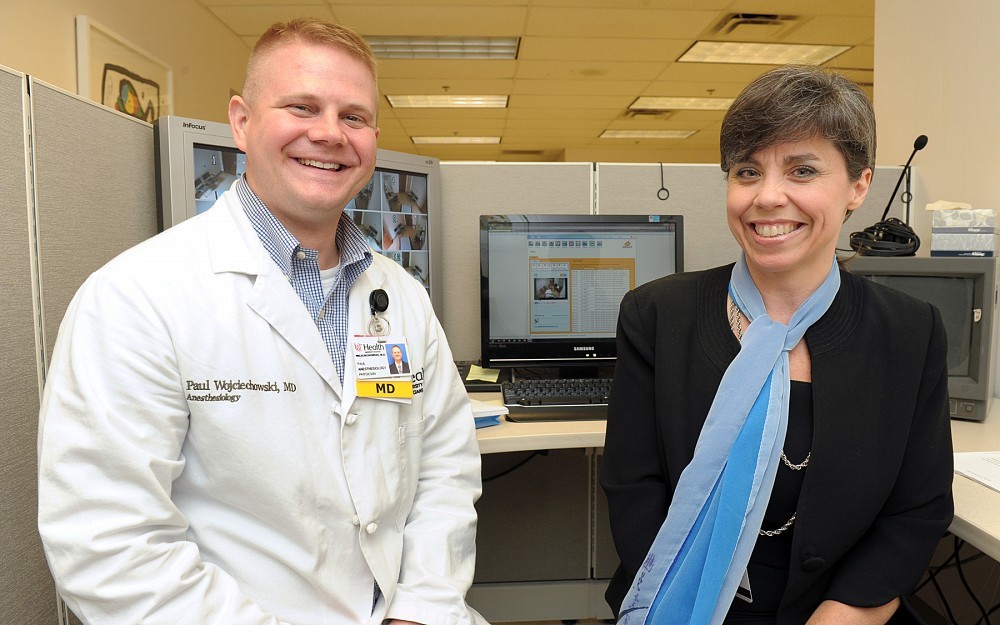
Amy Bunger, PhD, assistant designated institutional official and co-principal investigator of BRACK, along with Paul Wojciechowski, MD, assistant professor of anesthesia and BRACK co-PI, say residents arrive to UC with a variety of educational experiences, particularly the amount of time since their last clinical rotation.
During the evaluation in which they are scored on eight common clinical cases, residents also are evaluated on patient interaction, gathering an appropriate history and physical, rendering a differential diagnosis and communicating a treatment plan.
Most importantly, they receive immediate feedback from eight senior clinicians and chief residents.
"The BRACK program teaches residents what we expect of them and helps them be successful, says Bunger. "We measure the entire clinical experienceeverything from the residents introducing themselves and using the patients names to safe hand washing and hand-off practices. Its not just, Did you get the diagnosis right? Its the process by which you reach that destination.
Bunger says the program also helps UC refine resident education.
"By having a baseline measure of resident performance, were best able to see how they grow and acquire expertise, says Bunger. "Were trying to accelerate residents to competencybut we cant accelerate them if we dont know how they start.
Program directors receive resident-specific BRACK data prior to the start of clinical service, including quantified performance data and qualitative and case-specific feedback.
"Some residents discover particular strengths in the BRACK program, says Bunger. "They can then role model those skills and learn from their peers. It helps us identify where somebody has a particular strength that a department can then deploy on the floor.
UCs BRACK program was modeled after programs at the University of Michigan and Vanderbilt University, but remains very rare in resident education. The team presented the program at the International Forum on Quality and Safety in Healthcare this spring.
This year, they expanded it to assess residents at Christ Hospital and Clinton Memorial Hospital in Wilmington, Ohio.
Feedback from residents has been overwhelmingly positive. After this years session, one resident called the BRACK program: "a good reflection of where I stand at this point in my training. It allows me to enter into residency with a reminder of what I need to work on and what my strengths are.
In 2012, 95 percent of residents said the tested scenarios reflected appropriate decision-making challenges for an incoming PGY1 and 80 percent reported BRACK was a "worthwhile investment in my educational development.
That term"investmentis exactly what the BRACK team hopes residents understand
about the program.
"We want residents to understand that, from day one, UC is invested in their education and in growing their capacity as physicians, says Bunger. "That is really important to uswe are truly invested in it.
Related Stories
UC radiation oncologist speaks with Local 12 news about clinical trial for head and neck cancer treatment
August 10, 2026

Dr. Sara Medek, a UC radiation oncology professor, speaks with Local 12 news about a new clinical trial aimed at reducing radiation in certain areas while still treating cancer effectively but with fewer painful side effects.
Cancer Center director charts future based on collaboration, AI
August 10, 2026

David Gius, MD, PhD, was featured in a Cincinnati Business Courier article and The Cancer Letter’s “The Directors" podcast discussing his priorities and goals as he recently took the helm as director of the University of Cincinnati Cancer Center.
UC graduates cross finish line at commencement
August 7, 2026
The University of Cincinnati recognized 2,125 graduates in two ceremonies at summer commencement Friday on campus at Fifth Third Arena.