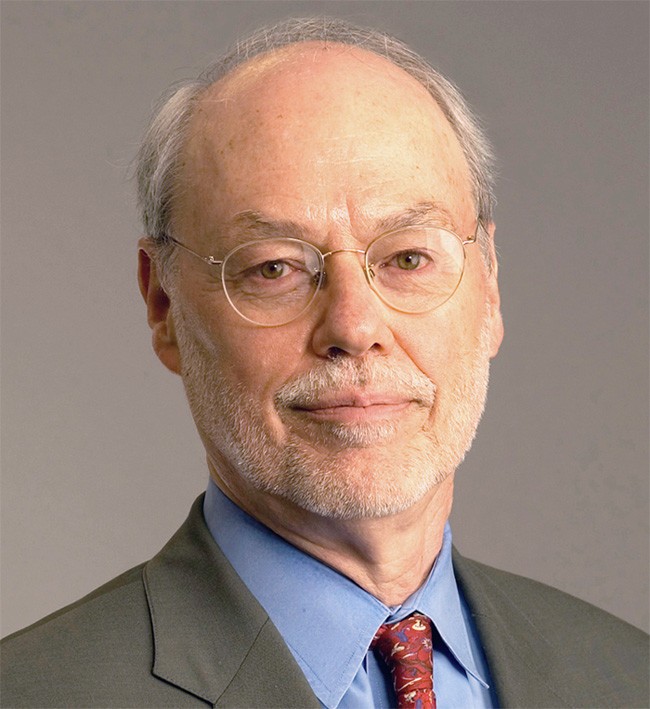
Nobel Laureate Phillip Sharp to Speak, Receive President's Award

CINCINNATINobel laureate Phillip Sharp, PhD, will speak at the University of Cincinnati (UC) and Cincinnati Childrens Hospital Medical Center Nov. 7 and 8 and receive the Presidents Award for Excellence from UC President Santa Ono, PhD.
Sharp, president -elect of the American Association for the Advancement of Science, will speak at 4 p.m. Thursday, Nov. 7, at Kresge Auditorium in the Medical Sciences Building on UCs medical campus. His topic will be: "CONVERGENCE: Biomedical Science in the 21st Century.
Before the talk, which is sponsored by the Fellows of the Graduate School and the Office of the President, Ono will present Sharp with the Presidents Award for Excellence for his significant contributions in research and education.
"Dr. Sharp is an icon in the field of molecular biology, Ono says. "What elevates him further in my eyes is his humble demeanor and his service to others via a myriad of leadership positions.
Sharp will present a second lecture at 10 a.m. Friday, Nov. 8, in the Cincinnati Childrens Research Auditorium (R3381) on "The Synthesis and Function of Noncoding RNAs. The talk is part of the Rachford Lecture series, sponsored by the Cincinnati Childrens Research Foundation.
Both lectures are free and open to the public. They represent a homecoming for Sharp, a native of Falmouth, Ky. Phillip Sharp Middle School in his native Pendleton County was named in his honor.
Sharp is Institute Professor at the Massachusetts Institute of Technology (MIT), where much of his research work has been conducted at the Koch Institute for Integrative Cancer Research (formerly the Center for Cancer Research), which he joined in 1974 and directed from 1985 to 1991. He subsequently led the Department of Biology from 1991 to 1999 before assuming the directorship of the McGovern Institute for Brain Research from 2000 to 2004.
Sharps research interests have centered on the molecular biology of gene expression relevant to cancer and the mechanisms of RNA splicing. His landmark achievement was the discovery in 1977 of RNA splicing, an achievement that earned him the 1993 Nobel Prize in Physiology or Medicine. His lab has now turned its attention to understanding how RNA molecules act as switches to turn genes on and off (RNA interference).
Sharp is a graduate of Union College in Barbourville, Ky., and earned his PhD in chemistry from the University of Illinois, Champaign-Urbana. He pursued postdoctoral training at the California Institute of Technology, where he studied the molecular biology of plasmids from bacteria. Prior to joining MIT, he was senior scientist at Cold Spring Harbor Laboratory in Cold Spring Harbor, N.Y.
Tags
Related Stories
Career fairs and resources for every Bearcat
August 11, 2026
UC's fall career fairs connect Bearcats with co-ops, internships, and jobs — plus free resume help, career coaching, and prep resources at the Bearcat Promise Career Studio.
UC radiation oncologist speaks with Local 12 news about clinical trial for head and neck cancer treatment
August 10, 2026

Dr. Sara Medek, a UC radiation oncology professor, speaks with Local 12 news about a new clinical trial aimed at reducing radiation in certain areas while still treating cancer effectively but with fewer painful side effects.
Cancer Center director charts future based on collaboration, AI
August 10, 2026

David Gius, MD, PhD, was featured in a Cincinnati Business Courier article and The Cancer Letter’s “The Directors" podcast discussing his priorities and goals as he recently took the helm as director of the University of Cincinnati Cancer Center.