Neurobiology Research Center Awards 8 Peer-Reviewed Pilot Grants

The Neurobiology Research Center at the University of Cincinnati (UC) Neuroscience Institute this year awarded eight peer-reviewed pilot grants. That is more than double the number awarded at UC in the past three years combined, demonstrating the level of interest and commitment in neuroscience research. The awards this year total $200,000.
"The goal of these pilot grants is to provide seed money for projects that have legs and will hopefully attract national funding, said James Herman, PhD, director of the Neurobiology Research Center.
"A second important goal is to encourage collaborative research and build team science, he added. "The Neurobiology Research Center aims to bring together investigators from across departments, colleges and institutions to further collaborative thinking and development of leading research in the neurosciences.
Funding for the grants came from the UC College of Medicine ($50,000), the George Wile Fund for neuroscience basic research ($50,000), the Sunflower Revolution Fund ($50,000) and the Mitsui Foundation for research in stroke ($50,000).
Oxidative Stress in a Mouse Model of Alzheimer's Disease
This study will characterize longitudinal alterations in the brain bioenergetics and intracellular redox state in the brain of amyloid-beta overexpressing Tg2576 mice using phosphorus-31 magnetic resonance spectroscopy.
Principal Investigator: Jon Dudley, PhD
Treating Bacterial Overgrowth in Parkinsons Disease
This study tests the hypothesis that Parkinson's patients who test positive for Small Intestinal Bacterial Overgrowth (SIBO) will exhibit an improvement in motor symptoms following eradication of SIBO with the antibiotic Rifaximin.
Principal Investigator: Alberto Espay, MD
Co-Investigator: Hilary Perez, PhD
Expression of ATP13A2 as a Novel Therapeutic Target for Parkinson's Disease
This grant investigates the therapeutic potential of overexpression of ATP13A2 using viral vector technology on alpha-synuclein pathology in the mouse.
Principal Investigator: Sheila Fleming, PhD
Co-Investigator: Ying Sun, PhD
Quantitative Proteomic Analysis of the PSD-95 Interactome in Schizophrenia
This study will use affinity purification from brain samples of normal and schizophrenia subjects, coupled with mass-spectrometry, to identify differential protein-protein interactions of synaptic proteins relevant for cognition.
Principal Investigator: Adam Funk, PhD
Co-Investigator: Robert McCullumsmith, MD, PhD
Developmental Manganese and Parkinsons Disease
The goal of this study is to determine if early-life overexposure to the heavy metal manganese is an environmental factor contributing to the development of Parkinsons disease.
Principal Investigator: Kim Seroogy, PhD
Co-Investigator: Michael Williams, PhD, and Charles Vorhees, PhD
Priming the Brain for Stroke Recovery
The objective of this proposal is to determine the effects of high-intensity aerobic exercise on blood biomarkers (e.g., brain-derived neurotrophic factor) release and cortical priming among people who experience deficits following a stroke.
Principal Investigator: Kari Dunning, PT, PhD
Co-Investigator: Brett Kissela, MD, MS
Development of a Prehospital Stroke Sensitivity Scale
This project is designed to gather pilot prospective validation data of a clinical scale to assist prehospital providers triage of acute stroke patients.
Principal Investigator: Jason McMullan, MD
Co-Investigator: Brian Scott Katz, MD
Targeting a Novel Target for Treatment of Glioblastoma Patients
The project aims to develop a new therapy for glioma using FDA-approved drug that targets glioma specific GTP-metabolism.
Principal Investigator: Nazanin Majd, MD, PhD
Co-Investigator: Atsuo Sasaki, PhD
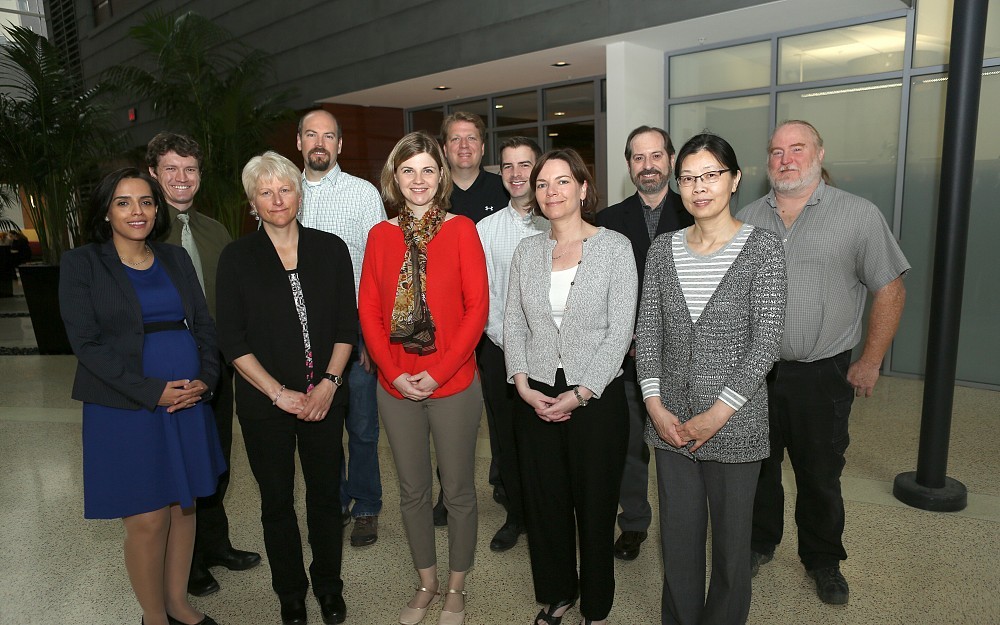
Pilot grant winners in the photo accompanying this story are (left to right): Nazanin Majd, MD, PhD; Brian Scott Katz, MD; Kari Dunning, PT, PhD; Adam Funk, PhD; Hilary Perez, PhD; Robert McCullumsmith, MD, PhD; Jon Dudley, PhD; Sheila Fleming, PhD; Kim Seroogy, PhD; Ying Sun, PhD; and Michael Williams, PhD.
Related Stories
UC radiation oncologist speaks with Local 12 news about clinical trial for head and neck cancer treatment
August 10, 2026

Dr. Sara Medek, a UC radiation oncology professor, speaks with Local 12 news about a new clinical trial aimed at reducing radiation in certain areas while still treating cancer effectively but with fewer painful side effects.
Cancer Center director charts future based on collaboration, AI
August 10, 2026

David Gius, MD, PhD, was featured in a Cincinnati Business Courier article and The Cancer Letter’s “The Directors" podcast discussing his priorities and goals as he recently took the helm as director of the University of Cincinnati Cancer Center.
UC graduates cross finish line at commencement
August 7, 2026
The University of Cincinnati recognized 2,125 graduates in two ceremonies at summer commencement Friday on campus at Fifth Third Arena.