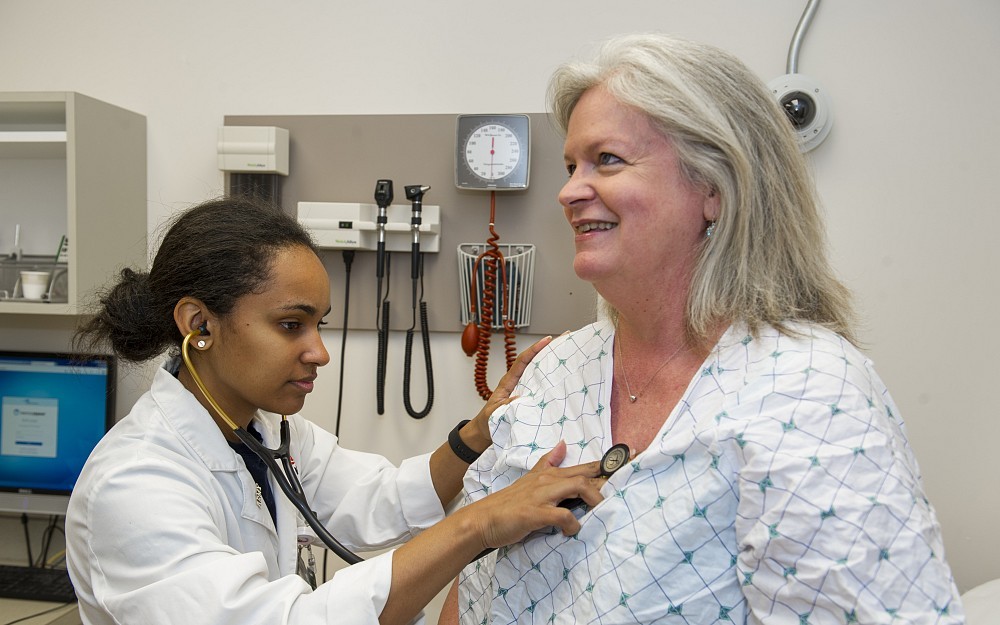
Standardized Patients Help Test Clinical Skills of Fourth-Year Med Students

One standardized patient presented signs that suggested a heart attack, while for another gastroenteritis or even a surgical problem may have brought them to the doctors office. The patients were actors trained to test and observe medical students as part of the Clinical Competency Exam (CCX) held in the College of Medicines Simulation Center for the 15th consecutive year.
The exam, required of all fourth-year med students, was designed to prepare them for Step 2 of the United States Licensing Medical Examination (USMLE). The CCX looks at a students professionalism toward patients, their ability to collect a patients medical history, perform a physical and whether they can identify medical conditions and prescribe appropriate medical tests, says Michael Sostok, MD, assistant dean for medical education in the College of Medicine.
This years Clinical Competency Exams were administered July 25-August 4. Fourth-year medical students were presented with seven cases during a four-hour period. Their encounters were evaluated by standardized patients and videotaped for review by medical education faculty.
"We develop cases that represent the kinds of medical problems and patients they have seen throughout their three years of medical school, says Sostok, who is also medical director of the Simulation Center. "Generally, our students do very well on the exam. They have well trained clinically, which is one of the strengths of the UC College of Medicine. Thats borne out not only by their performance on the national board exams but also there is a survey taken of all PGY-1s throughout the country.
"We get the data back from our students who have matriculated into various residency programs, and we get feedback from the program directors. Uniformly, residency program directors report that our students are a little bit ahead of the curve when it comes to clinical knowledge, skills and the ability to manage complex patients, says Sostok.
Performance on the CCX also helps identify the small number of students who may struggle with Step 2 clinical skills on USMLE. Faculty members work with students to suggest ways to strengthen their clinical skills.
"Since the CCX is given at the beginning of the academic year, if there is an area students need to work on they have the entire fourth-year to do so as they prepare for their residency, says Maureen Asebrook, standardized patient program director in the College of Medicine.
Medical students are allowed to view their videotaped standardized patient encounters after the CCX is completed.
"We want them to see how they communicate with the patient, says Sostok. "Often they dont realize how they are coming across until they see themselves. When they are viewing the video, they can become that observer, and its often very powerful and informative to them. It helps them improve their doctor-patient communication skills.
Marcus Germany, a fourth-medical student, says he feels more confident about the clinical skills section of Step 2 USMLE after completing the CCX.
"The exam feels very authentic, providing opportunities to practice realistic cases that students encounter on licensing exams as well as on the wards, explains Germany. "The cases used for the exam are written by a physician who practices real medicine and has experience in creating board-style questions. These cases are mostly problems encountered in the outpatient clinic setting, ranging from chronic pain management, issues affecting activities of daily living and common pediatric and obstetrical complaints.
Craig Boldman, a 60-year-old Hamilton resident, has participated in the standardized patient sessions since 2008.
"You will find that a lot of us come here by way of an acting connection, says Boldman. "I had been doing some theater work and some film work and during one of those film jobs, I was doing a commercial shoot in Columbus. One of my co-actors was talking about the SP work at a hospital in Columbus. She suggested I check to see if there was such a program in Cincinnati.
Boldman is one of about 40 standardized patients, who have replaced attending physicians who initially handled CCX evaluations when the program started 15 years ago at the College of Medicine. Sostok says hes found that evaluations given by the standardized patients are as accurate as evaluations given by attending physicians.
Boldman remembers his initial sessions with students were "simple jobs and that he spent time observing other physician-patient encounters. He took home case studies assigned by Asebrook for review and study.
"In many ways, this is more of an acting role than something you do on screen, says Boldman. "You get to interact with someone who is not an actor so there is a certain amount of improvisation as well. You cant get away from the idea you are serving a useful purpose.
"During the course of the day, I will see several students and its interesting to note the differences in their approaches to a casewhat one does differently from the other, and the different conclusions they draw. It can be just one detail that I give which can send them down a path that makes them think this is wrong with me, when another comment might send someone down a different path. Its enlightening to me to see how the process works. It gives me some insight on how doctors work. It impresses on me if I am seeing my actual doctor, Ive learned some information about what I need to get across to him to get an accurate diagnosis.
Boldman says hes impressed with medical students who someday will be licensed physicians.
"They are incredibly bright and seem so accomplished, says Boldman. "It takes my breath away that they present themselves so professionally. They are still students and still learning, but a lot of them carry this sense of authority and confidence that you want a doctor to have.

Marcus Germany, a fourth med student, fills out his patient evaluation during a CCX session.

Maureen Asebrook, standardized patient program director in the College of Medicine, views student-patient sessions during the CCX.
Related Stories
UC radiation oncologist speaks with Local 12 news about clinical trial for head and neck cancer treatment
August 10, 2026

Dr. Sara Medek, a UC radiation oncology professor, speaks with Local 12 news about a new clinical trial aimed at reducing radiation in certain areas while still treating cancer effectively but with fewer painful side effects.
Cancer Center director charts future based on collaboration, AI
August 10, 2026

David Gius, MD, PhD, was featured in a Cincinnati Business Courier article and The Cancer Letter’s “The Directors" podcast discussing his priorities and goals as he recently took the helm as director of the University of Cincinnati Cancer Center.
UC graduates cross finish line at commencement
August 7, 2026
The University of Cincinnati recognized 2,125 graduates in two ceremonies at summer commencement Friday on campus at Fifth Third Arena.